
Adelaide's Warbler
Setophaga adelaidae
Order: Passeriformes / Family: Parulidae
Wikimedia Commons
About the Adelaide's Warbler
Adelaide's Warbler, or Setophaga adelaidae, is a small, vibrantly colored songbird endemic to Puerto Rico, playing a crucial role in the island's ecosystems. This species thrives in subtropical and tropical dry forests, moist lowland forests, and mangrove swamps, where it contributes to insect population control and serves as an indicator of environmental health. The bird has adapted well to its environment, making it a prime example of species resilience and ecological importance in these unique habitats. Its presence is vital in maintaining the balance of insect populations, which, in turn, supports the broader ecological framework of these regions.
These warblers exhibit fascinating seasonal behaviors, including subtle shifts in territory and activity patterns. During the breeding season, they become more territorial, with males known for their vocal displays to ward off rivals and attract mates. In the non-breeding season, Adelaide's Warbler may form mixed-species flocks, demonstrating a flexible social behavior that allows them to maximize foraging efficiency and protection against predators. This seasonal adaptability highlights the species' intricate relationship with its environment.
The adelaidae species is significant not only for its ecological role but also for cultural reasons, as it is unique to Puerto Rico. Its existence underscores the importance of conserving island biodiversity, which faces threats from habitat destruction and climate change. By understanding the life and habits of Adelaide's Warbler, conservationists can develop strategies tailored to preserving Puerto Rico's unique avian fauna. Despite facing challenges, the warbler's ability to thrive in diverse habitats showcases its resilience and the ecological vibrancy of the regions it inhabits.
The Adelaide's Warbler belongs to the family Parulidae, within the order Passeriformes. These birds typically live average around 5 years, with some living up to 8 years..
How to Identify a Adelaide's Warbler
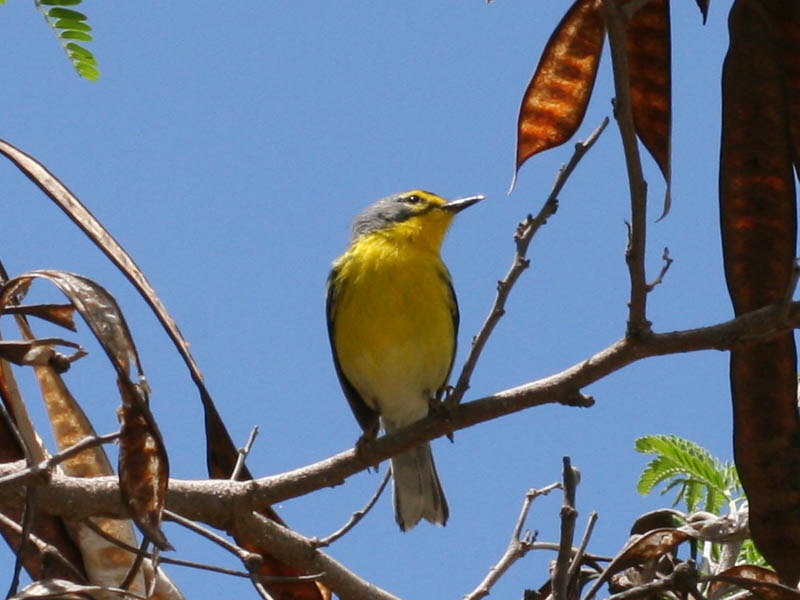
Adelaide's Warbler is easily identified by its bright yellow underparts and olive-green upperparts, with a distinctive white eye-ring that gives it an alert expression. The bird's wings and tail are accented with dark gray, while the throat and chest display a more intense yellow hue, making it stand out against the green foliage. Adults measure approximately 12 cm in length and weigh around 10 grams, placing them in the small size class for songbirds. Juveniles share similar color patterns but with slightly duller plumage, lacking the brightness of mature birds.
Males and females appear remarkably similar, though males may exhibit a slightly more vibrant coloration, especially during the breeding season. This subtle sexual dimorphism can make field identification challenging without a close view. However, their distinctive coloration and vocalizations usually set them apart from similar species.
When in flight, Adelaide's Warbler displays a rapid wing beat, typical of many warblers, with a short, bouncing flight pattern. Perched, its posture is often upright and alert, moving quickly through foliage as it forages. While the bird's coloration might lead to confusion with other warblers, such as the Yellow Warbler, its unique habitat preference and vocalizations aid in accurate identification.
Having trouble telling birds apart? Upload a photo to our bird identification tool for an instant species match.
Adelaide's Warbler Habitat and Range
Preferred Habitat
Adelaide's Warbler inhabits a variety of forested environments throughout Puerto Rico, including subtropical and tropical dry forests, moist lowland forests, and mangrove swamps. These habitats generally occur from sea level up to elevations of about 800 meters, where the bird finds ample food and nesting sites. The warbler is less commonly found in urban settings, preferring the cover and resources provided by more natural environments.
Seasonal habitat shifts are subtle, as the warbler is a year-round resident of Puerto Rico. However, during the breeding season, it may favor denser forested areas that provide suitable nesting sites and protection from predators. In contrast, during the non-breeding season, the bird might be observed in more open areas within its range, joining mixed-species flocks that traverse various forest types in search of food.
Geographic Range
Adelaide's Warbler is endemic to Puerto Rico, where it is a non-migratory resident. This bird is found throughout the island, from coastal regions to the mountainous interiors, though its population density is highest in areas with suitable forest habitats. The warbler's range does not extend beyond Puerto Rico, making it an island specialist with adaptations specific to the local ecosystems.
Population density hotspots include the dry forests of Guánica, the moist lowland forests of El Yunque National Forest, and the mangrove areas in the island's northeastern and southwestern corners. These locations provide the diverse vegetation and insect populations necessary for the warbler's survival, underscoring its reliance on the island's varied environmental conditions.
Want to know which birds visit your area? Browse our backyard birds by location guides for region-specific species lists.
What Does the Adelaide's Warbler Eat?
Adelaide's Warbler primarily feeds on insects, playing a significant role in controlling insect populations within its habitat. Its diet consists of spiders, caterpillars, beetles, and other arthropods, which it gleans from foliage and bark. This foraging technique involves the bird moving rapidly through shrubs and trees, capturing prey with precise movements.
The warbler's diet exhibits some seasonal variation, with a higher intake of caterpillars and beetles during the breeding season when these insects are more abundant. This dietary flexibility ensures the bird can meet its nutritional needs year-round, despite fluctuations in prey availability. Feeding occurs throughout the day, with peak activity in the early morning and late afternoon when insects are most active.
Adelaide's Warbler Behavior and Social Structure
Adelaide's Warbler exhibits a range of fascinating behaviors. This species is typically observed alone or in pairs during the breeding season, displaying strong territorial behavior as males sing from high perches to assert their presence and attract mates. The song is a distinctive, melodious series of notes that serves both as a territorial marker and a courtship display.
Outside the breeding season, Adelaide's Warbler often joins mixed-species flocks, a behavior that increases foraging efficiency and reduces the risk of predation. The warbler's response to predators includes alarm calls and rapid evasive maneuvers, showcasing its agility and alertness.
Daily activity patterns involve active foraging interspersed with periods of rest and preening. The bird relies on its keen eyesight and quick reflexes to capture insects, maintaining a high level of activity throughout the day.
Adelaide's Warbler Nesting and Reproduction
Adelaide's Warbler constructs cup-shaped nests made from grass, plant fibers, and spider silk. These nests are typically built in low shrubs or small trees, usually no more than a few meters off the ground. The warbler favors dense vegetation for nesting sites, which provides cover from predators and harsh weather.
A typical clutch consists of two to three eggs, which the female incubates over approximately 12 to 14 days. Both parents participate in feeding the chicks, which fledge about 10 to 12 days after hatching. Adelaide's Warbler may raise one to two broods per year, depending on environmental conditions and food availability.
Parental roles are well-defined, with both the male and female actively involved in rearing the young. The male often guards the territory and assists in feeding the fledglings, ensuring their survival in the early stages of life.
Adelaide's Warbler Sounds and Vocalizations
The primary song of Adelaide's Warbler is a series of high-pitched, melodious notes that descend in pitch, creating a musical phrase easily recognizable in the forest. This song is used mainly by males to establish territory and attract females during the breeding season. Call notes are sharp and distinct, serving as communication between pairs and as alarms when predators are near.
Alarm calls are brief, sharp chips, alerting other birds to potential danger. During the dawn chorus, the warbler's song stands out due to its rhythmic and lyrical quality, often compared to the clear, sweet notes of other New World warblers.
Interesting Facts About the Adelaide's Warbler
- 1Adelaide's Warbler is named in honor of Adelaide Swift, the wife of an American ornithologist.
- 2Unlike many warblers, Adelaide's Warbler does not migrate and remains in Puerto Rico year-round.
- 3The warbler's diet includes a high proportion of caterpillars, which are abundant in its forest habitats.
- 4Adelaide's Warbler's song is often one of the first heard during the dawn chorus in Puerto Rico.
- 5This species was first described in 1864 by George Newbold Lawrence, an American ornithologist.
- 6Adelaide's Warbler has a relatively long breeding season, allowing for multiple broods if conditions are favorable.
- 7The bird is a key insect predator, helping to maintain a balance in the forest ecosystem.
Adelaide's Warbler Conservation Status
Currently, Adelaide's Warbler is listed as Least Concern by the IUCN, with a stable population trend. The primary threats to this species include habitat destruction due to urban development and agriculture. Conservation efforts focus on preserving and restoring native forest habitats across Puerto Rico, ensuring that these areas remain viable for the warbler and other endemic species. Historically, the warbler's population has remained relatively stable, although fluctuations have occurred in response to environmental changes and human activity. Continued conservation efforts aim to mitigate these impacts and ensure the warbler's long-term survival in its native habitats.


