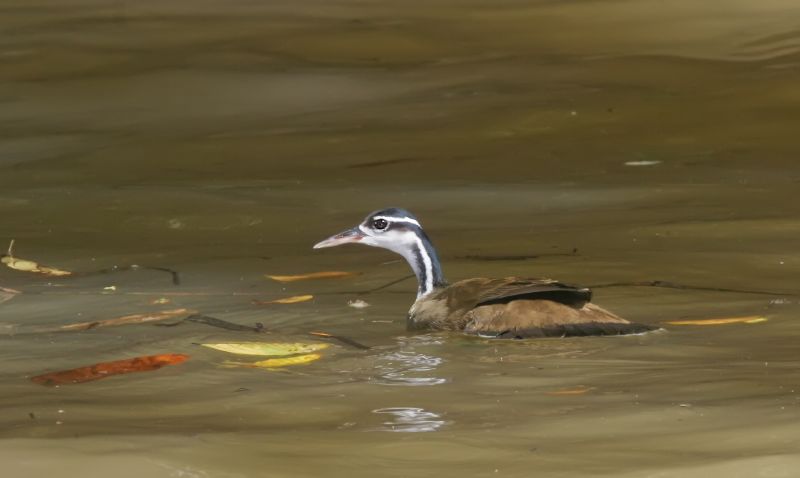
African Finfoot
Podica senegalensis
Order: Gruiformes / Family: Heliornithidae

Wikimedia Commons
About the African Finfoot
The African Finfoot, Podica senegalensis, is a unique waterbird belonging to the family Heliornithidae. It occupies freshwater habitats across sub-Saharan Africa, including rivers, streams, and wooded wetlands. This species is particularly notable for its adaptability to a wide range of aquatic environments, from slow-moving streams in West Africa to the dense riparian zones of the Congo Basin. Its distribution spans countries like Nigeria, Ghana, and down to South Africa, reflecting its adaptability to diverse ecosystems.
Ecologically, the African Finfoot plays a significant role in its habitat as both predator and prey. Its diet consists of aquatic invertebrates and small fish, contributing to the control of these populations. Furthermore, its presence indicates a healthy aquatic ecosystem, as it requires clean, undisturbed water bodies for feeding and nesting. The African Finfoot's elusive nature and preference for densely vegetated waterways often make it a challenging species for birdwatchers to observe, yet it remains a prized sighting due to its rarity and unique characteristics.
This bird exhibits interesting seasonal behaviors, particularly during the breeding season. During this period, which generally aligns with the rainy season in its range, the African Finfoot becomes more vocal and conspicuous as it establishes breeding territories. The species is also known for its solitary nature, typically found alone or in pairs. However, during the non-breeding season, the African Finfoot may occasionally be seen in small family groups. Despite its widespread range, the bird's population is believed to be declining due to habitat loss and degradation, making conservation efforts crucial for its survival.
The African Finfoot belongs to the family Heliornithidae, within the order Gruiformes. These birds typically live average lifespan is around 10-12 years in the wild..
How to Identify a African Finfoot
The African Finfoot is a medium-sized waterbird with a distinct appearance that aids in its identification. Adults typically measure between 43 to 56 cm in length and have a wingspan ranging from 70 to 86 cm. Males and females are similar in size, although males may be slightly larger. One of the key identifying features is its bright orange-red bill and striking lobed feet, which are adapted for swimming.
In terms of plumage, the African Finfoot displays a range of colors. It has a dark brown back with a characteristic white throat and chest. Its underparts are finely barred or spotted, providing camouflage against the dappled light of its habitat. Juveniles have a duller coloration compared to adults, with less pronounced markings and a paler bill. This helps them remain inconspicuous among the riverine vegetation.
While the African Finfoot might be confused with other waterbirds, its lobed feet and unique coloring set it apart. In flight, it presents a relatively low profile with rapid wingbeats, and on land, it often adopts a hunched posture, further aiding in concealment. Its behavior of skulking through dense vegetation also differs from more open-water species.
Having trouble telling birds apart? Upload a photo to our bird identification tool for an instant species match.
African Finfoot Habitat and Range
Preferred Habitat
The African Finfoot prefers freshwater environments, thriving in rivers, streams, lakes, and marshes with dense vegetation. It is commonly found at elevations ranging from sea level to 1,500 meters. The species shows a preference for habitats with overhanging vegetation, which provides cover from predators and facilitates its secretive lifestyle.
During the breeding season, the African Finfoot selects areas with ample food supply and nesting opportunities, such as slow-moving rivers and lakes with thick reed beds. In contrast, during the non-breeding season, it may inhabit more varied habitats, including flooded forests and swampy areas.
Although the African Finfoot generally avoids urban areas, it may occasionally be found in rural settings where natural water bodies remain undisturbed. Its presence in both pristine and slightly modified habitats highlights its adaptability, although it remains vulnerable to significant habitat destruction.
Geographic Range
The African Finfoot's range covers a broad expanse of sub-Saharan Africa, from Senegal and Gambia in the west to Ethiopia and Kenya in the east, and extending southward to South Africa. The species does not undertake large-scale migrations, but it may exhibit some local movements in response to seasonal changes in water levels and food availability.
In West Africa, it is found along the river systems of countries like Nigeria and Ghana. In Central Africa, its presence is recorded in the Congo Basin, where lush, dense forests offer ideal conditions. Southern populations occur in the Zambezi River basin and other significant watercourses in Mozambique and South Africa.
Population density is generally low, with some hotspots of higher density in areas where food and habitat conditions are optimal. The African Finfoot's wide distribution, however, masks the local declines caused by habitat degradation and fragmentation.
Want to know which birds visit your area? Browse our backyard birds by location guides for region-specific species lists.
What Does the African Finfoot Eat?
The African Finfoot primarily feeds on aquatic invertebrates, small fish, and amphibians, which it captures through its adept swimming abilities. Its lobed feet allow it to maneuver efficiently in water while searching for prey. This bird typically forages alone, using a combination of stealth and patience to approach potential food sources.
Seasonal changes in water levels can influence its diet, with more terrestrial insects and crustaceans being consumed during the rainy season when these resources are more abundant. The African Finfoot employs a variety of foraging techniques, including diving and surface pecking. Prey size varies, but it typically targets small to medium-sized organisms that can be swallowed whole.
Feeding usually occurs during the early morning and late afternoon when the bird is most active. Its diet diversity reflects its adaptability and the ecological niches it occupies across its range.
African Finfoot Behavior and Social Structure
The African Finfoot is predominantly solitary, although it is occasionally observed in pairs during the breeding season. This species is territorial, with individuals or pairs defending a stretch of river or lakeshore from intruders. Territorial disputes are typically resolved through vocalizations and displays rather than physical confrontation.
Courtship displays are subtle, involving mutual preening and synchronized swimming, which strengthens pair bonds. Once paired, the African Finfoot remains monogamous for the breeding season, with both partners participating in nest building and chick rearing.
In response to predators, the African Finfoot employs a strategy of concealment, using its cryptic plumage and the dense vegetation of its habitat to remain undetected. The bird is most active during dawn and dusk, displaying crepuscular behavior patterns that help it avoid peak predator activity.
Flocking behavior is rare, but family groups may be observed during the post-breeding period, with parents and fledglings remaining together until the young are fully independent.
African Finfoot Nesting and Reproduction
The African Finfoot constructs its nest close to water, often concealed within dense vegetation or under overhanging branches. The nest itself is a rudimentary platform of sticks and reeds, lined with softer materials such as leaves and grass.
Clutch size usually consists of 2 to 4 eggs, which are incubated by both parents. The incubation period lasts around 21 to 23 days. During this time, both male and female share responsibilities, alternating between incubation and foraging.
Once hatched, the chicks are semi-precocial, leaving the nest within days but remaining under the watchful care of the parents. Fledging occurs about four weeks after hatching, though the young continue to rely on parental support for some time. The African Finfoot typically raises one brood per year, although favorable conditions may allow for a second.
African Finfoot Sounds and Vocalizations
The African Finfoot's vocalizations include a series of low, guttural calls that are often described as croaks or grunts. These sounds are most commonly heard during the breeding season when the birds are more vocal in establishing territories and attracting mates.
Alarm calls are sharper and more urgent, serving to alert nearby individuals of potential threats. While not known for elaborate songs, the African Finfoot's vocal repertoire is suited to its secretive lifestyle, blending well with the ambient noise of its riverine environment.
During the dawn chorus, the African Finfoot's calls may be interspersed among those of other wetland birds, providing a distinctive, albeit subtle, contribution to the soundscape of its habitat.
Interesting Facts About the African Finfoot
- 1The African Finfoot's lobed feet are an adaptation that allows it to swim and dive efficiently, similar to those of grebes and coots.
- 2Unlike many waterbirds, the African Finfoot does not have a layer of insulating down feathers, relying instead on its ability to seek shelter in dense vegetation.
- 3The African Finfoot is capable of swimming long distances underwater to evade predators, using its powerful legs to propel itself.
- 4This bird's elusive nature often leads to it being more frequently heard than seen, as it remains well-hidden in its habitat.
- 5African Finfoots often build their nests in locations difficult for predators to access, such as overhanging tree roots or dense reed beds.
- 6The African Finfoot shares its habitat with various crocodilian species, yet it often coexists peacefully due to its secretive habits and evasive abilities.
- 7Despite its widespread range, the African Finfoot is considered one of the least understood African waterbirds due to its cryptic behavior and challenging habitats.
African Finfoot Conservation Status
The African Finfoot is currently listed as Least Concern by the IUCN, but its population trend is decreasing. Major threats include habitat loss due to deforestation, water pollution, and human disturbance. Dams and water extraction for agriculture also pose significant challenges, altering the natural flow of rivers and reducing the availability of suitable habitats. Conservation efforts focus on habitat protection and the establishment of protected areas that safeguard critical river systems. Community engagement and sustainable land management practices are also key components of strategies aimed at preserving this species. Historically, the African Finfoot's population has fluctuated with changes in habitat quality, underscoring the importance of maintaining healthy water ecosystems for its continued survival.