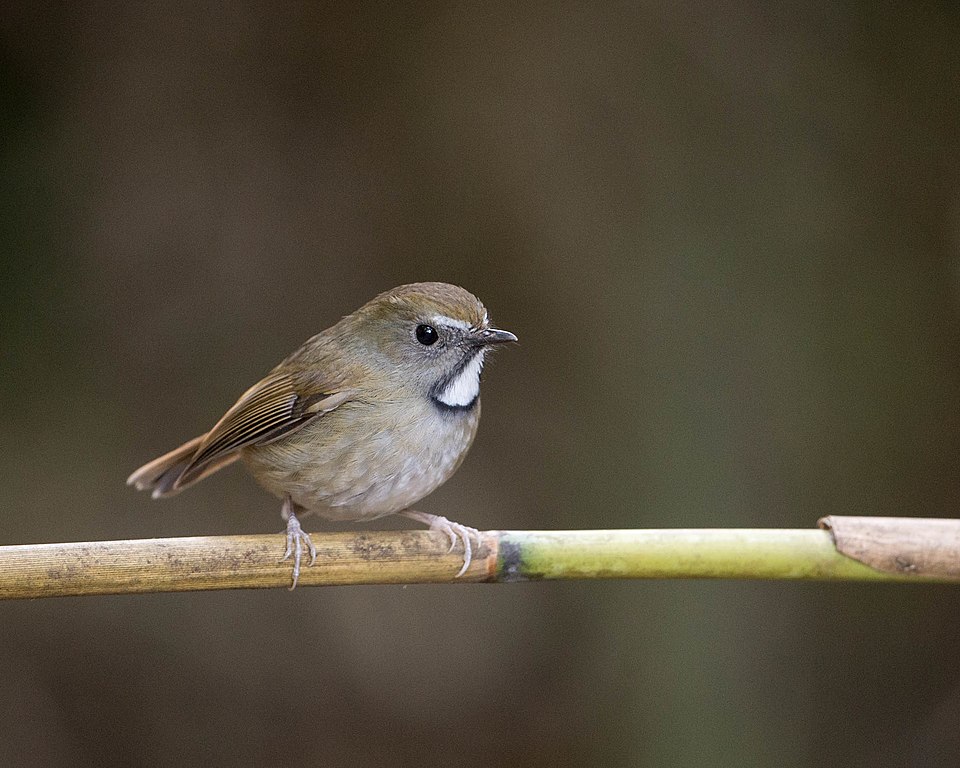
African Scrub-Robin
Cercotrichas minor
Order: Passeriformes / Family: Muscicapidae

Wikimedia Commons
About the African Scrub-Robin
The African Scrub-Robin (Cercotrichas minor) is a small, active songbird belonging to the family Muscicapidae. This species is widely distributed across sub-Saharan Africa, favoring open woodlands, dry thickets, and shrublands from Angola to Zimbabwe. It plays a critical ecological role as both a predator of insects and a prey species for larger birds and mammals. The African Scrub-Robin's presence is often indicative of healthy, biodiverse habitats.
This bird is significant not only for its role in the ecosystem but also for its melodious song, which can be heard throughout its range. The song consists of a series of clear, whistle-like notes that are both a territorial marker and a means of attracting mates. The African Scrub-Robin's adaptability to various dry and semi-arid environments has allowed it to maintain stable populations across its range, even in the face of habitat changes.
Ecologically, the African Scrub-Robin contributes to insect population control, feeding primarily on ants, beetles, and caterpillars. It also participates in seed dispersal indirectly by spreading the seeds of the plants whose fruits it consumes. During the breeding season, its nesting habits support the health of local flora, as the bird often chooses to nest in dense vegetation that provides ample cover from predators. Seasonal behaviors include increased vocal activity during the breeding season and a shift in foraging patterns to exploit seasonal abundances of prey.
The African Scrub-Robin belongs to the family Muscicapidae, within the order Passeriformes. These birds typically live average 5 years with max recorded 8 years..
How to Identify a African Scrub-Robin
The African Scrub-Robin is recognized by its medium size, approximately 14-16 cm in length, and its slender build. Adults display a distinctive reddish-brown upper body with a paler, buff-colored underside, which aids in camouflage against the dry, earthy tones of its preferred habitats. The bird's face is marked by a subtle white supercilium above the eye, giving it a slightly alert expression. Its tail is long and often held upright, displaying a pattern of dark brown with white edges that is visible when the bird is in flight.
Juveniles resemble adults but are generally duller and have a more spotted or mottled appearance on their underparts. Males and females appear similar, making sex differentiation challenging in the field. However, males might sometimes exhibit slightly brighter plumage during the breeding season.
The African Scrub-Robin can be confused with similar species such as the Brown Scrub-Robin, but it is distinguishable by its more reddish coloration and the absence of the Brown Scrub-Robin's more uniform brown plumage. In flight, the African Scrub-Robin's silhouette is characterized by its long, distinctly marked tail and quick, direct flight pattern. When perched, it often flicks its tail upwards, a behavior that is useful for identification.
Having trouble telling birds apart? Upload a photo to our bird identification tool for an instant species match.
African Scrub-Robin Habitat and Range
Preferred Habitat
The African Scrub-Robin thrives in dry, open woodlands, scrublands, and savannahs. It is commonly found in regions characterized by sparse tree cover with ample undergrowth, which provides necessary cover and foraging grounds. The bird favors elevations ranging from sea level up to about 2000 meters, depending on the local climate and vegetation structure.
Throughout its range, the African Scrub-Robin exhibits some adaptability to habitat changes, often persisting in areas that have experienced moderate disturbance, such as light grazing or selective logging. However, it is less commonly found in heavily urbanized areas, preferring rural landscapes where natural vegetation remains predominant. During the dry season, the bird may move to areas with more abundant water sources, but it does not undertake long-distance migrations.
Geographic Range
The African Scrub-Robin's range extends across a wide swath of sub-Saharan Africa. It breeds throughout Angola, Zambia, Zimbabwe, Botswana, Namibia, and parts of South Africa, particularly in regions where suitable scrub and woodland habitats are present. The species is predominantly sedentary, with only localized movements in response to environmental conditions such as drought or food scarcity.
In countries like Zimbabwe and Botswana, the African Scrub-Robin is a common resident, thriving in the extensive savannahs and woodlands. Populations in Namibia and South Africa are similarly stable, with the bird occupying dry riverbeds and thornveld regions. Despite its broad distribution, the species' density is often highest in areas where human activity is minimal, allowing for more intact habitats.
Want to know which birds visit your area? Browse our backyard birds by location guides for region-specific species lists.
What Does the African Scrub-Robin Eat?
The diet of the African Scrub-Robin primarily consists of insects, making it an important insectivore within its ecosystem. Its preferred prey includes ants, beetles, caterpillars, and various other small arthropods. These are typically captured through a foraging technique known as 'gleaning,' where the bird actively hunts along the ground and through low vegetation.
In addition to insects, this robin occasionally consumes small fruits and seeds, especially during times when insect prey is less abundant. Seasonal diet shifts occur as the bird takes advantage of food resources that become available with changing weather patterns. During the breeding season, the African Scrub-Robin increases its food intake to meet the demands of raising young, often foraging more extensively at dawn and dusk.
African Scrub-Robin Behavior and Social Structure
The African Scrub-Robin exhibits a range of interesting behaviors, particularly regarding its social structure and territoriality. This bird is generally solitary or found in pairs, especially during the breeding season. It is highly territorial, with males singing prominently to defend their chosen area from intruders. This singing serves both as a deterrent to other males and as an attraction to potential mates.
Courtship displays involve a series of intricate movements, including tail flicking and wing displays, often accompanied by soft calls. Once paired, the partners remain together for the breeding season, working cooperatively to raise their young.
The African Scrub-Robin is most active during the cooler parts of the day, such as early morning and late afternoon, avoiding the midday heat typical of its habitat. In response to predators, it often employs a strategy of rapid, low flight into dense cover, utilizing its cryptic coloration to remain hidden.
African Scrub-Robin Nesting and Reproduction
The nesting behavior of the African Scrub-Robin involves constructing a neat cup-shaped nest, typically made of fine grasses and lined with softer materials like feathers or hair. These nests are usually located within dense shrubbery or low trees, providing concealment from predators and harsh weather.
The female lays a clutch of 2-4 eggs, which she incubates over a period of approximately 12-14 days. During this time, the male may assist by bringing food to the female. Once hatched, the chicks are altricial, requiring significant parental care. Both parents participate in feeding the young, who fledge around 14-16 days after hatching. The African Scrub-Robin may produce one to two broods per year, depending on environmental conditions and food availability.
African Scrub-Robin Sounds and Vocalizations
The song of the African Scrub-Robin is a melodious series of clear, whistle-like notes that can be heard echoing through its habitat. The rhythm is generally slow and deliberate, with a quality that is both soothing and persistent. In addition to its primary song, the bird emits various call notes, including a sharp 'tuk' sound used for communication between mates or as an alarm call when danger is near.
During the dawn chorus, the African Scrub-Robin becomes particularly vocal, its song serving to establish territory and reinforce pair bonds. The bird's calls and songs are distinctive within its range, aiding birdwatchers in locating and identifying it amidst the diverse avian soundscape of sub-Saharan Africa.
Interesting Facts About the African Scrub-Robin
- 1The African Scrub-Robin's song can carry over distances greater than 100 meters, making it a prominent feature in its environment.
- 2This robin is known to engage in a behavior called 'anting,' where it uses ants to remove parasites from its plumage.
- 3The nest of an African Scrub-Robin is often located less than 1 meter above ground, tucked into dense foliage for protection.
- 4Despite its small size, the African Scrub-Robin is an effective predator of large insects, including beetles up to 2 cm long.
- 5The robin's tendency to flick its tail and wings is thought to help flush out insects from the undergrowth.
- 6African Scrub-Robins can live up to 8 years in the wild, with longevity linked to stable habitat conditions.
- 7This bird's call repertoire includes over 10 distinct sounds, each serving a specific communicative purpose.
African Scrub-Robin Conservation Status
The African Scrub-Robin is currently classified as Least Concern by the IUCN. Its population trend is considered stable, with no major threats causing significant declines. However, habitat degradation due to agricultural expansion, deforestation, and climate change could pose future challenges. Conservation efforts focus on habitat preservation and the maintenance of ecological corridors that ensure genetic diversity and population resilience. Historically, the African Scrub-Robin's adaptability has allowed it to persist despite some habitat changes, but ongoing monitoring is essential to ensure long-term stability.