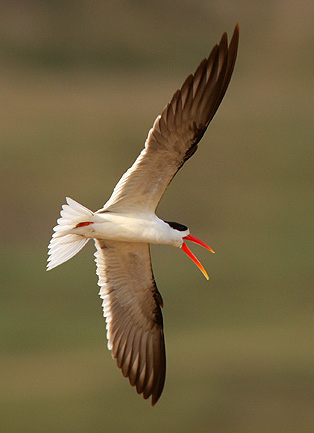
African Skimmer
Rynchops flavirostris
Order: Charadriiformes / Family: Laridae

Wikimedia Commons
About the African Skimmer
The African Skimmer (Rynchops flavirostris) is a distinctive member of the family Laridae, standing out among African birdlife with its unique bill structure. The species is most prominent along large inland rivers and lakes in sub-Saharan Africa, where it plays a significant role in the ecosystem by controlling fish populations and thus maintaining a balanced aquatic environment. These birds are particularly common in regions such as the Zambezi River basin in Zambia and Mozambique, the Nile River in Sudan, and the rivers of West Africa spanning countries like Nigeria and Senegal. African Skimmers depend heavily on these aquatic systems, where they forage expertly by skimming the water surface with their elongated lower mandible. This specialized feeding behavior is not only fascinating to observe but also underscores their ecological role as indicators of healthy fish populations. During the breeding season, which typically coincides with the dry months when water levels are lower, African Skimmers congregate in colonies on sandy riverbanks and islands. This seasonal behavior allows them to exploit exposed sandbars for nesting, ensuring that their eggs and chicks have minimal risk of flooding. Outside the breeding season, African Skimmers may disperse over a broader range, although they remain tied to water bodies. Their presence in a region can indicate the health of wetland ecosystems, making their conservation crucial for maintaining biodiversity within these habitats. The African Skimmer's unique adaptations and its reliance on specific habitats highlight the importance of conserving aquatic environments in Africa.
The African Skimmer belongs to the family Laridae, within the order Charadriiformes. These birds typically live typically 10-12 years, with some living up to 15 years..
How to Identify a African Skimmer
The African Skimmer is easily recognizable thanks to its striking black and white plumage and its elongated, brightly colored bill. Adult African Skimmers display a stark contrast between their black upperparts and white underparts, with a sharp line along the neck dividing these color regions. This color pattern is visible both when the bird is in flight and at rest. The elongated lower mandible, which is longer than the upper one, is bright orange to red, a feature that makes it unmistakable among waterbirds. Juvenile African Skimmers show more subdued colors, with browner upperparts and a less pronounced bill color. Males and females look alike, making gender identification in the field challenging without observing behavior. In flight, the African Skimmer has a distinctive silhouette due to its long wings and forked tail. The wings are long and pointed, adapted for agile flight over water surfaces. When perched, the bird maintains a horizontal posture, often resting on sandbars or low-lying branches near water bodies. Although it shares some similarities with terns and other skimmers, the African Skimmer's vivid bill and unique feeding technique help distinguish it from these species.
Having trouble telling birds apart? Upload a photo to our bird identification tool for an instant species match.
African Skimmer Habitat and Range
Preferred Habitat
African Skimmers are predominantly found in large river systems, lakes, and estuaries across sub-Saharan Africa. They favor habitats with wide, slow-moving rivers that have sandbanks and islands, which are crucial for their breeding activities. Noteworthy habitats include the Zambezi, Okavango, and Nile river systems, where they take advantage of the seasonal changes in water levels. Their preference for lowland rivers means they are typically found at elevations below 1500 meters. Seasonal shifts in habitat occur as water levels change, with skimmers retreating to larger water bodies during high-water periods and exploiting exposed sandbanks during the dry season. Although primarily associated with rural and remote areas, African Skimmers can occasionally be observed in urban settings where suitable river habitats exist, such as near the cities of Khartoum or Lusaka.
Geographic Range
The African Skimmer's range encompasses a broad swath of sub-Saharan Africa. They breed along major river systems such as the Niger, Congo, and Zambezi rivers, where sandy islands and banks provide ideal nesting sites. In the non-breeding season, they disperse along these waterways but remain within the continent, avoiding long-distance migrations. The species is notably present in countries like Zambia, Zimbabwe, Botswana, and Angola, where abundant suitable habitats exist. Despite this wide range, African Skimmers are not uniformly distributed, with higher population densities occurring in regions with extensive, undisturbed river systems. Their presence in certain areas may fluctuate seasonally, influenced by water levels and prey availability, yet they are a consistent presence in central and southern Africa.
Want to know which birds visit your area? Browse our backyard birds by location guides for region-specific species lists.
What Does the African Skimmer Eat?
The African Skimmer's diet primarily consists of small fish, which they capture through a distinctive foraging technique known as skimming. They fly low over the water surface with their elongated lower mandible submerged, snapping shut their bills upon contact with prey. This technique requires precision and skill, allowing them to target fish typically less than 10 centimeters in length. While fish make up the bulk of their diet, they may occasionally consume aquatic insects and crustaceans, especially when fish are less abundant. Seasonal changes in water levels can affect prey availability, prompting African Skimmers to adjust their hunting grounds and sometimes their diet. They typically forage during the early morning and late afternoon when fish are more active near the surface, making for effective hunting.
African Skimmer Behavior and Social Structure
The social behavior of African Skimmers is characterized by their tendency to form colonies during the breeding season, which provides safety in numbers against predators. These colonies can consist of dozens to hundreds of individuals, with birds nesting closely together on sandbanks. Outside the breeding season, skimmers may become more solitary or form smaller groups, often seen resting or preening together. Territorial behavior is evident during nesting, with pairs defending their chosen sandbanks from intruders. Courtship displays involve aerial chases and synchronized movements, which help strengthen pair bonds. African Skimmers are generally crepuscular, being most active during dawn and dusk when they forage for fish. When threatened by predators such as large birds of prey or ground predators, skimmers rely on their agility and speed to evade capture, often taking to the air in swift, coordinated flights.
African Skimmer Nesting and Reproduction
African Skimmers nest in colonies, often choosing sandy islands or banks along large rivers. They create shallow scrapes in the sand, which serve as nests, providing minimal protection but blending well with the surroundings. The typical clutch size is two to four eggs, which are cryptically colored to resemble the sand, thus reducing predation risks. Both parents share incubation duties, which last approximately 21 to 25 days. After hatching, the chicks, which are precocial, remain in the nest for several weeks before fledging. During this time, both parents provide food and protection. The fledging period extends to about 4 to 5 weeks after hatching, depending on food availability and weather conditions. African Skimmers usually have one brood per year, although in regions with consistent food supplies and favorable conditions, a second brood is possible.
African Skimmer Sounds and Vocalizations
The African Skimmer's vocalizations include a series of harsh, nasal calls that serve as contact calls within colonies. These calls, often described as a rapid, repeated 'kek-kek-kek,' can be heard most frequently around breeding sites. Their call notes are somewhat similar to those of terns but tend to be more resonant. Alarm calls are more intense and drawn out, intended to alert colony members of potential threats. During the dawn chorus, African Skimmers contribute to the symphony of wetland sounds with their distinctive vocalizations, which can be crucial for maintaining contact among individuals, particularly in low light conditions.
Interesting Facts About the African Skimmer
- 1African Skimmers can fly at speeds of up to 50 kilometers per hour while skimming the water surface for fish.
- 2Despite their seemingly fragile structure, the lower mandible of the African Skimmer is highly resilient, adapted to withstand repeated contact with water.
- 3The unique feeding technique of the African Skimmer is shared by only two other skimmer species worldwide, both found in the Americas.
- 4The African Skimmer relies on precise timing and alignment to capture fish, often closing its bill within a fraction of a second after contact.
- 5Colonies of African Skimmers can number from a few dozen to over a thousand pairs, depending on the availability of suitable sandbanks.
- 6The bright orange-red bill of the African Skimmer fades to a duller color outside of the breeding season, a potential adaptation for reduced visibility to predators.
- 7During the breeding season, African Skimmers often engage in synchronized flying displays, a behavior thought to strengthen pair bonds.
African Skimmer Conservation Status
The African Skimmer is currently classified as Near Threatened by the IUCN, with its population showing a declining trend. Primary threats include habitat loss due to dam construction, water extraction, and land development along river systems. These activities reduce the availability of suitable nesting sites and alter the dynamics of prey populations. Conservation efforts focus on protecting critical wetland habitats and mitigating the impacts of riverbank disturbance. Organizations are working to raise awareness among local communities about the ecological importance of skimmers and the need for sustainable water management practices. Historically, changes in water management and increased human activity have led to fluctuations in skimmer populations, underscoring the need for vigilant conservation measures.
Other Laridae Species


Birds Similar to the African Skimmer
These species are often confused with the African Skimmer due to similar appearance or overlapping range.