
Ash-throated Crake
Porzana albicollis
Order: Gruiformes / Family: Rallidae
Wikimedia Commons
About the Ash-throated Crake
The Ash-throated Crake (Porzana albicollis) is a small waterbird belonging to the Rallidae family, an ensemble of birds known for their preference for wetland habitats. This particular species is renowned for its secretive nature and inconspicuous behavior, often observed skirting the edges of marshes and swamps where it adeptly navigates dense vegetation. Found primarily in South America, the Ash-throated Crake inhabits countries such as Brazil, Paraguay, Uruguay, Argentina, and Bolivia. These birds thrive in a variety of wetland environments, including marshes, ponds, and flooded grasslands. The presence of dense undergrowth is crucial for their survival, as it provides both food and shelter. During the breeding season, which typically aligns with the rainy months, their activity becomes more pronounced as they engage in courtship displays and territorial defense.
The ecological role of the Ash-throated Crake is significant within its habitat. As insectivores, these birds contribute to the control of insect populations, playing a vital role in the balance of the wetland ecosystems. They also serve as prey for larger predators, thus forming an essential link in the food chain. Despite their shyness, the Ash-throated Crake's presence is an indicator of healthy wetland environments, which are essential for biodiversity and water purification.
Seasonal behaviors of the Ash-throated Crake vary, with increased vocalizations and visible activity occurring during the breeding season. This period contrasts with their otherwise reclusive nature, as they become more territorial and vocal in defense of their nesting sites. Outside of breeding, these birds maintain a low profile, using their cryptic plumage to blend seamlessly into their environment. These behaviors highlight their adaptation to both the opportunities and challenges presented by their habitats, demonstrating a remarkable ability to thrive in conditions that can be harsh and variable.
The Ash-throated Crake belongs to the family Rallidae, within the order Gruiformes. These birds typically live 3-5 years with a maximum recorded of 7 years..
How to Identify a Ash-throated Crake
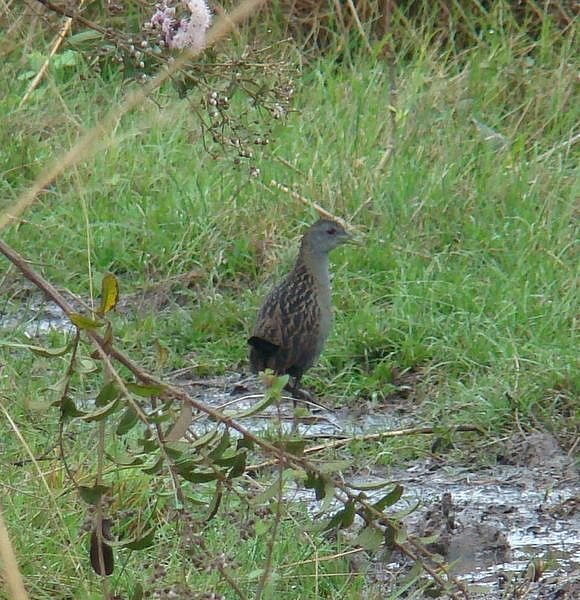
The Ash-throated Crake is medium in size, with adults displaying a mixture of browns and grays across their plumage. A key identifying feature is the pale gray to whitish throat that stands out against the darker brown body. This contrast is especially noticeable when the bird is seen in dense undergrowth or during brief flights. The rest of the underparts are typically richer in color, with a rufous tint that blends well with marsh vegetation. Juveniles resemble adults but exhibit a slightly duller coloration, lacking the clear contrast between the throat and surrounding plumage.
No significant sexual dimorphism exists in this species, making it challenging to distinguish males from females in the field. However, during the breeding season, males may appear slightly more aggressive and vocal as they establish territories. Confusion with similar species such as the Grey-necked Wood-Rail can occur, but the Ash-throated Crake is smaller and lacks the prominent neck coloration of the wood-rail.
In flight, the Ash-throated Crake shows a rounded wing shape and a short tail, both adaptations for maneuvering through thick vegetation rather than sustained long-distance flight. When perched, it often adopts a horizontal posture, keeping a low profile to remain hidden from predators.
Having trouble telling birds apart? Upload a photo to our bird identification tool for an instant species match.
Ash-throated Crake Habitat and Range
Preferred Habitat
The Ash-throated Crake predominantly inhabits wetland environments throughout its range. These include marshes, swamps, and flooded grasslands, all characterized by dense vegetation that provides cover and foraging opportunities. They prefer areas with a mix of open water and thick plant growth, which supports their secretive lifestyle. Although primarily a lowland species, they may be found at elevations up to 1,000 meters in some regions.
Seasonal shifts in habitat selection are minimal, as they tend to remain in wetland areas year-round. However, during dry seasons, they may congregate in permanent water bodies or irrigated fields. While predominantly found in rural settings, they can occasionally be spotted in urban fringe areas where suitable wetlands exist. This adaptability to different wetland types highlights their flexibility in habitat preference, though always within the context of sufficient vegetative cover.
Geographic Range
The Ash-throated Crake's range extends over a large portion of South America. It is a resident breeder in countries such as Brazil, Argentina, Uruguay, Paraguay, and Bolivia. Within these regions, the bird is widely distributed across suitable wetland habitats, avoiding only the most arid and high-altitude areas.
Although generally considered non-migratory, some local movements may occur in response to water levels and food availability, particularly during the dry season. In such instances, they may shift to more permanent water bodies or areas with higher rainfall. Population density hotspots are often found in extensive wetland systems like the Pantanal in Brazil, where the combination of water and dense vegetation provides optimal conditions.
Their presence is less common in heavily urbanized or industrial areas, as these generally lack the habitat complexity required by the species. The Ash-throated Crake's distribution reflects its dependence on a specific habitat type, resulting in a patchy but widespread presence across its range.
Want to know which birds visit your area? Browse our backyard birds by location guides for region-specific species lists.
What Does the Ash-throated Crake Eat?
The diet of the Ash-throated Crake consists primarily of small invertebrates, with insects forming the bulk of their intake. Beetles, ants, and various aquatic insects are typical prey, supplemented by small crustaceans and mollusks found within their wetland habitats. They forage by walking slowly through dense vegetation, using their keen eyesight to spot movement among the leaves and water.
During the wet season, when insect populations peak, their diet is more varied, allowing them to exploit the abundance of prey. As the dry season progresses and food becomes scarcer, they may rely more heavily on aquatic sources, including small fish and amphibians, although these are secondary in importance.
Foraging typically occurs during early morning and late afternoon, taking advantage of cooler temperatures and increased insect activity. They may also feed opportunistically throughout the day, especially when rearing young and the demand for food is greater.
Ash-throated Crake Behavior and Social Structure
The behavior of the Ash-throated Crake is characterized by its secretive and solitary nature. These birds are typically found alone or in pairs, rarely forming larger groups except during the breeding season when territorial interactions become more frequent. Their territories are fiercely defended through vocalizations and displays, with males often engaging in calls to announce their presence and deter rivals.
Courtship involves a series of displays and vocal exchanges between potential mates, reinforcing pair bonds and coordinating breeding activities. Once paired, they remain monogamous throughout the breeding season, collaborating closely in nesting and chick rearing.
In response to predators, Ash-throated Crakes rely on camouflage and stealth, often freezing or seeking immediate cover in dense vegetation. Their cryptic plumage aids in this strategy, making them difficult to spot even at close range. Daily activity patterns include periods of foraging interspersed with resting and preening, often in secluded areas where they are less likely to be disturbed.
Ash-throated Crake Nesting and Reproduction
Ash-throated Crakes construct their nests within dense vegetation, favoring sites with ample cover near water. The nests are platforms of grasses and reeds, carefully woven together to create a stable structure that can accommodate the changing water levels typical of their habitats. Located low to the ground, these nests are well-concealed from predators.
A typical clutch consists of 3 to 5 eggs, which exhibit a pale coloration with brown speckling. Both parents share the responsibility of incubation, which lasts approximately 18 to 20 days. After hatching, the chicks are precocial and leave the nest shortly after, though they remain under the watchful eyes of their parents.
Fledging occurs within a few weeks, with young birds becoming independent by the time they are one month old. The species is capable of raising multiple broods per year, contingent on favorable environmental conditions and food availability.
Ash-throated Crake Sounds and Vocalizations
The primary vocalization of the Ash-throated Crake is a series of sharp, metallic 'kik-kik-kik' notes, often delivered in rapid succession. These calls are most commonly heard during dawn and dusk, when the birds are most active. The rhythm is steady and the pitch somewhat high, carrying well over short distances to communicate territory boundaries and mating availability.
Alarm calls differ slightly, consisting of a more abrupt, staccato series of 'kek' sounds, which signal awareness of potential threats. These calls are less frequent but serve an important role in alerting mates or young to the presence of danger. Compared to other wetland species, the Ash-throated Crake's vocalizations are relatively simple, yet effective for their communication needs.
Interesting Facts About the Ash-throated Crake
- 1The Ash-throated Crake's diet shifts significantly between seasons, with a greater reliance on aquatic life during the dry months.
- 2Despite their secretive nature, Ash-throated Crakes engage in surprisingly noisy courtship displays during the breeding season.
- 3They are known for their ability to squeeze through dense vegetation, using their laterally compressed bodies to navigate tight spaces.
- 4The Ash-throated Crake's camouflaging plumage is so effective that it can remain undetected even when only a few meters away.
- 5Unlike many birds, both male and female Ash-throated Crakes participate equally in nest building and chick rearing.
- 6The species can thrive in both natural and human-modified wetlands, demonstrating a degree of adaptability in habitat use.
- 7Their vocalizations are a reliable indicator of their presence in an area, as visual sightings are often rare due to their elusive behavior.
Ash-throated Crake Conservation Status
Currently, the Ash-throated Crake is listed as Least Concern by the IUCN, reflecting a stable population trend across much of its range. Despite this status, the species faces threats from habitat loss due to wetland drainage and agricultural expansion, which reduce the availability of suitable nesting and feeding areas. Conservation efforts focus on protecting and restoring wetland habitats, essential for maintaining the ecological conditions that support the species. Regional conservation initiatives, particularly in the Pantanal and other key areas, aim to balance human land use with biodiversity preservation. Historically, population numbers have fluctuated with changes in habitat availability, but recent trends suggest a relatively stable outlook, provided that current conservation measures continue and expand where necessary.
Other Rallidae Species


Birds Similar to the Ash-throated Crake
These species are often confused with the Ash-throated Crake due to similar appearance or overlapping range.

