
Azure-crested Flycatcher
Myiagra azureocapilla
Order: Passeriformes / Family: Monarchidae
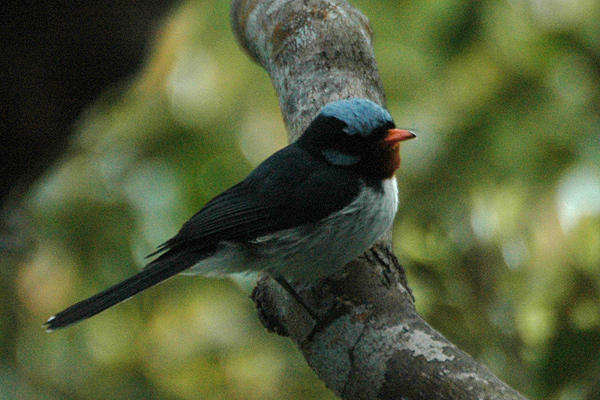
Wikimedia Commons
About the Azure-crested Flycatcher
The Azure-crested Flycatcher (Myiagra azureocapilla) is a small, vibrant member of the Monarchidae family that thrives in the dense forests of the Solomon Islands. This species is particularly noted for its striking azure cap, which makes it easily distinguishable from other birds within its habitat. The Azure-crested Flycatcher plays a vital role in its ecosystem, primarily through its insectivorous diet, which helps control insect populations and maintain ecological balance. These birds are typically found in lowland and montane forests, preferring areas with dense canopy that provide ample foraging opportunities and protection from predators. The Azure-crested Flycatcher is non-migratory, residing within its native range year-round. During the breeding season, which coincides with the wet season, these birds become more vocal and territorial, engaging in intricate courtship displays and territorial disputes to secure mates and nesting sites. The significance of the Azure-crested Flycatcher extends beyond its ecological role. It is also an indicator of forest health, as its presence signifies a well-preserved habitat. As human activities encroach upon their natural habitats, the conservation of the Azure-crested Flycatcher becomes increasingly vital. Local conservation efforts aim to protect the pristine forests of the Solomon Islands, thus ensuring the survival of this enchanting bird. Indigenous communities value the Azure-crested Flycatcher not only for its ecological contributions but also for its cultural symbolism. The bird features in local folklore and traditional stories, often representing agility, alertness, and the spirit of the forest itself. As such, the preservation of this species holds cultural as well as ecological importance.
The Azure-crested Flycatcher belongs to the family Monarchidae, within the order Passeriformes. These birds typically live typically 5-7 years, with some individuals living up to 9 years..
How to Identify a Azure-crested Flycatcher
The Azure-crested Flycatcher can be identified by its vibrant azure-blue cap, contrasting sharply with its olive-brown back and wings. Adult males and females display similar plumage, though males tend to have slightly more intense coloration. The underparts of both sexes are a soft, grayish-white, providing a subtle contrast to their more colorful upper parts. Juveniles, however, have a duller appearance with less prominent azure coloring, making it somewhat challenging to distinguish them from similar species in the field. In flight, the Azure-crested Flycatcher exhibits a distinctive silhouette characterized by its medium size and relatively short, rounded wings. When perched, this species often adopts an upright posture, showcasing its blue cap prominently. Birders should note that the Azure-crested Flycatcher can be mistaken for other members of the Monarchidae family, such as the Blue-faced Monarch, which inhabits nearby regions. However, the latter lacks the azure crest and has a more extensive blue facial area. Careful observation of the head coloration and body size can assist in accurate identification.
Having trouble telling birds apart? Upload a photo to our bird identification tool for an instant species match.
Azure-crested Flycatcher Habitat and Range
Preferred Habitat
The Azure-crested Flycatcher predominantly inhabits lowland and montane forests within the Solomon Islands. These birds thrive in dense, humid forests where the canopy provides ample cover and a rich supply of insects. The elevation range for this species is generally from sea level up to 1,500 meters, though they are most abundant at mid-elevations. Unlike some bird species, the Azure-crested Flycatcher does not exhibit significant seasonal habitat shifts, remaining within forested areas throughout the year. While primarily a forest-dwelling species, the Azure-crested Flycatcher may occasionally venture into adjacent secondary growth areas, especially if such habitats are close to pristine forest. However, they are rarely found in urban or heavily altered landscapes, as these environments lack the dense vegetation and insect prey necessary for their survival.
Geographic Range
The Azure-crested Flycatcher is endemic to the Solomon Islands, inhabiting a range that includes several of the archipelago's larger islands such as Guadalcanal, Malaita, and Makira. These islands provide the dense forest environments that the species requires for breeding and foraging. Being a non-migratory bird, the Azure-crested Flycatcher does not undertake seasonal migrations, remaining within its established territories throughout the year. The population density of this species tends to be highest in regions where forest cover is extensive and well-preserved. In particular, the central highlands of Guadalcanal and the forested areas of Malaita are known hotspots for this bird. However, deforestation and habitat degradation pose significant threats to its range, making conservation efforts crucial to maintaining stable populations.
Want to know which birds visit your area? Browse our backyard birds by location guides for region-specific species lists.
What Does the Azure-crested Flycatcher Eat?
The diet of the Azure-crested Flycatcher primarily consists of insects, which it captures through a technique known as 'hawking.' This involves the bird perching on a branch and scanning for flying insects before launching into a short, agile flight to catch them mid-air. Common prey items include flies, beetles, and small moths, all of which provide the necessary protein for energy and growth. During different seasons, the abundance of specific insect types may vary, prompting the Azure-crested Flycatcher to adjust its foraging behavior accordingly. In the wet season, for example, an increase in insect activity allows these birds to consume a more diverse array of prey. The Azure-crested Flycatcher typically forages during daylight hours, with peak activity occurring in the early morning and late afternoon when insects are most active. This diurnal feeding schedule helps the bird avoid the hottest parts of the day while maximizing its hunting success.
Azure-crested Flycatcher Behavior and Social Structure
The Azure-crested Flycatcher exhibits a range of behaviors that reflect its territorial and social nature. Typically, these birds are solitary or found in pairs, especially during the breeding season when they become particularly territorial. Males engage in vocal displays and physical posturing to defend their territories from intruders, a behavior that intensifies during courtship. The courtship displays of the Azure-crested Flycatcher are elaborate, involving a combination of vocalizations, feather displays, and aerial maneuvers. These displays serve to attract mates and establish pair bonds. Once paired, both males and females participate in nest building and caring for their young. Though generally solitary, the Azure-crested Flycatcher may join mixed-species foraging flocks outside the breeding season, a strategy that enhances foraging efficiency and reduces predation risk. When faced with predators, this species employs evasive flight tactics and alarm calls to alert nearby birds. Daily activity patterns of the Azure-crested Flycatcher are diurnal, with most activity concentrated in the cooler hours of the morning and late afternoon.
Azure-crested Flycatcher Nesting and Reproduction
The Azure-crested Flycatcher constructs its nest in the fork of a tree branch, using materials such as grasses, leaves, and spiderwebs to create a compact cup-shaped structure. Nesting typically occurs during the wet season, when food resources are plentiful. Clutch size generally ranges from two to three eggs, which are pale with brown speckling. Both parents share incubation duties, which last approximately 14 days. After hatching, the chicks remain in the nest for about 16 to 18 days, during which both parents feed and care for them. Parental roles are equitable, with both the male and female taking turns in feeding the young and guarding the nest. The Azure-crested Flycatcher typically raises one brood per year, although in optimal conditions, a second brood may occasionally be attempted.
Azure-crested Flycatcher Sounds and Vocalizations
The primary song of the Azure-crested Flycatcher is a melodious sequence of clear, whistled notes that rise and fall in pitch. This song serves both to establish territory and attract mates. In addition to its song, the bird produces a series of short, sharp call notes used to communicate with potential mates and deter rivals. Alarm calls are harsher and more rapid, designed to alert conspecifics to the presence of predators. During the dawn chorus, the Azure-crested Flycatcher contributes a lively and prominent voice, its song standing out among the symphony of forest sounds. The tonal quality of its calls may remind listeners of certain flute-like instruments, though with a naturally avian resonance.
Interesting Facts About the Azure-crested Flycatcher
- 1The Azure-crested Flycatcher's striking blue cap is not just for show; it plays a role in mate selection during the breeding season.
- 2This species is known for its 'hawking' foraging technique, catching insects mid-air with remarkable agility.
- 3Despite its small size, the Azure-crested Flycatcher can hold territories of up to 0.5 hectares, defending them vigorously.
- 4The bird's song features prominently in the dawn chorus, making it one of the first sounds of the morning in its habitat.
- 5A pair of Azure-crested Flycatchers can consume hundreds of insects per day, providing valuable pest control in their ecosystem.
- 6The Azure-crested Flycatcher is an indicator species, meaning its presence signifies a healthy, undisturbed forest ecosystem.
- 7Juvenile Azure-crested Flycatchers take several months to develop the full intensity of their adult plumage.
Azure-crested Flycatcher Conservation Status
Currently, the Azure-crested Flycatcher is classified as Least Concern by the IUCN, although its population trend is decreasing due to habitat loss and fragmentation. Deforestation for timber and agricultural expansion poses the most significant threat to its habitat. Conservation efforts focus on preserving the remaining tracts of forest within the Solomon Islands, which are critical not only for this species but for the entire regional biodiversity. Historical data indicate that the Azure-crested Flycatcher's range has contracted somewhat due to these pressures, making habitat protection an urgent priority. Local and international conservation organizations are working to implement sustainable land-use practices and raise awareness about the importance of preserving these unique ecosystems.


