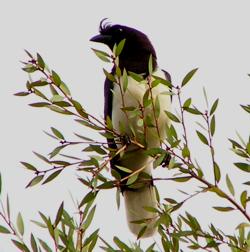
Azure Jay
Cyanocorax coeruleus
Order: Passeriformes / Family: Corvidae

Wikimedia Commons
About the Azure Jay
The Azure Jay, Cyanocorax coeruleus, holds a unique place in the avian world with its iridescent blue plumage and notable presence in the Atlantic Forest of South America. This medium-sized bird, a member of the Corvidae family, is not only an emblem of biodiversity but also a key player in the ecological dynamics of its habitat. Found primarily in Brazil's southern regions, including Rio Grande do Sul, Santa Catarina, and Paraná, the Azure Jay thrives in humid subtropical forests where it contributes to seed dispersion and forest regeneration. The bird's role as a disperser of seeds, particularly from the Araucaria pine, underscores its ecological significance. During the breeding season, which spans from September to February, Azure Jays exhibit increased vocal activity and social interactions, often forming small, loosely organized groups. Their social structure becomes more pronounced during this period, with pairs engaging in cooperative breeding behaviors. As a resident species, the Azure Jay does not undertake long migrations, although it may move locally in response to food availability. This bird's adaptability allows it to exploit a variety of forest niches, from the canopy to the understory, aiding in its survival amidst habitat changes. Seasonal variations in food resources also influence their foraging patterns, with a diet shifting from insects and invertebrates to fruits and seeds as different resources become available. The Azure Jay's presence reflects the health of its environment, making it a valuable indicator species for conservationists monitoring the Atlantic Forest's condition.
The Azure Jay belongs to the family Corvidae, within the order Passeriformes. These birds typically live average 10 years; max recorded 14 years.
How to Identify a Azure Jay
The Azure Jay distinguishes itself through a vivid blue plumage that covers most of its body, contrasted by a black head and upper breast. Adult males and females exhibit similar coloring, though close observation reveals slightly larger sizes and more robust bills in males. Juvenile Azure Jays are notably duller, with a more subdued shade of blue and a less glossy appearance than adults. This bird can often be confused with the Blue Jay, but the Azure Jay lacks the white wing bars and tail spots characteristic of the Blue Jay. In flight, the Azure Jay displays a broad, rounded wing silhouette with a steady, direct flight pattern. When perching, it maintains an upright posture, often flicking its tail and wings as it surveys its surroundings. The distinct coloration and behavior of the Azure Jay make it a relatively easy bird to identify within its native range, despite occasional confusion with other Corvids.
Having trouble telling birds apart? Upload a photo to our bird identification tool for an instant species match.
Azure Jay Habitat and Range
Preferred Habitat
The Azure Jay inhabits the lush Atlantic Forest, a biome characterized by high biodiversity and endemism. This forest type is primarily found in southeastern Brazil, extending into parts of Paraguay and northern Argentina. The bird thrives at elevations ranging from sea level to about 1,500 meters, showing particular affinity for areas with dense canopy cover and abundant food resources. While predominantly a forest dweller, the Azure Jay occasionally ventures into adjacent agricultural and suburban areas, especially where forest fragments persist. Seasonal habitat shifts are subtle, as the bird remains within forested regions but may adjust its range slightly in response to local resource availability. Despite its adaptability, the Azure Jay's preference for primary and secondary forests makes it vulnerable to habitat loss from deforestation and land conversion.
Geographic Range
The Azure Jay's range is primarily confined to the Atlantic Forest of South America, with its core populations located in southern Brazil. It is especially prevalent in the states of Rio Grande do Sul, Santa Catarina, and Paraná. The bird's range extends marginally into eastern Paraguay and the Misiones province of Argentina. This species does not migrate long distances, instead exhibiting local movements that respond to seasonal changes in food supply. Population density hotspots often align with areas of intact forest, where the Azure Jay's ecological role as a seed disperser is most effectively fulfilled. Despite its relatively limited geographic range, the Azure Jay's adaptability to varied forest conditions has enabled it to maintain stable populations in regions where suitable habitat remains.
Want to know which birds visit your area? Browse our backyard birds by location guides for region-specific species lists.
What Does the Azure Jay Eat?
The Azure Jay's diet is diverse, reflecting its opportunistic feeding habits and the seasonal availability of food resources. Primarily, it consumes fruits and seeds, playing a crucial role in the dispersal of the Araucaria pine seeds. During the breeding season, its diet shifts to include a higher proportion of insects and other invertebrates, which provide necessary protein for developing chicks. The Azure Jay forages both in the canopy and on the forest floor, employing a variety of techniques such as gleaning from leaves and branches and occasionally capturing prey in mid-air. This bird exhibits a preference for large seeds and fruits but will also consume smaller items when necessary. Its feeding schedule aligns with peak activity periods in the early morning and late afternoon, coinciding with the availability of its preferred food sources.
Azure Jay Behavior and Social Structure
The Azure Jay exhibits complex social behaviors, often forming small, cohesive groups that facilitate cooperative feeding and predator detection. These groups, typically consisting of family units, demonstrate a high degree of social learning and communication. Territorial behavior is pronounced during the breeding season, with pairs defending nesting sites aggressively against intruders. Courtship displays involve vocalizations and mutual preening, strengthening pair bonds. The Azure Jay's response to predators includes mobbing behavior, where multiple individuals collectively harass and drive off potential threats. Daily activity patterns are diurnal, with peak periods of activity in the cooler hours of the morning and late afternoon. During these times, the Azure Jay can be observed engaging in foraging, vocal communication, and social interactions.
Azure Jay Nesting and Reproduction
The Azure Jay constructs its nests high in the forest canopy, often in the forks of tall trees to ensure safety from ground predators. The nest is a bulky cup made of twigs, leaves, and grasses, lined with softer materials for insulation. Clutch sizes typically range from 3 to 5 eggs, with both parents sharing incubation duties over a period of about 18 to 20 days. Following hatching, the fledging period lasts approximately 25 to 28 days, during which time both parents actively feed and care for the young. The Azure Jay may produce one or two broods per year, depending on environmental conditions and food availability. Parental roles are cooperative, with both males and females participating in feeding and protecting the chicks.
Azure Jay Sounds and Vocalizations
The Azure Jay's primary song consists of a series of harsh, metallic calls, often described as a raspy 'kra-kra-kra' that carries through the dense forest. Call notes include a variety of squawks and chirps used for communication within flocks. Alarm calls are sharp and intense, designed to alert other jays to potential threats. During the dawn chorus, the Azure Jay's vocalizations become more frequent and varied, contributing to the rich soundscape of the forest. These sounds are reminiscent of other Corvids, though with a distinctly harsher quality unique to the Azure Jay.
Interesting Facts About the Azure Jay
- 1The Azure Jay is the state bird of Paraná, highlighting its cultural and ecological importance in Brazil.
- 2Azure Jays play a significant role in the dispersal of Araucaria pine seeds, which are vital to the forest ecosystem.
- 3Despite their striking appearance, Azure Jays can be elusive, often blending into the forest canopy.
- 4These birds demonstrate remarkable intelligence, capable of complex problem-solving and tool use.
- 5The Azure Jay's social structure facilitates cooperative breeding, with non-breeding individuals aiding in chick rearing.
- 6Azure Jays are known for their vocal mimicry, sometimes imitating the calls of other bird species.
- 7Their adaptability to various forest habitats helps buffer against the impacts of environmental changes.
Azure Jay Conservation Status
The Azure Jay is currently listed as Near Threatened on the IUCN Red List, with population trends indicating a decline due to ongoing habitat destruction. The primary threat to its survival is deforestation of the Atlantic Forest, driven by agricultural expansion and urbanization. Conservation efforts focus on habitat protection and restoration, with several protected areas established within its range. Historically, the Azure Jay has faced challenges from habitat fragmentation, but recent initiatives aim to connect forest patches and promote sustainable land use practices. Ongoing monitoring and research are crucial to understanding and mitigating the factors contributing to its population decline.
Other Corvidae Species


Birds Similar to the Azure Jay
These species are often confused with the Azure Jay due to similar appearance or overlapping range.