
Balearic Shearwater
Puffinus mauretanicus
Order: Procellariiformes / Family: Procellariidae
Wikimedia Commons
About the Balearic Shearwater
The Balearic Shearwater, Puffinus mauretanicus, is an intriguing seabird endemic to the Mediterranean region, particularly the Balearic Islands, which include Mallorca, Menorca, and Ibiza. As a member of the Procellariidae family, this bird is closely related to other shearwaters and petrels, known for their exceptional navigational abilities and long-distance flying. The Balearic Shearwater holds a particular significance due to its critically endangered status, largely attributable to habitat loss, human disturbance, and predation by invasive species such as rats and cats. Despite these threats, the Balearic Shearwater plays a vital ecological role as part of the marine food web. Its foraging activities help maintain the balance of fish populations, as it primarily feeds on small fish and squid. During the breeding season, these birds are found nesting in crevices and caves along the rugged coasts of the Balearic Islands. Outside the breeding season, the Balearic Shearwater disperses widely, with sightings off the coasts of France, the United Kingdom, and as far afield as the North Atlantic Ocean. This seasonal movement highlights the bird's adaptability and emphasizes the need for international cooperation in its conservation. The Balearic Shearwater's ecological role extends beyond its immediate environment. By participating in nutrient cycling and serving as both predator and prey, it influences the structure of the food web in its native habitats. Its presence indicates healthy marine ecosystems, and efforts to protect this species can have broader environmental benefits. The Balearic Shearwater migrates along the Atlantic coast of Europe, reaching as far north as Scandinavia. During this time, it faces threats from pollution, bycatch in fishing nets, and climate change, which alter its food availability and breeding success. Conservation measures, such as establishing protected areas and implementing sustainable fishing practices, are crucial to improving the outlook for this enigmatic bird. The Balearic Shearwater's plight has drawn attention from conservationists worldwide. Collaborative efforts between governments and non-governmental organizations aim to mitigate threats and restore habitats, ensuring that this remarkable bird continues to grace the Mediterranean skies for generations to come.
The Balearic Shearwater belongs to the family Procellariidae, within the order Procellariiformes. These birds typically live average 20 years, max recorded 40 years..
How to Identify a Balearic Shearwater
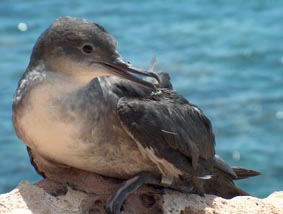
The Balearic Shearwater is a medium-sized seabird, measuring about 33-38 cm in length with a wingspan of 78-90 cm. Adults exhibit a dark brown upper side contrasting with a paler underbelly, often appearing grayish or dirty white, which can aid in identification at sea. The bird's head is similarly dark, and its bill is slender and hooked, ideal for catching fish. Juvenile Balearic Shearwaters look similar to adults but often have slightly fresher plumage and less worn feathers. There is little sexual dimorphism, so males and females are challenging to distinguish in the field. Compared to similar species such as the Manx Shearwater (Puffinus puffinus) or the Yelkouan Shearwater (Puffinus yelkouan), the Balearic Shearwater is slightly larger and has a more robust, darker overall appearance. In flight, the Balearic Shearwater exhibits a characteristic flight pattern, consisting of a series of rapid wingbeats followed by gliding in a direct line above the waves, often interspersed with banking turns. This flight silhouette is a key field mark, as it distinguishes the bird from the more erratic flight of other shearwaters. When perched, the Balearic Shearwater typically rests on the water's surface in loose flocks, making it easy to observe its distinctive dark body and contrasting pale face and underparts.
Having trouble telling birds apart? Upload a photo to our bird identification tool for an instant species match.
Balearic Shearwater Habitat and Range
Preferred Habitat
The Balearic Shearwater primarily inhabits coastal and marine environments, with a strong preference for the rocky shores and sea cliffs of the Balearic Islands during the breeding season. These birds nest in crevices, caves, and burrows, which provide shelter from predators and protection from the elements. Outside the breeding season, the Balearic Shearwater ranges widely across the open ocean, often found in nutrient-rich waters where fish and squid are abundant. The bird typically remains at low elevations, close to sea level, where it can easily take off and land on the water. Seasonal habitat shifts occur as the Balearic Shearwater migrates along the European Atlantic coast, venturing into the open ocean and occasionally visiting more urbanized coastal areas where food sources are accessible. Although primarily associated with natural marine environments, the Balearic Shearwater can occasionally be observed near fishing ports, where its scavenging behavior allows it to exploit human activities for food.
Geographic Range
The Balearic Shearwater's breeding range is centered on the Balearic Islands of Spain, particularly Mallorca, Menorca, and Ibiza. These islands serve as critical nesting sites from February to June. Following the breeding season, the bird migrates northward along the Atlantic coast of Europe, reaching countries such as France, the United Kingdom, and even Norway. The migration corridor primarily follows the Iberian Peninsula's western coastline, where the Balearic Shearwater takes advantage of the rich fisheries and abundant food supply. During the non-breeding season, the bird's range extends into the North Atlantic Ocean, where it is often seen in offshore waters. Despite the wide-ranging movements, certain areas, such as the Bay of Biscay and the English Channel, host higher population densities during migration. Within its range, population densities vary, with the highest concentrations found in traditional breeding sites and along migratory routes where food is plentiful. Conservation concerns arise from this restricted and fragmented range, underscoring the importance of international collaboration in protecting migratory corridors and feeding areas.
Want to know which birds visit your area? Browse our backyard birds by location guides for region-specific species lists.
What Does the Balearic Shearwater Eat?
The Balearic Shearwater's diet primarily consists of small fish and squid, which it captures through surface seizing and plunge diving. This bird often preys on species such as sardines and anchovies, which thrive in the nutrient-rich waters of the Mediterranean and Atlantic. Seasonal shifts in diet occur as the shearwater migrates, with some variation in prey availability depending on local fish populations and environmental conditions. During the breeding season, adults forage closer to nesting sites, bringing back food to feed their chicks. The Balearic Shearwater typically forages in groups, often joining mixed-species flocks that include gulls and other seabirds. This social foraging behavior increases hunting efficiency by helping birds locate prey schools. Prey size usually ranges from small fry to adult fish up to 15 cm, which the shearwater can handle with its agile flight and strong bill. Feeding often occurs during daylight hours, although the bird can adapt to nocturnal foraging when necessary, depending on prey activity patterns and competition from other marine predators.
Balearic Shearwater Behavior and Social Structure
The Balearic Shearwater exhibits a social structure characterized by loose flocks, particularly during migration and non-breeding seasons, where collective foraging improves feeding success. Territorial behavior is less pronounced, although breeding pairs display site fidelity to nest areas, defending them from intruders. Courtship displays include synchronized flying and vocalizations, strengthening pair bonds and ensuring successful mating. Flocking patterns change with seasonal movements, as the shearwater joins other seabirds in feeding aggregations. These gatherings enhance survival by improving foraging efficiency and predator detection. In response to predators, the Balearic Shearwater relies on its agile flight and group vigilance. Although vulnerable to terrestrial predators at nesting sites, this bird exhibits evasive tactics at sea, avoiding aerial threats like larger gulls. Daily activity patterns involve extended periods at sea, with frequent long-distance flights for food. The shearwater's crepuscular and nocturnal activities, especially during chick-rearing, optimize resource use and minimize competition.
Balearic Shearwater Nesting and Reproduction
The Balearic Shearwater nests in remote, inaccessible locations such as rocky crevices, sea caves, and burrows on the Balearic Islands. These sites provide protection from predators and harsh weather, essential for breeding success. Nest materials include plant matter, feathers, and any available debris that offers insulation and padding. The average clutch size is one egg, with both parents sharing incubation duties over a period of about 51-54 days. Fledging occurs approximately 70-75 days after hatching, depending on food availability and environmental conditions. Parental roles are well-defined, with both sexes involved in provisioning and protecting the chick. Typically, the Balearic Shearwater produces one brood per year, although breeding success varies due to environmental pressures and human disturbances. The species' reliance on specific nesting sites makes it vulnerable to habitat loss and predation, highlighting the need for conservation measures to secure these critical areas.
Balearic Shearwater Sounds and Vocalizations
The Balearic Shearwater's vocalizations include a variety of harsh, croaking calls often described as a 'kee-ah kee-ah' sound. These calls are most frequently heard at night near breeding colonies, where birds communicate with mates and establish territory. Alarm calls are sharper and more urgent, serving to alert others to potential threats. During the dawn chorus, mixed flocks of shearwaters and other seabirds create a cacophony of sounds that fills the air, reminiscent of a bustling seabird colony. These vocalizations play a crucial role in maintaining social bonds and facilitating coordination within flocks. Compared to other seabirds, the Balearic Shearwater's calls are more guttural and less melodious, reflecting its rugged coastal environment.
Interesting Facts About the Balearic Shearwater
- 1The Balearic Shearwater can fly over 500 km in a single day while searching for food, showcasing its impressive endurance.
- 2Researchers have tracked Balearic Shearwaters as far as the North Sea, demonstrating their extensive migratory range.
- 3This species is one of the rarest seabirds in Europe, with an estimated population of fewer than 3,000 breeding pairs.
- 4Balearic Shearwaters have been recorded diving to depths of 10 meters while hunting for fish and squid.
- 5The bird's flight pattern, a mix of rapid wingbeats and gliding, helps it conserve energy over long distances.
- 6Balearic Shearwaters often associate with dolphins, taking advantage of fish driven to the surface by the marine mammals.
- 7During courtship, pairs perform synchronized aerial displays that strengthen their bond and improve breeding success.
Balearic Shearwater Conservation Status
The Balearic Shearwater is classified as Critically Endangered by the IUCN, with a decreasing population trend. Primary threats include habitat destruction, invasive species, bycatch in fishing gear, and pollution. Conservation efforts focus on habitat protection, invasive species eradication, and sustainable fishing practices. Historically, the population has experienced significant declines due to human activities, but recent efforts offer hope for stabilization. Successful conservation programs involve international cooperation, such as the establishment of marine protected areas and awareness campaigns to reduce bycatch incidents. Continued monitoring and research are essential to adapting conservation strategies to evolving environmental threats.


