
Band-rumped Swift
Chaetura spinicaudus
Order: Apodiformes / Family: Apodidae
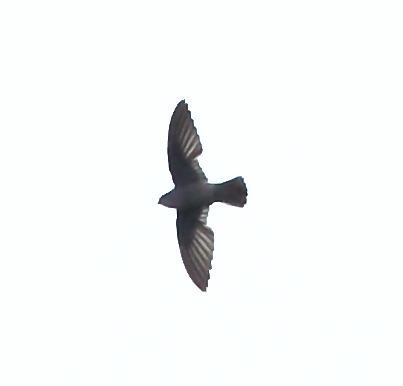
Wikimedia Commons
About the Band-rumped Swift
The Band-rumped Swift, scientifically known as Chaetura spinicaudus, is a small bird belonging to the family Apodidae. This swift is renowned for its aerial agility and is often seen darting across the skies in pursuit of insects. Its ecological significance is tied to its role as an insectivore, which helps control insect populations. The Band-rumped Swift predominantly inhabits the tropical and subtropical regions of the Americas, with notable populations found in the Amazon Basin, the foothills of the Andes, and Central America. These swifts prefer habitats that provide ample foraging opportunities, such as open woodlands, river valleys, and sometimes even urban areas where insects are abundant.
This swift plays a crucial ecological role in its habitat by participating in the control of insect populations, thus contributing to the ecological balance. The Band-rumped Swift tends to be found in large flocks, which enhances their capacity to locate food sources and avoid predators. Seasonally, these birds engage in partial migrations, particularly in response to food availability and climatic conditions. In the Amazon Basin, for instance, the swifts may move to higher elevations during wetter periods when insect abundance decreases in lower areas.
The significance of the Band-rumped Swift extends beyond its ecological role. Its presence is indicative of a healthy ecosystem, as these birds rely on diverse insect populations, which in turn depend on a variety of plant species. Therefore, the Band-rumped Swift serves as a bioindicator species, with its presence or absence providing insights into the health of the ecosystems it inhabits. Furthermore, their migratory patterns offer valuable data on environmental changes, as shifts in their traditional patterns may signal larger ecological disruptions.
The Band-rumped Swift belongs to the family Apodidae, within the order Apodiformes. These birds typically live typically around 4-6 years, with some individuals living up to 10 years..
How to Identify a Band-rumped Swift
The Band-rumped Swift is a small, agile bird with a streamlined body, adapted for high-speed aerial maneuvers. Adult Band-rumped Swifts possess a distinctive plumage characterized by dark, sooty-brown upperparts and slightly paler underparts. One of their most recognizable features is their short, square tail, which is fringed with a pale band-a key identifying trait that distinguishes them from similar swift species. Juvenile swifts resemble the adults but may exhibit slightly duller plumage and less defined tail bands.
Male and female Band-rumped Swifts are similar in appearance, making it difficult to distinguish between the sexes in the field. However, during the breeding season, subtle differences may be noted in the plumage condition and wear, particularly in males that engage in more frequent aerial displays.
In flight, the Band-rumped Swift's silhouette reveals narrow, pointed wings that are well-suited for rapid, agile flight. They often maintain a direct, fast flight path interspersed with sharp turns and acrobatic maneuvers. Unlike some swifts that are known for their erratic flight patterns, the Band-rumped Swift exhibits a more consistent rhythm, often flying in loose flocks. Their perching posture is seldom observed as they spend most of their time on the wing, but when at rest, their small feet are used to cling vertically to tree trunks or rock surfaces.
Having trouble telling birds apart? Upload a photo to our bird identification tool for an instant species match.
Band-rumped Swift Habitat and Range
Preferred Habitat
The Band-rumped Swift occupies a variety of habitats, primarily favoring tropical and subtropical environments. They are commonly found in open woodlands, forest edges, and river valleys, where they can effectively forage for insects. In the Amazon Basin, these swifts are particularly abundant, thriving in the diverse and insect-rich environments of the lowland rainforests.
Elevation plays a role in their habitat preferences, with the Band-rumped Swift typically found at elevations ranging from sea level up to 1,500 meters, although they may venture higher in search of food. Seasonal shifts in habitat can occur, particularly during periods of low insect availability, prompting these swifts to move to areas with more abundant food sources.
While the Band-rumped Swift primarily inhabits rural and forested areas, it is also known to adapt to more urban environments. In cities, they can be observed foraging over parks and gardens, benefiting from artificial lighting that attracts insects. This ability to thrive in both natural and modified landscapes demonstrates the adaptability of the Band-rumped Swift.
Geographic Range
The Band-rumped Swift's range extends across significant portions of Central and South America. During the breeding season, they are commonly found in countries such as Brazil, Colombia, Ecuador, and Peru, where they inhabit the vast expanses of the Amazon Basin. They also populate the lowland regions and foothills along the eastern slopes of the Andes.
In Central America, the Band-rumped Swift is observed in countries like Costa Rica and Panama, where they are present year-round. Their distribution continues northward into parts of southern Mexico, although they are less common in this region. The swift's range also includes parts of the Caribbean, notably Trinidad and Tobago, where populations are well-established.
Migration patterns of the Band-rumped Swift are influenced by food availability and climatic conditions. While many populations are resident, some exhibit partial migratory behavior, moving to more favorable areas during the dry season when insect populations decline. The flexibility in their range and migration underscores the species' adaptability to varying environmental conditions.
Want to know which birds visit your area? Browse our backyard birds by location guides for region-specific species lists.
What Does the Band-rumped Swift Eat?
The Band-rumped Swift primarily feeds on insects, making it a crucial player in the ecosystem as a natural pest controller. Their diet consists mainly of flying insects, including beetles, flies, and moths. These swifts are aerial foragers, adept at capturing prey mid-flight with their agile maneuvers and swift speed.
Seasonal variations influence their diet, with certain insect groups becoming more prevalent at different times of the year. During the rainy season in tropical regions, when insect populations surge, the Band-rumped Swift takes advantage of the abundance to meet its nutritional needs and feed its young.
Foraging typically occurs throughout the day, with peak activity during the early morning and late afternoon. This schedule coincides with the periods of highest insect activity. The swift's ability to adapt its foraging strategy to changing environmental conditions highlights its role as an efficient and flexible predator within its habitat.
Band-rumped Swift Behavior and Social Structure
Band-rumped Swifts are highly social birds, often seen in large flocks that enhance their foraging efficiency and predator detection. These flocks can consist of hundreds of individuals, creating a dynamic aerial display as they sweep across the sky in search of insects. The swifts communicate with each other through a series of high-pitched calls, which help maintain coordination during flight and alert others to potential food sources or threats.
Territorial behavior is minimal among Band-rumped Swifts, as they are not known to defend specific areas. Instead, their movements are largely dictated by food availability. During the breeding season, however, some individuals may exhibit increased territorial aggression in defense of nesting sites.
Courtship displays are subtle and primarily involve aerial acrobatics, with males performing swift, looping flights to attract females. Despite their aerial prowess, these swifts are vulnerable to predation by birds of prey. When threatened, the flock's coordinated movement and rapid flight patterns serve as an effective defense mechanism, often confusing and deterring potential predators.
Daily activity patterns of the Band-rumped Swift revolve around foraging, with the majority of their waking hours spent on the wing in search of food. As daylight fades, the swifts retreat to communal roosts, where they rest until dawn.
Band-rumped Swift Nesting and Reproduction
The nesting habits of the Band-rumped Swift are closely tied to their need for secure and sheltered environments. These swifts typically construct their nests in crevices of cliffs, tree holes, or even man-made structures such as bridges and buildings. The nest itself is a simple structure, often composed of twigs, leaves, and saliva, which hardens to form a secure cup.
Clutch size for the Band-rumped Swift usually consists of 2 to 3 eggs. Both parents share the responsibility of incubation, which lasts approximately 18 to 21 days. Once the eggs hatch, the chicks are cared for by both parents, who take turns foraging and feeding the young.
Fledging occurs about 30 days after hatching, with the young swifts leaving the nest when they are capable of sustained flight. The Band-rumped Swift typically produces one brood per year, although in regions with longer favorable conditions, two broods may be possible. This reproductive strategy ensures a stable population even in the face of environmental fluctuations.
Band-rumped Swift Sounds and Vocalizations
The vocalizations of the Band-rumped Swift are characterized by a series of high-pitched, twittering notes. Their primary song consists of rapid, repetitive chirps that resonate with a clear, ringing quality. These calls are often heard during flight, serving as a means of communication within the flock.
Besides their flight calls, Band-rumped Swifts also emit shorter, sharper notes that serve as alarm calls when predators are detected. During the dawn chorus, their calls become more frequent and pronounced, contributing to the lively soundscape of their habitat.
The swift's vocalizations can be compared to the sound of small bells or chimes, providing an auditory cue for identification. This distinctive sound profile aids birders in locating and identifying these elusive birds, even when they are not visible in the dense canopy or high above the ground.
Interesting Facts About the Band-rumped Swift
- 1The Band-rumped Swift can spend up to 90% of its life in flight, only landing to nest and roost.
- 2Unlike many birds, the Band-rumped Swift does not perch on branches but clings to vertical surfaces with its strong feet.
- 3A single Band-rumped Swift can travel over 500 km in a day while foraging for insects.
- 4The swift's short, square tail aids in their exceptional agility during rapid aerial maneuvers and turns.
- 5Band-rumped Swifts are known to fly at altitudes of up to 3,000 meters, taking advantage of thermal air currents.
- 6Despite their small size, these swifts can reach speeds of up to 100 km/h during flight.
- 7The Band-rumped Swift's specialized saliva acts as an adhesive, helping to construct and solidify their nests.
Band-rumped Swift Conservation Status
The Band-rumped Swift is currently listed as a species of Least Concern on the IUCN Red List. Their population trend is considered stable, with no major widespread threats identified. However, localized threats such as habitat destruction due to deforestation and urban expansion pose potential risks. Conservation efforts for the Band-rumped Swift focus primarily on habitat preservation and environmental education. Protecting the diverse ecosystems they inhabit is crucial for maintaining healthy populations. Historical data suggests that while the swift's population has remained relatively stable, continued monitoring is necessary to detect any future changes. Recent conservation initiatives aim to promote sustainable land use practices in regions where the Band-rumped Swift is found. These efforts help ensure that the swift's natural habitat is preserved, allowing them to thrive alongside human development.


