
Bannerman's Turaco
Tauraco bannermani
Order: Musophagiformes / Family: Musophagidae
Wikimedia Commons
About the Bannerman's Turaco
Bannerman's Turaco, scientifically known as Tauraco bannermani, is a captivating bird species endemic to the highland regions of Cameroon. This bird belongs to the family Musophagidae, often referred to as 'banana-eaters' due to their fruit-heavy diet. The species plays a vital ecological role as both a seed disperser and a part of the food web in these montane ecosystems. With its vibrant green body and a distinctive crimson crest, the Bannerman's Turaco is not only a visual delight but also a key indicator of the health of its forest habitat.
The significance of Bannerman's Turaco extends beyond its ecological role. As an endemic species, it highlights the unique biodiversity of Cameroon's highlands, particularly in areas like the Bamenda Highlands and the Oku Volcanic Field. These regions are characterized by their lush montane forests, which provide the necessary conditions for the turaco's survival and reproduction. The bird's presence in these forests underscores the importance of conserving these critical habitats, which are under threat from human activities such as logging and agriculture.
Bannerman's Turaco exhibits intriguing seasonal behaviors, though it remains a resident species throughout the year. The bird's activity levels and foraging patterns may vary with the availability of fruiting trees, which are its primary food source. During the breeding season, the turaco engages in more conspicuous courtship displays and vocalizations, making it easier for observers to spot and study. The bird's adaptability to seasonal changes in food availability demonstrates its resilience, but also highlights the need for preserving a variety of fruiting species within its habitat.
Overall, Bannerman's Turaco serves as a symbol of the rich avian diversity found in West Africa's montane regions. Its ecological role, coupled with its striking appearance and restricted range, underscores the importance of targeted conservation efforts to ensure that this fascinating bird remains a thriving part of Cameroon's natural heritage.
The Bannerman's Turaco belongs to the family Musophagidae, within the order Musophagiformes. These birds typically live up to 10 years in the wild..
How to Identify a Bannerman's Turaco
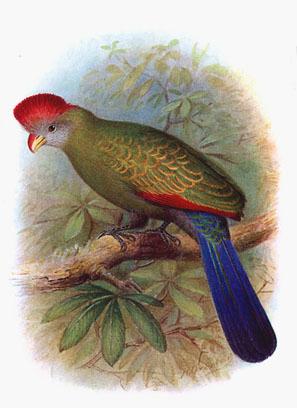
Bannerman's Turaco is a medium-sized bird, easily identifiable by its vibrant green plumage and striking crimson crest. The adult plumage features a rich green body that transitions to a blue-green hue on the wings and tail. The crimson crest and red wing feathers become visible during flight, creating a stunning contrast against the bird's green body. Its eyes are surrounded by a vivid red eye-ring, adding to its distinctive facial appearance.
Juvenile Bannerman's Turacos resemble adults but with slightly duller plumage and a less pronounced crest. As they mature, their colors intensify, and the crest becomes more prominent. Males and females share similar plumage, making them difficult to differentiate based solely on appearance. However, subtle differences in body size and behavior during the breeding season may help in distinguishing the sexes.
In flight, the Bannerman's Turaco presents a unique silhouette with broad, rounded wings and a long tail. Its flight is characterized by short bursts of flapping interspersed with glides, allowing the red wing patches to flash intermittently. When perched, the bird maintains an upright posture, often seen among the dense foliage of montane forests. Confusion with other turaco species is minimal due to the Bannerman's distinctive combination of green and crimson colors, as well as its limited geographic range.
Having trouble telling birds apart? Upload a photo to our bird identification tool for an instant species match.
Bannerman's Turaco Habitat and Range
Preferred Habitat
Bannerman's Turaco is predominantly found in the montane forests of Cameroon, particularly favoring elevations between 1,800 to 2,500 meters. These forests provide a dense canopy and a rich variety of fruiting trees, essential for the turaco's diet. The bird thrives in both primary and secondary forests, indicating a degree of adaptability to habitat changes.
During different seasons, Bannerman's Turaco may shift its range within the montane forest to follow fruiting cycles of different tree species. Its presence is strongly associated with areas that have abundant fruit supply, highlighting the importance of these forests in sustaining its population.
Although primarily a forest dweller, the Bannerman's Turaco occasionally ventures into forest edges and clearings, especially where fruiting trees are present. Its adaptability to various forest types underscores its resilience, but urban presence is minimal due to its specialized habitat requirements.
Geographic Range
Bannerman's Turaco is endemic to the highlands of Cameroon, with its range confined to specific regions such as the Bamenda Highlands and the Oku Volcanic Field. These areas are part of the Cameroon Volcanic Line, known for their rich biodiversity and unique ecosystems.
The bird's breeding range coincides with its overall distribution, as it does not undertake long-distance migrations. Instead, Bannerman's Turaco displays some local movements driven by seasonal fruit availability within its montane forest habitat.
Population density hotspots include regions with dense montane forests where fruiting trees are abundant. These areas are crucial for the turaco's survival, but they face threats from habitat destruction and fragmentation. Conservation efforts focus on protecting these key habitats to ensure the continued presence of Bannerman's Turaco in its native range.
Want to know which birds visit your area? Browse our backyard birds by location guides for region-specific species lists.
What Does the Bannerman's Turaco Eat?
Bannerman's Turaco primarily feeds on fruits, making it an essential frugivore within its montane forest habitat. It favors a diet rich in figs, berries, and the fruits of various native trees, playing a crucial role in seed dispersal and forest regeneration.
Seasonal changes in fruit availability affect the turaco's diet, prompting it to shift its foraging areas accordingly. When fruits are scarce, the Bannerman's Turaco may supplement its diet with leaves, flowers, and occasionally small invertebrates, showcasing its dietary flexibility.
Foraging techniques involve agile movements through the forest canopy, often seen hopping and climbing among branches to reach ripe fruits. The bird typically feeds during the early morning and late afternoon, capitalizing on the cooler hours of the day to avoid heat stress and maximize feeding efficiency.
Bannerman's Turaco Behavior and Social Structure
Bannerman's Turaco exhibits a social structure that includes small family groups or pairs, with limited evidence of larger flocking behavior. Its territorial nature becomes pronounced during the breeding season, when pairs defend their nesting sites through vocalizations and occasional displays.
Courtship displays involve a series of visual and auditory signals, including crest raising, wing fluttering, and soft calls. These displays serve to strengthen pair bonds and signal breeding readiness. Once a pair forms, they often remain together throughout the breeding season.
In response to predators, Bannerman's Turaco relies on its dense forest habitat for cover, often retreating to the upper canopy. Its calls serve as both territorial markers and alarm signals, alerting other turacos to potential threats. Daily activity patterns include periods of rest and preening during the hottest parts of the day, with increased foraging activity during cooler hours.
Bannerman's Turaco Nesting and Reproduction
Bannerman's Turaco constructs a simple yet effective nest using twigs and leaves, typically located in the dense foliage of montane forests. Nest placement is usually at mid-canopy level, providing protection from ground predators and harsh weather.
The female lays a clutch of two to three eggs, with both parents sharing incubation duties. The incubation period lasts approximately 21 to 23 days, during which the parents take turns keeping the eggs warm and protected.
Once hatched, the chicks remain in the nest for about four weeks. Both parents participate in feeding and caring for the young, ensuring a steady supply of regurgitated fruit and other food items. Bannerman's Turaco typically raises one brood per year, although favorable conditions may allow for a second clutch.
Bannerman's Turaco Sounds and Vocalizations
Bannerman's Turaco is known for its distinctive vocalizations, which play a crucial role in communication and territory establishment. The primary song consists of a series of loud, rhythmic 'kow-kow-kow' notes, often delivered in rapid succession.
Call notes vary from soft, conversational 'chuck' sounds to more urgent alarm calls when threats are detected. The turaco's vocalizations are most prominent during the early morning and late afternoon, coinciding with peak activity periods.
The dawn chorus of Bannerman's Turaco is a hallmark of its montane forest habitat, with its calls echoing through the canopy. These sounds serve as an acoustic signature of the species, aiding in its identification even when the bird is not visible.
Interesting Facts About the Bannerman's Turaco
- 1Bannerman's Turaco's striking red wing coloration comes from unique pigments called turacins, found only in turacos.
- 2The bird's vocalizations can be heard over a kilometer away, helping maintain territories and social bonds.
- 3Bannerman's Turaco has a specialized digestive system that efficiently extracts nutrients from fibrous fruits.
- 4This turaco species can live up to 10 years in the wild, a relatively long lifespan for bird species of its size.
- 5Despite being fruit specialists, Bannerman's Turacos occasionally consume insects, showcasing dietary versatility.
- 6The bird's name honors David Armitage Bannerman, a prominent ornithologist who extensively studied African birds.
- 7Bannerman's Turaco's vibrant plumage is a result of light refraction rather than pigment alone, a rare trait in birds.
Bannerman's Turaco Conservation Status
The IUCN currently lists Bannerman's Turaco as endangered, citing habitat loss as a primary threat to its survival. Population trends indicate a decline due to ongoing deforestation and habitat fragmentation in its limited range. Conservation efforts focus on preserving and restoring montane forest habitats, with initiatives involving local communities and international conservation organizations. Protecting these highland forests not only benefits Bannerman's Turaco but also supports a wide range of endemic species that rely on these ecosystems. Historical population changes show a decrease in numbers due to increased human activities, emphasizing the need for continued protection and habitat management to ensure the species' long-term viability.
Other Musophagidae Species


Birds Similar to the Bannerman's Turaco
These species are often confused with the Bannerman's Turaco due to similar appearance or overlapping range.

