
Bat-like Spinetail
Neafrapus boehmi
Order: Apodiformes / Family: Apodidae
Wikimedia Commons
About the Bat-like Spinetail
The Bat-like Spinetail, scientifically known as Neafrapus boehmi, is a notable member of the swift family, Apodidae. This species is primarily found across the tropical regions of sub-Saharan Africa, showcasing a remarkable adaptation to life in the skies. Its presence is significant in regions such as the Congo Basin and extending into parts of West and East Africa. The bird's ecological role is primarily aerial, as it spends much of its life on the wing, expertly navigating through the forest canopy and open skies. This adaptation allows it to efficiently exploit the abundant insect life that thrives in these warm climates. The Bat-like Spinetail is particularly active during the wet season when insect populations peak. During this time, the bird's feeding habits support local ecosystems by controlling insect numbers, thereby maintaining ecological balance. Its preference for humid, densely vegetated areas, such as lowland rainforests, places it in a critical position within these biodiverse environments. The species contributes to seed dispersal indirectly by influencing the insect populations that affect plant pollination and growth. Additionally, the Bat-like Spinetail's role extends to being a vital component of the food chain, serving as prey for larger aerial predators like hawks and falcons. The bird’s behavior changes with seasons, and during the breeding season, it becomes more territorial, often seen in pairs or small flocks around nesting sites. This seasonal behavior is crucial for understanding its ecological impact and conservation needs.
The Bat-like Spinetail belongs to the family Apodidae, within the order Apodiformes. These birds typically live average 4-6 years, with a maximum recorded of 8 years..
How to Identify a Bat-like Spinetail
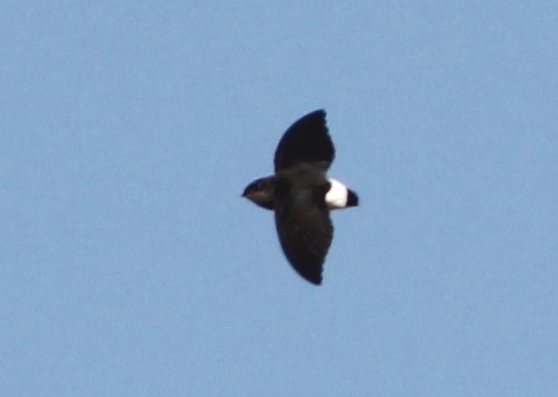
The Bat-like Spinetail is a small bird, measuring around 12 to 14 centimeters in length. It is predominantly dark brown, with subtle white markings on its throat and belly, which can be challenging to spot unless observed closely in good lighting. Adult plumage is generally consistent across genders, though females may appear slightly duller. Juveniles resemble adults but often have a more muted coloration and less distinct white markings. When in flight, the Bat-like Spinetail exhibits a distinctive silhouette due to its short, broad wings and a tail that is often held closed, enhancing its name. This species is sometimes confused with other swifts, such as the African Palm Swift, but can be differentiated by its unique flight style, which involves rapid, erratic movements reminiscent of a bat. The bird's perching posture, although infrequent due to its aerial lifestyle, shows it clinging to vertical surfaces, much like other swifts.
Having trouble telling birds apart? Upload a photo to our bird identification tool for an instant species match.
Bat-like Spinetail Habitat and Range
Preferred Habitat
The Bat-like Spinetail predominantly inhabits tropical lowland forests and moist savannas. It thrives in areas with a dense canopy, such as the tropical rainforests of the Congo Basin and West Africa. These environments provide the ideal conditions for its insectivorous diet. The species is also found in secondary forests and forest edges, where it can easily access open spaces for feeding. Although primarily a forest dweller, the Bat-like Spinetail occasionally ventures into more open savanna regions, especially during the wet season when insect activity is high. The bird's elevation range is generally below 1,500 meters, as it prefers the humid, warm air of lower altitudes. Urban presence is rare, as the species is more adapted to natural forested environments rather than human-modified landscapes.
Geographic Range
The Bat-like Spinetail's range spans much of sub-Saharan Africa, with notable populations in the Democratic Republic of the Congo, Gabon, and Cameroon. It is also found in eastern countries such as Kenya and Tanzania. The bird does not typically migrate, but it may exhibit seasonal movements in response to food availability or climatic conditions. During the breeding season, it prefers the more humid regions of its range to support its nesting and feeding requirements. In terms of population density, the species is more concentrated in the central African regions, where dense forest habitats provide ample foraging opportunities. The lack of significant migratory behavior suggests a year-round residency within these regions.
Want to know which birds visit your area? Browse our backyard birds by location guides for region-specific species lists.
What Does the Bat-like Spinetail Eat?
The Bat-like Spinetail primarily feeds on insects, focusing on flying insects such as beetles, flies, and moths. Its diet changes slightly with the seasons, depending on insect availability. During the wet season, when insect numbers surge, the Bat-like Spinetail takes advantage of the abundance, feeding extensively throughout the day. In the dry season, its feeding becomes more strategic, targeting areas where insects are still plentiful, such as near water bodies or flowering trees. The spinetail employs an aerial foraging technique, capturing prey mid-flight with impressive agility. It utilizes its broad wings and rapid flight to maneuver through swarms of insects, often feeding in mixed-species flocks with other swift species. The bird's feeding schedule is primarily diurnal, with peak activity in the early morning and late afternoon when insects are most active.
Bat-like Spinetail Behavior and Social Structure
The Bat-like Spinetail exhibits a primarily social structure, often seen in flocks, particularly outside of the breeding season. These flocks can include a mix of swift species, engaging in communal foraging activities. The bird's territorial behavior becomes more pronounced during the breeding season, with pairs establishing and defending nesting sites. Courtship displays involve aerial chases and synchronized flying, displaying agility and coordination to potential mates. This species is generally non-aggressive, but it will defend its territory from other swifts or potential nest site competitors. In response to predators, the Bat-like Spinetail relies on its speed and agility, often performing rapid, evasive maneuvers to escape aerial threats. Its daily activity patterns are largely dictated by insect availability, with increased activity during periods of high insect density.
Bat-like Spinetail Nesting and Reproduction
The nesting behavior of the Bat-like Spinetail involves the construction of nests in tree cavities or on vertical surfaces, such as cliffs. Nests are composed of a mixture of feathers, plant material, and sometimes mud, held together with saliva. These nests are typically located in areas that offer protection from predators and harsh weather. The typical clutch size ranges from one to three eggs, with both parents sharing incubation duties. The incubation period lasts approximately 18 to 21 days. After hatching, the chicks remain in the nest for about 30 days before fledging. Both parents are involved in feeding and caring for the young, ensuring a steady supply of insects. The Bat-like Spinetail usually raises one brood per year, although favorable conditions may allow for a second.
Bat-like Spinetail Sounds and Vocalizations
The Bat-like Spinetail produces a series of high-pitched, twittering calls that are most commonly heard during flight. These calls are characterized by a rapid rhythm and a sharp, piercing quality, often used for communication within flocks. The bird does not have a complex song like many passerines, but its vocalizations are distinct and serve to maintain flock cohesion and signal alarm. Alarm calls are sharper and more urgent, alerting other members of potential threats. During the dawn chorus, the Bat-like Spinetail's calls contribute to the aerial soundscape, overlapping with those of other swift species.
Interesting Facts About the Bat-like Spinetail
- 1The Bat-like Spinetail can fly at speeds exceeding 100 km/h, making it one of the fastest birds in its habitat.
- 2Despite its name, the Bat-like Spinetail is not a bat, but its flight pattern is remarkably similar to that of some bat species.
- 3This species rarely perches, spending most of its life on the wing, a behavior typical of many swifts.
- 4The Bat-like Spinetail's aerial agility allows it to capture insects on the wing with incredible precision.
- 5Unlike many birds, the Bat-like Spinetail often nests on vertical surfaces, using its strong feet to cling tightly.
Bat-like Spinetail Conservation Status
The Bat-like Spinetail is currently classified as Least Concern by the IUCN, indicating a stable population trend. However, like many forest-dependent species, it faces threats from habitat loss due to deforestation and land conversion for agriculture. Although the species is not considered endangered, conservation efforts focus on preserving its natural habitats in the tropical forests of Africa. Historical population changes are difficult to assess due to the bird’s wide range and elusive nature. Efforts to monitor populations and protect critical habitats continue, ensuring the species remains a vibrant part of Africa's avian biodiversity.


