
Bearded Tachuri
Polystictus pectoralis
Order: Passeriformes / Family: Tyrannidae
Wikimedia Commons
About the Bearded Tachuri
The Bearded Tachuri, scientifically known as Polystictus pectoralis, is a small yet distinctive member of the Tyrannidae family. This bird is significant for ornithologists and bird enthusiasts alike due to its unique appearance and the role it plays in various ecosystems. Found primarily in the grasslands of South America, the Bearded Tachuri is most prevalent in countries like Brazil, Argentina, and Paraguay. Its presence is often an indicator of healthy grasslands, a habitat that is rapidly diminishing due to agricultural expansion. The Bearded Tachuri's ecological role includes helping control insect populations and providing food for predators, thus maintaining balance in its native ecosystems. During the breeding season, which typically occurs from September to December, the Bearded Tachuri becomes more active and vocal as it seeks to attract mates and establish territories. Its song, while not as elaborate as that of some other flycatchers, plays a crucial role in its social interactions. The Bearded Tachuri is also a key species for studies on habitat fragmentation effects, given its sensitivity to environmental changes. Conservationists often use it as a focal species to advocate for grassland preservation across South America. Its presence in these habitats is a sign of ecological health, and its absence can signal detrimental changes. The Bearded Tachuri's population is currently declining, largely due to habitat loss, making conservation efforts increasingly important. This bird's reliance on specific grassland habitats makes it particularly vulnerable, emphasizing the need for targeted conservation strategies to ensure its survival.
The Bearded Tachuri belongs to the family Tyrannidae, within the order Passeriformes. These birds typically live average 4-6 years with a maximum recorded lifespan of 8 years..
How to Identify a Bearded Tachuri
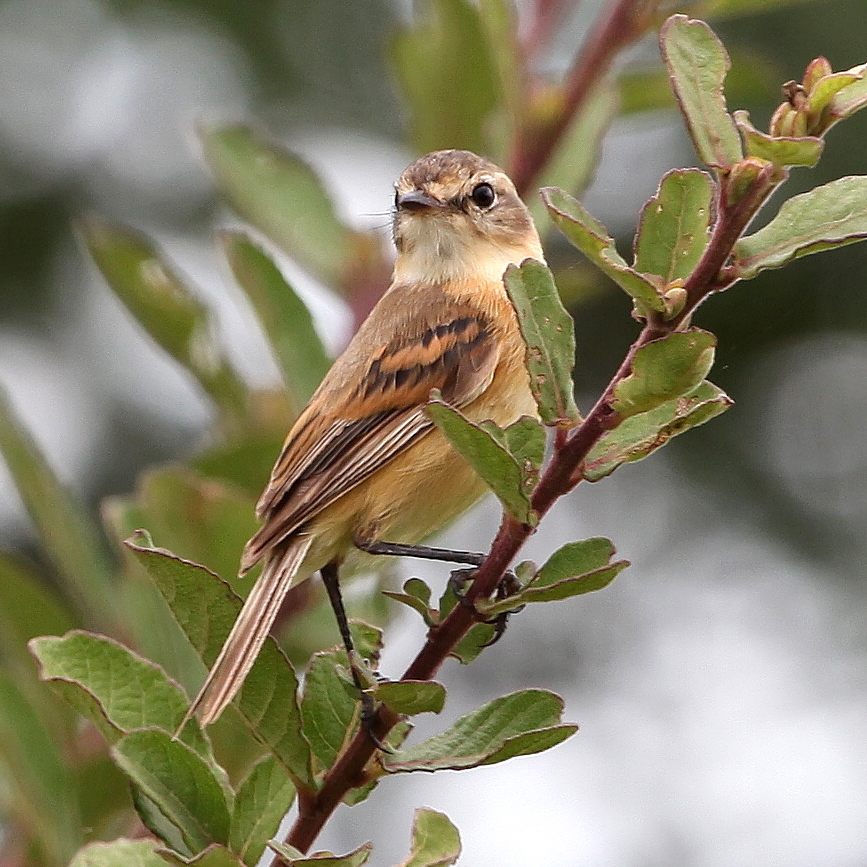
In the field, the Bearded Tachuri is best identified by its small size, measuring around 10-11 cm in length. Its plumage is predominantly olive-brown, which provides excellent camouflage in its grassy habitats. The most striking feature is the black throat patch, or 'beard,' which is more pronounced in males. Females tend to have a less defined patch, making sex differentiation somewhat challenging without close observation. Juveniles resemble adults but with less distinct markings and a softer, more muted coloration. When in flight, the Bearded Tachuri displays a short, rapid wingbeat pattern typical of many small flycatchers. Its tail is relatively short and often flicked, adding to its identification characteristics. Perching posture is upright, often on low vegetation or fences, where it remains alert and poised to catch passing insects. While similar in size and behavior to other grassland flycatchers, the Bearded Tachuri's distinctive throat patch helps distinguish it from species like the Lesser Elaenia and the Fork-tailed Flycatcher, which share its range but differ in plumage and tail morphology.
Having trouble telling birds apart? Upload a photo to our bird identification tool for an instant species match.
Bearded Tachuri Habitat and Range
Preferred Habitat
The Bearded Tachuri primarily inhabits open grasslands, particularly those with a mix of tall and short vegetation. These areas include the Pampas of Argentina, the Cerrado of Brazil, and similar habitats in Paraguay and Uruguay. It prefers elevations ranging from sea level to about 1,500 meters, avoiding dense forests and high mountains. During the breeding season, it may be found in slightly more shrubby areas within these grasslands, as they provide cover and nesting sites. Unlike some other passerines, the Bearded Tachuri does not typically venture into urban areas, preferring the rural expanses where it can find ample food and nesting opportunities. Seasonal habitat shifts are minimal, as this species tends to be resident within its range, although it may make small local movements in response to changes in food availability or habitat conditions.
Geographic Range
The Bearded Tachuri is distributed across the grasslands of South America, with its range primarily encompassing Brazil, Argentina, Paraguay, and Uruguay. In Brazil, it is particularly associated with the Cerrado biome. In Argentina, it is found in the Pampas, while in Paraguay and Uruguay, it frequents similar grassland environments. This species does not undertake long-distance migrations, though it may exhibit local movements in response to seasonal changes in its habitat. Population density tends to be higher in areas where grassland habitats remain relatively undisturbed. Hotspots of population density include regions where conservation efforts have successfully maintained native grasslands, such as certain protected areas in Brazil and Argentina. Outside these areas, the Bearded Tachuri is increasingly threatened by habitat loss.
Want to know which birds visit your area? Browse our backyard birds by location guides for region-specific species lists.
What Does the Bearded Tachuri Eat?
The Bearded Tachuri primarily feeds on insects, which it captures using a sallying technique typical of flycatchers. It often hunts from low perches, making quick, darting flights to snatch prey mid-air or from vegetation. Insects in its diet include beetles, grasshoppers, and various larvae. During the breeding season, the Bearded Tachuri increases its food intake to meet the higher energy demands of raising young. Seasonal variations in diet are minimal, although the availability of specific insect types can change with the seasons, causing the bird to adjust its foraging behavior accordingly. Prey size is typically small, reflecting the bird's diminutive stature. Foraging usually occurs during daylight hours, with peak activity in the early morning and late afternoon when insects are most active.
Bearded Tachuri Behavior and Social Structure
The Bearded Tachuri exhibits primarily solitary behavior, except during the breeding season when it forms monogamous pairs. These pairs establish and defend territories, often aggressively chasing away intruders. Courtship involves vocalizations and displays, with males showing off their distinctive throat patches to attract females. Displays can include short flights and perch-hopping. The Bearded Tachuri's typical daily activity pattern involves active foraging in the morning, followed by periods of rest and preening during the hottest parts of the day. It resumes foraging in the cooler late afternoon. This species is generally non-migratory, though it may make small local movements in search of food or suitable nesting sites. When threatened by predators, the Bearded Tachuri relies on its excellent camouflage and quick, erratic flight to escape. Its response to predators also includes alarm calls and, if necessary, evasive flight.
Bearded Tachuri Nesting and Reproduction
The Bearded Tachuri constructs open cup nests, typically placed low in dense grass or shrubs, providing some protection from predators and the elements. The nest is composed of fine grasses and other plant materials woven together. Clutch size usually consists of two to three eggs. The female primarily incubates the eggs, which take about 14-16 days to hatch. Both parents participate in feeding the chicks, providing a diet rich in insects. Fledging occurs approximately two weeks after hatching, depending on food availability and weather conditions. The Bearded Tachuri typically raises one brood per year, although in favorable conditions, a second brood may be attempted. Parental duties extend several weeks beyond fledging, with both adults involved in teaching the young birds essential survival skills.
Bearded Tachuri Sounds and Vocalizations
The primary song of the Bearded Tachuri consists of a series of high-pitched, short notes delivered in rapid succession. The rhythm can be described as a quick, repetitive 'chip-chip-chip' sound, which is used both for mate attraction and territorial defense. Call notes are generally softer and less structured than the song, often used in communication between mates or as contact calls. Alarm calls are harsher and more urgent, employed when the bird perceives a threat. During the dawn chorus, the Bearded Tachuri becomes more vocal, with males especially active in singing to establish dominance and territory. The song's quality is thin and metallic, distinct enough to aid in identification even without visual confirmation.
Interesting Facts About the Bearded Tachuri
- 1The Bearded Tachuri has one of the smallest ranges among South American flycatchers, making it a priority for conservation.
- 2Despite its small size, the Bearded Tachuri plays a vital role in controlling insect populations in grasslands.
- 3The Bearded Tachuri's distinctive black 'beard' is more than just ornamental; it plays a crucial role in mating displays.
- 4Unlike many birds, the Bearded Tachuri does not migrate but remains in its grassland habitat year-round.
- 5The Bearded Tachuri is often used as an indicator species for the health of grassland ecosystems.
- 6This bird's elusive nature and effective camouflage make it a challenging yet rewarding species to study in the wild.
- 7The Bearded Tachuri's song is a key tool for researchers monitoring population trends in grassland areas.
Bearded Tachuri Conservation Status
The Bearded Tachuri is currently listed as Near Threatened on the IUCN Red List, with populations decreasing due to habitat loss and fragmentation. The primary threat to this species is the conversion of grasslands into agricultural land, which significantly reduces suitable habitats. Conservation efforts focus on preserving remaining grasslands and restoring degraded areas. Protected areas in countries like Brazil and Argentina help maintain some populations, but more extensive measures are needed to halt the decline. Historically, the Bearded Tachuri had a wider range, but ongoing habitat destruction has led to its current status. Conservation organizations advocate for sustainable land-use practices to preserve the ecosystems on which this bird depends.


