
Black-capped Kingfisher
Halcyon pileata
Order: Coraciiformes / Family: Alcedinidae
Wikimedia Commons
About the Black-capped Kingfisher
The Black-capped Kingfisher (Halcyon pileata) stands out with its vibrant plumage and distinctive features, making it one of the most visually striking members of the Alcedinidae family. This species inhabits a wide range of environments from coastal regions to wooded areas and mangroves, where its presence often signifies a healthy ecosystem. Found predominantly in countries like India, China, and Thailand, the Black-capped Kingfisher is a resident and migratory bird, depending on the region and season. In parts of Southeast Asia, it remains year-round while in the northern parts of its range, such as China, it migrates southward during the winter months.
Its ecological role is significant as it acts as both predator and prey within its environment. By hunting small fish, insects, and amphibians, the Black-capped Kingfisher helps control these populations, maintaining balanced ecosystems. Its vivid appearance and resonant calls make it a favorite among birdwatchers and naturalists, contributing to ecotourism in its native regions. During the breeding season, this kingfisher exhibits fascinating behaviors such as territorial displays and complex courtship rituals, further emphasizing its importance as a study subject in avian ecology.
This species thrives in a variety of habitats, including coastal areas, riversides, and forested wetlands. It displays remarkable adaptability, which allows it to exploit different ecological niches across its range. In urban settings, it can sometimes be seen near parks and gardens, indicating its tolerance to human presence. Seasonal behaviors of the Black-capped Kingfisher vary, with increased activity during the breeding season when males establish territories and engage in vocal displays. These birds also demonstrate significant mobility, often relocating to favorable environments as conditions change, thus showcasing their resilience and adaptability to diverse habitats.
The Black-capped Kingfisher belongs to the family Alcedinidae, within the order Coraciiformes. These birds typically live average 8 years, with a maximum recorded of 13 years..
How to Identify a Black-capped Kingfisher
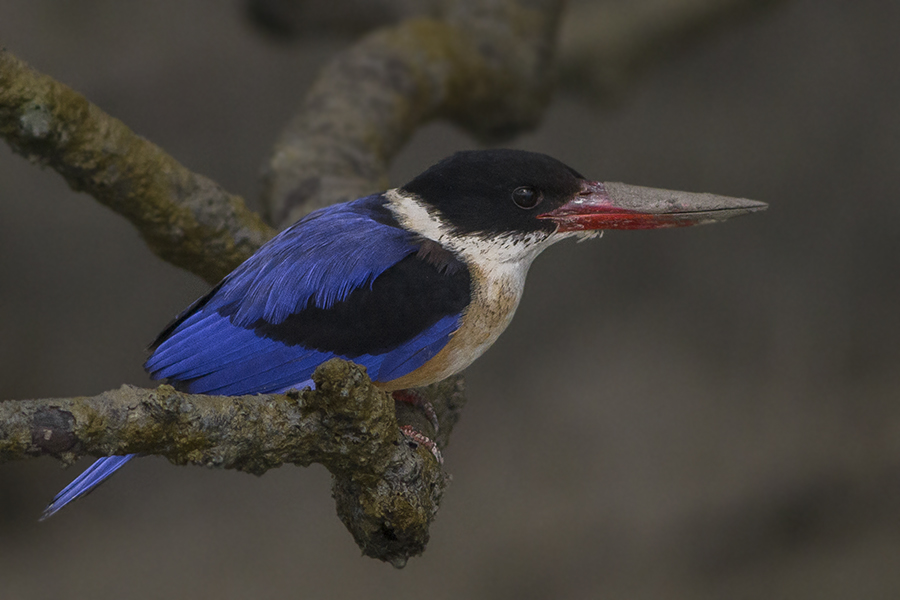
The Black-capped Kingfisher is unmistakable with its contrasting colors and bold features. Adult birds boast a striking black crown and nape, which sharply contrasts with their white throat and collar. Their wings and back are a bright shade of blue, while the underparts are a rich chestnut. The large, pointed bill is a vivid red-orange, standing out against the dark head. Juvenile birds display a duller plumage with less vibrant blues and more subdued chestnut tones.
There is minimal sexual dimorphism in this species, with males and females appearing similar, although males may have slightly longer bills. One might confuse the Black-capped Kingfisher with the White-throated Kingfisher, but the latter lacks the distinctive black cap and has a more widespread blue on the back and wings. In flight, the Black-capped Kingfisher shows a robust silhouette with broad wings and a relatively short tail, often flying with rapid wingbeats followed by brief glides.
When perched, the bird maintains an upright posture, often on a prominent branch or wire, scanning for prey. This behavior, combined with its vivid plumage, makes it relatively easy to spot in its preferred habitats. Its calls, which are loud and distinctive, often reveal its presence before it's seen.
Having trouble telling birds apart? Upload a photo to our bird identification tool for an instant species match.
Black-capped Kingfisher Habitat and Range
Preferred Habitat
The Black-capped Kingfisher occupies a diverse range of habitats, thriving in both natural and human-altered environments. It favors coastal areas, estuaries, and mangroves, where it can be seen perched along waterways. In inland regions, it inhabits forested areas along rivers and lakes, as well as open woodlands and agricultural lands.
This species typically resides at elevations from sea level up to 1,800 meters, although it is more commonly found in lowland areas. Seasonal shifts in habitat preference can occur, especially in regions with marked wet and dry seasons. During wetter periods, it may move to higher elevations or more sheltered areas to avoid flooding.
In urban settings, the Black-capped Kingfisher has adapted to environments such as parks and gardens, demonstrating its versatility. However, it tends to avoid heavily urbanized areas, preferring locations with some natural or semi-natural landscapes.
Geographic Range
The Black-capped Kingfisher has a broad range that spans across South and Southeast Asia, extending into China and the Philippines. During the breeding season, it is found in regions such as northeastern India, Bangladesh, and eastern China. As a partial migrant, populations from northern ranges migrate southward to winter in areas like southern India, Sri Lanka, and the Malay Peninsula.
In countries like Thailand and Vietnam, the Black-capped Kingfisher is a resident species, present throughout the year. Migration corridors are not as well defined as those of some other species, but birds typically follow coastlines and river systems during their seasonal movements. Population density is highest in mangrove-rich coastal areas and along large river systems, where food resources are abundant and nesting sites are plentiful.
The Black-capped Kingfisher is not uniformly distributed across its range, with certain regions hosting higher densities due to favorable habitat conditions. Conservation efforts in these areas often focus on preserving critical habitats such as mangroves and riverine forests.
Want to know which birds visit your area? Browse our backyard birds by location guides for region-specific species lists.
What Does the Black-capped Kingfisher Eat?
Primarily, the Black-capped Kingfisher feeds on a diverse diet of small fish, crustaceans, and insects. It captures prey with remarkable precision, often diving from a perch into water to snatch fish or crustaceans. This bird also hunts on land, preying on insects and small reptiles, such as lizards and frogs, which it catches with its strong bill.
Seasonal changes in diet occur, with a shift towards more terrestrial prey during wetter months when insects and amphibians are more abundant. The bird's foraging technique involves sitting quietly on a perch, scanning the surrounding area for movement before executing a swift, direct attack.
Prey size is usually small to medium, corresponding to the bird's own size and bill strength. Feeding primarily occurs during early morning and late afternoon, although it will hunt opportunistically throughout the day. This flexible diet allows the Black-capped Kingfisher to thrive in various habitats, from coastal waters to inland forests.
Black-capped Kingfisher Behavior and Social Structure
The Black-capped Kingfisher exhibits a solitary and territorial nature, particularly during the breeding season, when males establish and defend territories with vocal displays and aggressive encounters. Courtship involves dramatic aerial displays, with males showcasing their flight skills to attract females.
Social behavior outside the breeding season can be more relaxed, with individuals occasionally seen in loose groups, particularly around abundant food sources. This species responds to predators with loud, raucous calls, often mobbing smaller threats in groups to drive them away.
The bird's daily activity pattern involves feeding primarily during dawn and dusk, with periods of rest and preening in between. During the breeding season, both parents participate in territorial defense and feeding the young, showcasing strong parental investment.
Black-capped Kingfisher Nesting and Reproduction
The Black-capped Kingfisher prefers to nest in earthen banks or within tree cavities, which offer both protection and a strategic vantage point for feeding. The nest chamber is typically excavated by both sexes, with the entrance often located several meters above ground or water level to deter predators.
A typical clutch consists of 4-7 eggs, which are incubated primarily by the female for about 18-21 days. During this period, the male assists by providing food. Once hatched, the chicks remain in the nest for approximately 24-26 days before fledging.
Parents continue to care for the fledglings for several weeks post-fledging, teaching them essential skills for survival. The Black-capped Kingfisher generally raises one to two broods per year, depending on food availability and environmental conditions.
Black-capped Kingfisher Sounds and Vocalizations
The Black-capped Kingfisher's call is a series of loud, metallic notes that carry over long distances. Its primary song consists of a rapid series of 'kek-kek-kek' sounds, often delivered while perched conspicuously. These calls serve as territorial warnings and communication between mates.
Alarm calls are sharper and higher-pitched, triggered by the presence of potential threats. The bird participates in dawn chorus behavior, joining other avian species in a symphony of sound that marks the start of the day.
Its calls are reminiscent of other kingfisher species but are distinguished by their volume and clarity, often echoing across its preferred habitats.
Interesting Facts About the Black-capped Kingfisher
- 1The Black-capped Kingfisher can fly at speeds up to 40 km/h, allowing it to swiftly capture prey.
- 2This bird's loud call can be heard from over a kilometer away, an adaptation for dense habitats.
- 3Despite its name, the Black-capped Kingfisher's diet is not limited to fish and includes a variety of prey.
- 4It can remain motionless for long periods while hunting, making it a patient and effective predator.
- 5The Black-capped Kingfisher is known to reuse old nests, saving energy for other activities.
- 6This species is an indicator of healthy ecosystems, as it requires clean water and abundant prey.
- 7Its presence in urban areas is relatively recent, highlighting its adaptability to changing landscapes.
Black-capped Kingfisher Conservation Status
The Black-capped Kingfisher is currently listed as Least Concern by the IUCN, with a stable population trend. However, habitat loss due to deforestation, wetland drainage, and coastal development poses ongoing threats. Conservation efforts focus on habitat protection, particularly in key breeding and wintering areas. Historical population changes have not been significant, but localized declines have occurred in heavily industrialized regions. Continued monitoring and habitat preservation are essential to ensure this species remains a vibrant part of its ecosystem.
Other Alcedinidae Species


Birds Similar to the Black-capped Kingfisher
These species are often confused with the Black-capped Kingfisher due to similar appearance or overlapping range.

