
Black Dwarf Hornbill
Horizocerus hartlaubi
Order: Bucerotiformes / Family: Bucerotidae
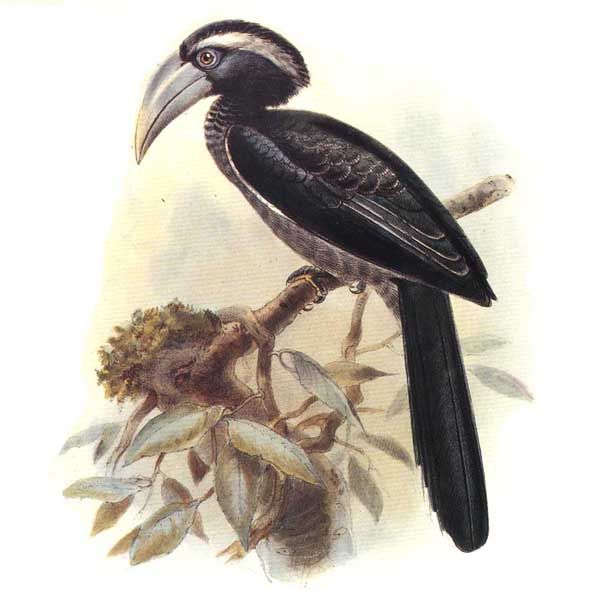
Wikimedia Commons
About the Black Dwarf Hornbill
The Black Dwarf Hornbill (Horizocerus hartlaubi) is a small, distinctive hornbill species endemic to the dense tropical forests of West Africa. Despite its small stature, the Black Dwarf Hornbill plays a significant ecological role as both a seed disperser and predator of insects. This bird thrives in the humid, lowland rainforests of countries such as Ghana, Liberia, and Sierra Leone, where it is an integral part of the forest ecosystem. Its presence contributes to the health and diversity of its habitat by facilitating seed dispersion and controlling insect populations. Seasonal behaviors of the Black Dwarf Hornbill include an increase in vocal activity during the breeding season, which typically aligns with the rainy months when food availability peaks. This increased vocalization helps maintain territories and attract mates. The species is also known for its adaptability to secondary growth forests, making it more resilient to habitat changes compared to other hornbills. Its ecological significance extends beyond seed dispersal as it also participates in the complex food web by preying on various insects. This role as both predator and prey highlights its importance in maintaining the balance of the forest ecosystem. The Black Dwarf Hornbill's ability to adapt to different forest conditions, including logged and secondary forests, makes it a fascinating subject of study for ornithologists and conservationists alike. By understanding its behaviors and ecological contributions, efforts can be made to ensure the preservation of its natural habitat, which is crucial for the survival of this and many other interdependent species in the region.
The Black Dwarf Hornbill belongs to the family Bucerotidae, within the order Bucerotiformes. These birds typically live average 10 years, with a maximum recorded up to 15 years..
How to Identify a Black Dwarf Hornbill
The Black Dwarf Hornbill is easily recognized by its entirely black plumage, a feature that distinguishes it from many other hornbill species. Adults have a sleek appearance with a compact body, measuring approximately 30-32 cm in length, which is small for hornbills. The bird's beak, while robust, is smaller and less pronounced than those of larger hornbills. Juveniles resemble adults but may have slightly duller feathers and a less defined beak structure. Both males and females appear similar in plumage, making gender identification challenging without close observation. However, males are slightly larger on average and may exhibit subtle differences in beak shape. The Black Dwarf Hornbill can be confused with the similar-looking White-crested Hornbill, but the latter is identifiable by its white crest and larger size. In flight, the Black Dwarf Hornbill displays a compact silhouette with rapid wingbeats, unlike the more languid flight of larger hornbills. When perched, it often adopts an upright posture on branches, using its tail for balance while scanning its surroundings for food.
Having trouble telling birds apart? Upload a photo to our bird identification tool for an instant species match.
Black Dwarf Hornbill Habitat and Range
Preferred Habitat
The Black Dwarf Hornbill predominantly inhabits lowland tropical rainforests, favoring dense, humid environments that provide ample cover and food resources. Within these forests, it can often be found in the understory or mid-canopy, where it forages for insects and small fruits. The species shows a preference for primary forests but is also adaptable to secondary growth and selectively logged areas, which expands its potential habitat range. Typically found at elevations up to 1000 meters, the Black Dwarf Hornbill does not generally occur in higher mountainous regions. Seasonal shifts in habitat are minimal, as it remains resident within its forested range year-round. While it is generally absent from urban areas, its presence in forest fragments near human settlements suggests some adaptability to human-altered landscapes.
Geographic Range
The geographical range of the Black Dwarf Hornbill spans across several West African countries, including Guinea, Sierra Leone, Liberia, Ivory Coast, Ghana, and Nigeria. It is primarily a resident bird, showing little evidence of long-distance migration, although some local movements may occur in response to food availability. The bird's population density is highest in large, contiguous forest blocks where human disturbance is minimal. While some populations exist in protected areas such as national parks, others inhabit unprotected forests, where they are more vulnerable to threats. The Black Dwarf Hornbill's range does not extend into the drier savannah regions or across major geographical barriers like significant rivers or mountain ranges.
Want to know which birds visit your area? Browse our backyard birds by location guides for region-specific species lists.
What Does the Black Dwarf Hornbill Eat?
The Black Dwarf Hornbill's diet primarily consists of insects and small fruits, reflecting its dual role as both a predator and seed disperser. Insects such as beetles, termites, and caterpillars form the bulk of its protein intake. The bird employs a foraging technique that involves hopping through branches and foliage to pick insects off leaves and bark. During the fruiting season, the hornbill supplements its diet with small fruits, including figs and berries, which provide essential vitamins. This seasonal diet shift not only ensures nutritional balance but also aids in seed dispersal, as the bird often drops seeds at various locations. The Black Dwarf Hornbill typically forages during the cooler hours of the early morning and late afternoon, avoiding the midday heat. Its small beak size limits it to prey that is easily manageable, further emphasizing its role in controlling smaller insect populations.
Black Dwarf Hornbill Behavior and Social Structure
Socially, the Black Dwarf Hornbill often forms small family groups, although it is not uncommon to see them foraging alone. Its territorial behavior is evident during the breeding season, when pairs actively defend their nesting sites through vocalizations and displays. Courtship involves mutual preening and food sharing, strengthening pair bonds. Outside of the breeding season, the hornbill is less aggressive, and its territorial boundaries are more relaxed. The bird's response to predators includes alarm calls and rapid flight to dense foliage, where it can hide effectively. Daily activity patterns show peaks in the morning and late afternoon, with rest periods during the hotter midday hours. Flocking behavior is more common during non-breeding periods, when individuals may join mixed-species flocks to forage, benefiting from the increased vigilance against predators.
Black Dwarf Hornbill Nesting and Reproduction
Nesting for the Black Dwarf Hornbill involves selecting tree cavities, often in large, mature trees, where it can securely rear its young. These cavities are lined with materials such as leaves and small twigs to provide a comfortable environment for the eggs. A typical clutch consists of two to three eggs, which both parents incubate for approximately 25-28 days. The fledging period lasts about 40-50 days, during which both parents are actively involved in feeding and protecting the young. Parental roles are shared, with both adults taking turns foraging and guarding the nest. The Black Dwarf Hornbill usually raises one brood per year, although in areas with abundant resources, a second brood is possible. The nesting cycle highlights the bird's dependence on mature forests, emphasizing the importance of preserving these habitats.
Black Dwarf Hornbill Sounds and Vocalizations
The vocalizations of the Black Dwarf Hornbill are varied, with its primary song being a series of soft, low-pitched notes, often described as a rolling 'krr-krr-krr'. These calls are most commonly heard during the early morning hours as part of the dawn chorus, serving to establish territory and communicate with mates. In addition to its song, the hornbill emits sharp alarm calls in response to threats, which alert other birds in the vicinity. Its vocalizations, while not as loud as those of larger hornbills, are distinctive enough to be a useful identification tool for birders. Compared to other species, the Black Dwarf Hornbill's calls are relatively subdued, reflecting its discreet nature and preference for staying hidden in the dense foliage.
Interesting Facts About the Black Dwarf Hornbill
- 1The Black Dwarf Hornbill is one of the smallest hornbills, measuring just 30-32 cm in length.
- 2Unlike many larger hornbills, the Black Dwarf Hornbill does not have a prominent casque on its bill.
- 3This species plays a crucial role in seed dispersal, aiding in forest regeneration.
- 4Black Dwarf Hornbills are known for their adaptability to secondary forests, unlike some other hornbills.
- 5Their diet shifts seasonally, with an increased consumption of fruits during the rainy season.
- 6The Black Dwarf Hornbill often forages in small family groups, enhancing its efficiency and safety.
- 7Despite their small size, Black Dwarf Hornbills have a loud, distinctive call that carries well through dense forests.
Black Dwarf Hornbill Conservation Status
Currently, the IUCN classifies the Black Dwarf Hornbill as Least Concern due to its relatively stable population across its range. However, ongoing habitat loss from logging and agricultural expansion poses a significant threat to its future. Conservation efforts focus on protecting forest habitats and enforcing regulations in protected areas. Historical population trends show a decline in regions with intense deforestation, but populations in well-managed reserves remain stable. Conservation organizations emphasize the importance of sustainable land-use practices to ensure the long-term survival of the Black Dwarf Hornbill and other forest-dependent species.


