
Black-faced Tanager
Schistochlamys melanopis
Order: Passeriformes / Family: Thraupidae
Wikimedia Commons
About the Black-faced Tanager
The Black-faced Tanager (Schistochlamys melanopis) is a striking songbird belonging to the Thraupidae family. Found predominantly in the tropical regions of South America, it inhabits countries such as Brazil, Bolivia, and Paraguay. This species favors open habitats like savannas, scrublands, and edges of forests where it can exploit its adaptive foraging strategies. The Black-faced Tanager plays a significant role in its ecosystem by participating in seed dispersal, which contributes to plant diversity and forest regeneration. Its presence is vital in maintaining the ecological balance within its habitat. Unlike many other tanagers, this species is not restricted to dense forests, allowing it to occupy a broader range of habitats. The bird is also observed in transitional zones where woodland meets grassland, exemplifying its adaptability. During the breeding season, typically spanning from September to February, the Black-faced Tanager becomes more conspicuous as it engages in courtship displays and territorial defense. In non-breeding months, it might be seen in small mixed-species flocks, utilizing its social nature to increase foraging efficiency and predator detection. The Black-faced Tanager is not just an ecological asset; it also holds cultural significance for local communities that recognize it for its vibrant appearance and melodious songs. As climate change and habitat destruction threaten many avian species globally, understanding the behaviors and roles of birds like the Black-faced Tanager becomes crucial for conservation efforts.
The Black-faced Tanager belongs to the family Thraupidae, within the order Passeriformes. These birds typically live average 5-7 years, with a maximum recorded of 9 years..
How to Identify a Black-faced Tanager
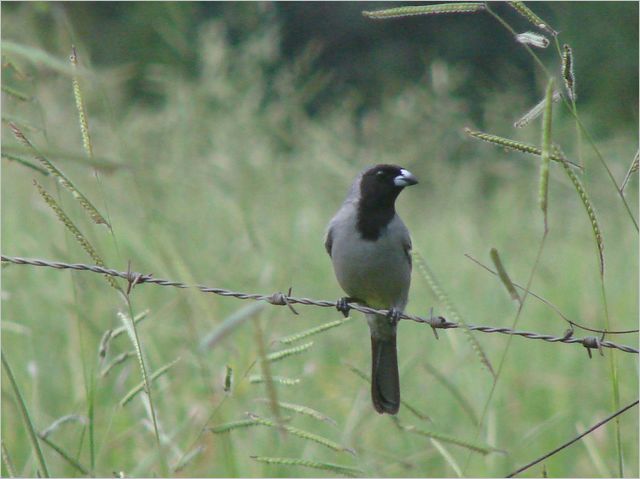
Adult Black-faced Tanagers are medium-sized birds, measuring about 18 centimeters in length. They exhibit a distinctive black mask that covers the face and throat, contrasting sharply with their pale gray upperparts and lighter underparts. This unique facial marking is a reliable field mark. Juveniles, on the other hand, lack the pronounced black mask, displaying a more subdued gray plumage and dusky facial markings, which can make identification challenging. Males and females share similar plumage, though males tend to have slightly more pronounced black markings. In flight, the Black-faced Tanager shows a compact silhouette with a relatively short tail and broad wings. Perched, it maintains an upright posture, often flicking its tail gently. It can be confused with other tanagers like the Black-backed Tanager, but the latter possesses darker upperparts and lacks the distinct facial mask. Observing the bird's habitat and behavior can aid in proper identification.
Having trouble telling birds apart? Upload a photo to our bird identification tool for an instant species match.
Black-faced Tanager Habitat and Range
Preferred Habitat
The Black-faced Tanager thrives in tropical savannas and scrublands, often found in regions where open landscapes meet wooded areas. It prefers elevations from sea level up to 1,200 meters, although it is more commonly seen at lower elevations. This species is adaptable, often residing in areas with scattered trees and shrubs, which provide ample foraging opportunities and nesting sites. While it is less common in dense forests, it can occasionally be found along forest edges and clearings. During the dry season, the bird may shift slightly to areas with more consistent food and water availability. Although it is not typically found in urban settings, it can sometimes be spotted in rural gardens and plantations, especially those adjacent to its preferred natural habitats.
Geographic Range
The Black-faced Tanager's range spans several South American countries, including Brazil, Bolivia, and Paraguay. It is a year-round resident, with no significant migratory movements noted for this species. Within its range, population densities vary, with higher concentrations in regions like the Brazilian Cerrado and parts of the Gran Chaco. Its presence in northern Argentina is more sporadic, reflecting the bird's preference for specific habitats. Although its range does not extend into the Amazon rainforest, it occupies a broad swath of tropical and subtropical regions outside of these densely forested areas. The Black-faced Tanager's ability to thrive in a variety of open habitats contributes to its relatively stable population across its range.
Want to know which birds visit your area? Browse our backyard birds by location guides for region-specific species lists.
What Does the Black-faced Tanager Eat?
The Black-faced Tanager has a varied diet primarily consisting of fruits and insects. It forages actively among foliage, often seen gleaning insects from leaves and branches. During the breeding season, its diet leans more towards protein-rich insects to support the increased energy demands of raising young. In contrast, during the non-breeding season, fruits become a more significant part of its diet. The bird's foraging technique involves moving methodically through vegetation, using its beak to pluck small fruits and catch insects mid-air. It tends to feed during cooler parts of the day, such as early morning and late afternoon, to avoid the intense midday heat common in its habitat. Prey sizes vary but usually include small insects and spiders.
Black-faced Tanager Behavior and Social Structure
Black-faced Tanagers exhibit a social structure that includes both solitary and group behaviors. Outside the breeding season, they often join mixed-species flocks, which enhances foraging success and predator vigilance. They exhibit territorial behavior during the breeding season, with males engaging in vocal displays to ward off rivals and attract mates. Their courtship displays involve fluttering flights and singing from exposed perches. In terms of flocking patterns, they are generally more solitary or found in pairs during breeding, becoming more communal in non-breeding periods. When confronted by predators, these tanagers rely on their agility and flight rather than aggressive defense, often retreating to dense foliage. Daily activity patterns involve periods of intense foraging alternating with rest during the hottest parts of the day.
Black-faced Tanager Nesting and Reproduction
The Black-faced Tanager builds cup-shaped nests, often located in the fork of a tree branch or shrub. The nest construction involves using fine twigs, grasses, and other plant materials, lined with softer fibers for comfort. Preferred nesting sites are typically 1 to 5 meters above the ground, providing security from ground predators. The female lays a clutch of two to three eggs, which she incubates for approximately 12 to 14 days. Both parents participate in feeding the chicks, which fledge after about 15 to 17 days post-hatching. The species usually raises one brood per year, although favorable conditions may occasionally permit a second brood. Parental roles are shared, with both the male and female involved in nurturing and protecting the young.
Black-faced Tanager Sounds and Vocalizations
The primary song of the Black-faced Tanager is a series of melodious whistles, delivered in a rhythmic pattern that varies slightly between individuals. These whistles are clear and sweet, with a moderate pitch that carries well across open landscapes. In addition to their song, they produce call notes that are sharp and metallic, often used during flight or when foraging in flocks. Alarm calls are more abrupt and intense, serving to alert other birds of potential danger. The Black-faced Tanager participates in the dawn chorus, adding its distinct voice to the morning symphony of the avian community.
Interesting Facts About the Black-faced Tanager
- 1The Black-faced Tanager is one of the few tanagers that thrive in open habitats, unlike its forest-dependent cousins.
- 2This species is known for its adaptability, often seen in mixed-species foraging flocks in the non-breeding season.
- 3Despite its name, not all individuals have a fully developed black face, especially juveniles and some females.
- 4The Black-faced Tanager's song is often mistaken for those of other tanager species due to its melodious quality.
- 5Its diet shifts seasonally, consuming more insects during breeding season to support its energetic demands.
- 6The Black-faced Tanager can be found at elevations up to 1,200 meters, though it prefers lower altitudes.
- 7This bird plays a vital role in seed dispersal, helping to maintain the health of its savanna and scrubland habitats.
Black-faced Tanager Conservation Status
The Black-faced Tanager is currently listed as a species of Least Concern on the IUCN Red List. Its population trend appears stable, largely due to its adaptability to a range of open habitats. However, primary threats include habitat loss from agricultural expansion and deforestation. Conservation efforts focus on preserving the savanna and scrubland habitats that are crucial for its survival. Historically, the Black-faced Tanager's population has been relatively stable, but ongoing monitoring is important to ensure it remains unaffected by increasing anthropogenic pressures.


