
Black-fronted Nunbird
Monasa nigrifrons
Order: Piciformes / Family: Bucconidae
Wikimedia Commons
About the Black-fronted Nunbird
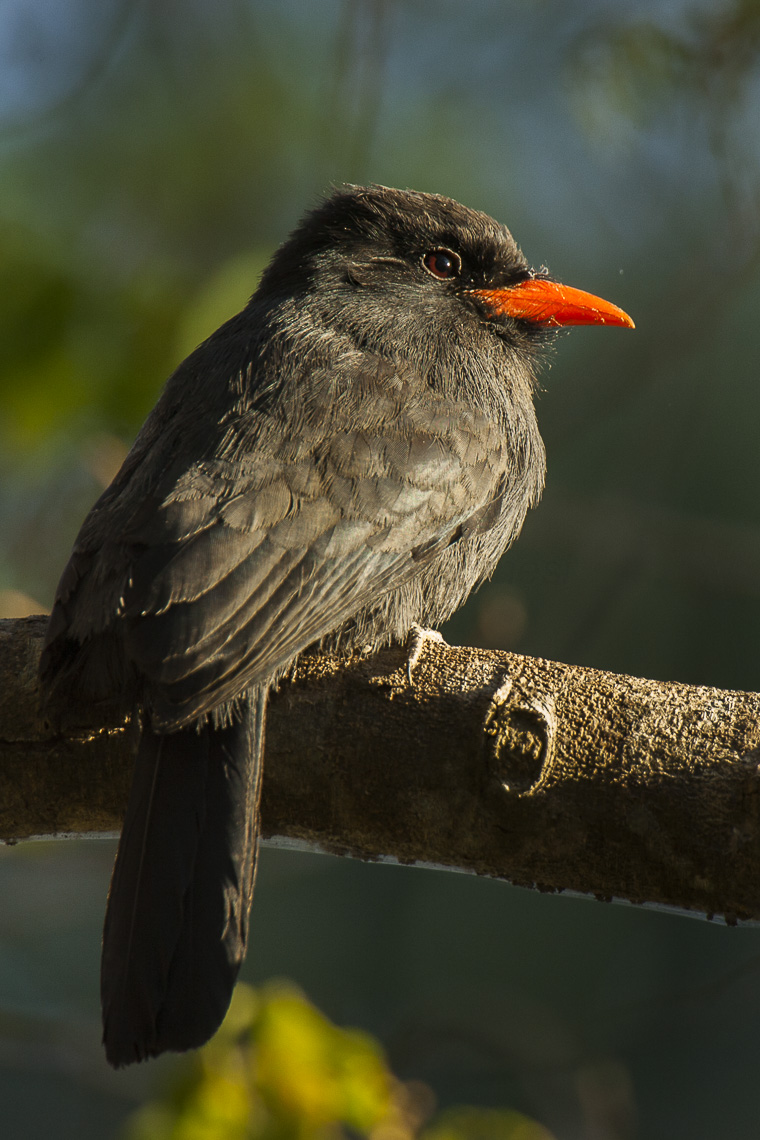
The Black-fronted Nunbird (Monasa nigrifrons) is a striking bird native to the tropical lowland forests of South America. It belongs to the Bucconidae family and resides primarily within the Amazon Basin, including countries like Brazil, Peru, and Ecuador. Characterized by its predominantly black plumage and bright red bill, this bird stands out in its habitat. The Black-fronted Nunbird plays a significant ecological role in these forests, acting as both predator and prey within its ecosystem. It primarily inhabits humid lowland forests, often found near rivers and streams where dense understory vegetation provides ample foraging opportunities. This bird is non-migratory and maintains a consistent presence in its range throughout the year. During the breeding season, however, it may exhibit more pronounced territorial behaviors. The Black-fronted Nunbird is known for its social nature, often seen in pairs or small family groups. Its presence contributes to the dynamic and complex web of forest life, supporting biodiversity by controlling insect populations and participating in nutrient cycling. Seasonal behaviors include subtle shifts in diet and foraging strategies to align with the availability of prey species. The bird's loud, distinctive calls resonate through the forest, serving as a means of communication and territorial marking. As a sentinel of the Amazonian ecosystem, the Black-fronted Nunbird offers invaluable insights into the health and stability of these crucial habitats.
The Black-fronted Nunbird belongs to the family Bucconidae, within the order Piciformes. These birds typically live average 6-8 years, with a maximum recorded of 12 years..
How to Identify a Black-fronted Nunbird
The Black-fronted Nunbird is easily identified by its black plumage, which contrasts sharply with its bright red bill. Adult birds exhibit a uniformly black face and body, with a subtle blue-gray gloss that can be observed in good lighting. Juveniles resemble adults but may have slightly duller plumage. There are no significant differences between males and females in terms of coloration, which is typical for the species. However, slight size variations may occur, with females generally being marginally smaller. When in flight, the Black-fronted Nunbird displays a rounded tail and broad wings, which contribute to its unique silhouette. Its perching posture is upright and alert, often seen on low branches or exposed perches within its forest habitat. Similar species such as the White-fronted Nunbird (Monasa morphoeus) can cause confusion, but the Black-fronted Nunbird's distinctive black facial coloration and red bill serve as reliable distinguishing features.
Having trouble telling birds apart? Upload a photo to our bird identification tool for an instant species match.
Black-fronted Nunbird Habitat and Range
Preferred Habitat
The Black-fronted Nunbird thrives in tropical lowland forests, particularly those within the Amazon Basin. It shows a preference for humid environments, often residing in areas with dense understory vegetation. Typical habitats include riverbanks, forest edges, and secondary growth forests. Elevation-wise, the Black-fronted Nunbird is primarily found from sea level up to 1,000 meters. Unlike some forest birds, it shows little aversion to forest fragmentation and can occasionally occur in lightly disturbed areas. Despite this adaptability, it remains largely absent from urban environments, as it relies heavily on forested landscapes for sustenance and shelter.
Geographic Range
The Black-fronted Nunbird's range is centered in the core of the Amazon Basin, spanning countries such as Brazil, Bolivia, Peru, Ecuador, Colombia, and Venezuela. It occupies both the Amazonian lowlands and the peripheral areas of the Guiana Shield. This species is a year-round resident and does not undertake significant migratory movements, although some local dispersal can occur depending on food availability. Population density tends to be higher in regions with intact forest cover, such as the western Amazon in Peru and parts of central Brazil. The absence of significant migratory behavior makes it a consistent presence within its range, contributing to the stability of its populations.
Want to know which birds visit your area? Browse our backyard birds by location guides for region-specific species lists.
What Does the Black-fronted Nunbird Eat?
The Black-fronted Nunbird is primarily insectivorous, feeding on a wide variety of arthropods such as beetles, grasshoppers, and spiders. During the wet season, when insects are abundant, it capitalizes on this resource by foraging actively. It employs a sit-and-wait hunting strategy, perching on low branches and swooping down to capture prey on the ground or foliage. The bird's keen eyesight and quick reflexes aid in its hunting efficiency. Occasionally, it supplements its diet with small vertebrates, such as lizards and frogs, and consumes fruits to a lesser extent. Seasonal shifts in diet are minimal, although there may be an increased reliance on fruit during periods of lower insect availability.
Black-fronted Nunbird Behavior and Social Structure
Socially, the Black-fronted Nunbird exhibits a gregarious nature, often seen in pairs or small family groups. It is not overtly territorial, although it may defend feeding areas from competing species. Courtship displays are subtle and involve mutual preening and bill-touching between mates. The bird's response to predators includes loud alarm calls and evasive flight. It is diurnal, with peak activity occurring in the early morning and late afternoon. During these times, it engages in foraging, preening, and social interactions. The Black-fronted Nunbird's vocalizations play a crucial role in maintaining group cohesion and communicating with neighboring birds.
Black-fronted Nunbird Nesting and Reproduction
Black-fronted Nunbirds nest in natural cavities or burrows, preferring locations with some degree of protection from predators. They may use tree holes or excavate burrows in earthen banks. The species exhibits loose pair bonding, with both parents participating in nest construction and care of the young. Clutch size typically ranges from 2 to 3 eggs, with an incubation period of about 18 to 20 days. The female primarily incubates the eggs, while the male provides food. Once hatched, chicks remain in the nest for approximately 24 to 26 days before fledging. Both parents continue to feed the fledglings for several weeks post-fledging, ensuring their survival and successful integration into the group.
Black-fronted Nunbird Sounds and Vocalizations
The Black-fronted Nunbird's primary song consists of a series of loud, melodious whistles that carry well through the forest. These whistles have a clear, rising pitch and are often repeated in a rhythmic pattern. Call notes are sharp, staccato sounds used for communication between individuals. In response to threats, it emits a rapid series of harsh alarm calls. During the dawn chorus, its voice blends with those of other forest birds, contributing to the rich acoustic tapestry typical of tropical forests. The bird's vocalizations can be compared to the whistling sounds made by some songbirds, albeit with a more piercing quality.
Interesting Facts About the Black-fronted Nunbird
- 1The Black-fronted Nunbird's red bill stands out vividly against its dark plumage, making it easy to identify even in dense foliage.
- 2Unlike many birds, the Black-fronted Nunbird is non-migratory, maintaining a year-round presence in its tropical forest habitat.
- 3This species belongs to the Bucconidae family, which also includes puffbirds known for their stout bodies and large heads.
- 4Black-fronted Nunbirds are often seen in mixed-species flocks, benefiting from the increased vigilance against predators.
- 5The bird's whistling calls serve not only for communication but also in strengthening pair bonds between mates.
- 6It plays a critical role in controlling insect populations, thus helping to maintain the ecological balance in tropical forests.
- 7Black-fronted Nunbirds are adaptable to some degree of habitat disturbance, thriving in both primary and secondary forests.
Black-fronted Nunbird Conservation Status
The Black-fronted Nunbird is currently listed as Least Concern by the IUCN, with stable populations across its range. Despite deforestation and habitat degradation posing significant threats, this species demonstrates resilience by adapting to secondary growth forests. Conservation efforts focus on preserving large tracts of contiguous forest, crucial for maintaining biodiversity in the Amazon. Historical data suggest that while some local populations may have experienced declines, the overall trend remains stable. Continuous monitoring and habitat protection are essential to ensure long-term survival amidst ongoing environmental changes.
Other Bucconidae Species


Birds Similar to the Black-fronted Nunbird
These species are often confused with the Black-fronted Nunbird due to similar appearance or overlapping range.
