
Black-girdled Barbet
Capito dayi
Order: Piciformes / Family: Capitonidae
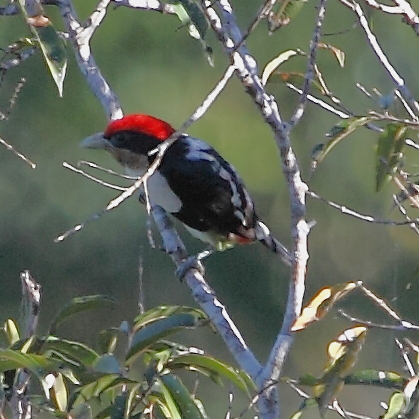
Wikimedia Commons
About the Black-girdled Barbet
The Black-girdled Barbet, Capito dayi, is a captivating bird that belongs to the family Capitonidae within the order Piciformes. This medium-sized bird inhabits the rich tropical forests of South America, particularly thriving in the Amazon Basin regions where dense forest canopies provide its ideal habitat. Its ecological role is significant, as it contributes to seed dispersal and helps maintain the balance of its ecosystem by controlling insect populations.
The Black-girdled Barbet is mostly found in Brazil, especially in the northern parts of the country such as Amazonas and Pará. This bird species prefers lowland rainforest environments where the abundance of fruiting trees supports its frugivorous diet. The presence of the Black-girdled Barbet in these forests signifies healthy biodiversity, as it relies on a variety of fruit-bearing trees and shrubs, which in turn depend on the bird for seed dispersal.
Throughout the year, the Black-girdled Barbet exhibits certain behavioral adaptations that align with seasonal changes. During the breeding season, which typically coincides with the wet season, these birds become more vocal and territorial. Their calls, which echo through the forest, play a crucial role in establishing territories and attracting mates. Outside the breeding season, they may form loose foraging groups, which helps in locating food sources efficiently. As a non-migratory species, the Black-girdled Barbet remains within its established range year-round, making it a reliable resident of its preferred habitats.
The Black-girdled Barbet belongs to the family Capitonidae, within the order Piciformes. These birds typically live average 5-8 years, with some individuals living up to 10 years..
How to Identify a Black-girdled Barbet
The Black-girdled Barbet is unmistakable due to its distinctive plumage. Adults display a vivid coloration with a predominantly red head and throat, contrasting sharply with a black band that encircles their chest and back, giving the bird its common name. The rest of the body is predominantly green, with white underparts that provide a striking contrast. Males and females are similar in appearance, although females may have slightly duller hues.
Juvenile Black-girdled Barbets are generally less vibrant than adults, exhibiting a more muted version of the adult plumage. Their black band is less pronounced, and their red head and throat are often tinged with brown. This difference aids in distinguishing younger birds in the field.
In flight, the Black-girdled Barbet shows a compact silhouette with rapid wingbeats. When perched, it adopts a typical barbet posture with an upright stance. Confusion with similar species, such as other barbets, is minimized due to its unique black girdle and distinctive coloration.
Having trouble telling birds apart? Upload a photo to our bird identification tool for an instant species match.
Black-girdled Barbet Habitat and Range
Preferred Habitat
The Black-girdled Barbet inhabits the lush lowland rainforests of South America, particularly favoring areas with dense canopy cover. It thrives in regions like the Amazon Basin, where primary forests provide ample food resources and nesting opportunities. These birds are typically found at elevations ranging from sea level to around 1500 meters, although they primarily occupy the lowlands.
Unlike some species that show seasonal habitat shifts, the Black-girdled Barbet remains in its tropical forest habitat year-round. The stability of this habitat is crucial for its survival, as it does not adapt well to urban or heavily disturbed environments. The bird's presence is a strong indicator of undisturbed, mature rainforest ecosystems.
Geographic Range
The Black-girdled Barbet's range is primarily restricted to the northern regions of South America. It is predominantly found in Brazil, within the expansive Amazon Basin. This includes areas in the states of Amazonas, Pará, and occasionally extending into neighboring regions. The species does not migrate, maintaining a stable presence in its tropical habitat.
Population density is highest in regions where the forest canopy remains intact and undisturbed by human activity. While its range is relatively limited compared to some other bird species, within its preferred environments, the Black-girdled Barbet is considered locally common.
Want to know which birds visit your area? Browse our backyard birds by location guides for region-specific species lists.
What Does the Black-girdled Barbet Eat?
Primarily frugivorous, the Black-girdled Barbet's diet consists mostly of fruits and berries, which it forages from the middle to upper canopy of the rainforest. This bird plays a critical role in seed dispersal, aiding in the regeneration of its forest habitat. It supplements its diet with insects, particularly during the breeding season, when protein demand increases.
The foraging technique of the Black-girdled Barbet involves acrobatically moving through dense foliage to reach fruiting branches. It often targets soft fruits, such as figs and berries, but it will also consume larger fruits if they are accessible. Its feeding schedule is flexible, allowing it to take advantage of fruit availability throughout the day.
Black-girdled Barbet Behavior and Social Structure
Socially, the Black-girdled Barbet is somewhat gregarious, often seen foraging in pairs or small groups outside of the breeding season. During the breeding season, however, these birds become more territorial, with males engaging in vocal displays to defend their territory and attract females. Courtship involves mutual preening and food exchanges, strengthening pair bonds.
The Black-girdled Barbet's response to predators involves a combination of vocal alarms and evasive flight. It is most active during the early morning and late afternoon, when it forages for food and engages in social interactions. Its daily activities center around feeding, preening, and maintaining social bonds within its group.
Black-girdled Barbet Nesting and Reproduction
The Black-girdled Barbet nests in cavities, which it often excavates in dead or decaying trees. This species prefers to nest at heights ranging from 5 to 15 meters above the ground, ensuring protection from ground predators. The nesting cavity is typically lined with wood chips, which the birds create during excavation.
Clutch size generally ranges from two to four eggs, with both parents participating in incubation, which lasts around 14 days. After hatching, the chicks remain in the nest for approximately three weeks, during which they are fed by both parents. The number of broods per year is usually limited to one, owing to the demanding nature of their nesting requirements and the need for suitable cavity sites.
Black-girdled Barbet Sounds and Vocalizations
The primary song of the Black-girdled Barbet is a series of resonant, rhythmic calls that carry through the forest canopy. These calls have a melodious quality, often described as a series of 'puk' notes repeated in quick succession. The call notes are less musical, serving more for communication within short distances.
Alarm calls are sharper and more urgent, used to signal the presence of predators. During the dawn chorus, the Black-girdled Barbet's song is prominent, playing a vital role in territorial defense and mate attraction.
Interesting Facts About the Black-girdled Barbet
- 1The Black-girdled Barbet is named for the distinctive black band that encircles its chest and back, a unique feature among barbets.
- 2This species is predominantly frugivorous, with over 70% of its diet consisting of various fruits and berries found in the rainforest.
- 3Both male and female Black-girdled Barbets participate equally in the incubation and feeding of their young, showcasing a strong parental bond.
- 4The species' preferred nesting sites are cavities in trees, often at heights of 5 to 15 meters, providing safety from ground predators.
- 5Despite its limited range in the Amazon Basin, the Black-girdled Barbet plays a crucial ecological role in seed dispersal and forest regeneration.
- 6The Black-girdled Barbet's song is a series of resonant, rhythmic calls that can be heard echoing through the forest canopy.
- 7This bird species is a reliable indicator of healthy, undisturbed rainforest ecosystems, as it thrives only in mature, intact forests.
Black-girdled Barbet Conservation Status
The Black-girdled Barbet is currently listed as Near Threatened on the IUCN Red List, with its population trend showing signs of decline. The primary threats to this species include habitat loss due to deforestation and land conversion for agriculture. Conservation efforts focus on protecting the remaining tracts of lowland rainforest, promoting sustainable land-use practices. Historical population changes are closely linked to deforestation rates, and efforts to curb habitat destruction are crucial for the species' survival. Conservationists emphasize the need for habitat preservation to ensure the long-term viability of the Black-girdled Barbet.
Other Capitonidae Species


Birds Similar to the Black-girdled Barbet
These species are often confused with the Black-girdled Barbet due to similar appearance or overlapping range.