
Black Goshawk
Accipiter melanoleucus
Order: Accipitriformes / Family: Accipitridae
Wikimedia Commons
About the Black Goshawk
The Black Goshawk, scientifically known as Accipiter melanoleucus, is a formidable bird of prey native to sub-Saharan Africa. This bird is notable for its striking appearance and adept hunting skills, making it a key predator in its ecosystem. Found primarily in dense forests, the Black Goshawk thrives in a variety of wooded habitats, ranging from coastal rainforests to montane forests. Its presence in regions such as the Congo Basin, southern Africa, and East Africa highlights its adaptability to different forest environments. As a top predator, the Black Goshawk plays a significant role in controlling the populations of its prey, which mainly includes birds and small mammals. Seasonal behaviors of the Black Goshawk are not as pronounced as in some other raptors, given its residency in relatively stable environments. However, it may adjust its hunting strategies according to prey availability, which can vary with seasonal changes. Throughout much of its range, this raptor is a sedentary species, though some local movements may occur in response to food scarcity or environmental changes. The ecological role of the Black Goshawk extends beyond predation. By maintaining a balance in the populations of its prey, it indirectly supports the health of the forest ecosystems it inhabits. Furthermore, as a top predator, it serves as an indicator species for habitat quality. A healthy population of Black Goshawks often signals a robust and biodiverse environment. With its impressive hunting prowess and ecological importance, the Black Goshawk is a remarkable component of Africa's avian community.
The Black Goshawk belongs to the family Accipitridae, within the order Accipitriformes. These birds typically live average 12 years with a maximum recorded of 18 years..
How to Identify a Black Goshawk
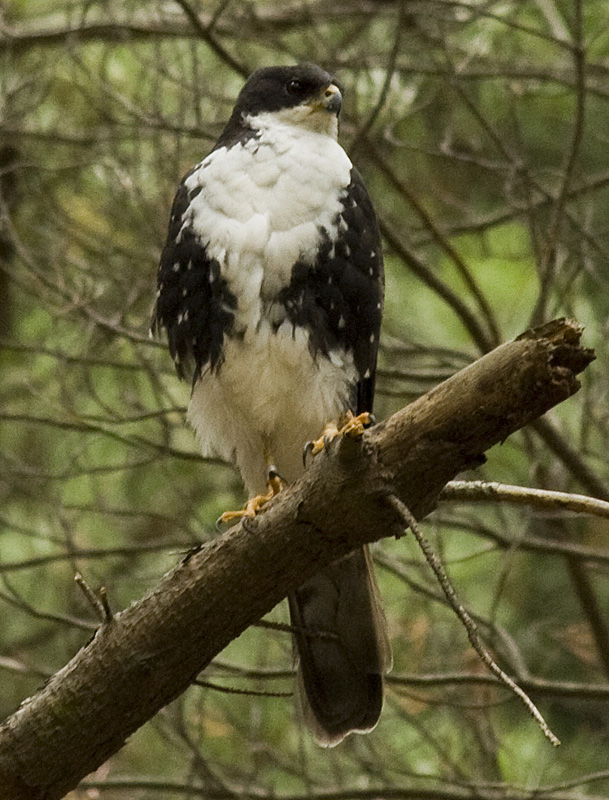
Adult Black Goshawks present a striking contrast with their black upperparts and white underparts, a plumage pattern that aids in their identification. The head, back, and wings are predominantly black, whereas the breast, belly, and undertail are white with fine black barring. In terms of size, they are large for a goshawk, with females being noticeably larger than males. This sexual dimorphism is common among raptors, where the female's larger size aids in incubating eggs and protecting their territory. Juveniles differ significantly from adults, exhibiting brownish plumage with more pronounced streaking and mottling on the chest and underparts. This coloration provides better camouflage in the dappled forest understory. In flight, Black Goshawks are recognized by their broad wings and long tail, which provide agility in forested environments. The flight silhouette of the Black Goshawk is distinct, with rounded wings and a long tail that help in navigating through dense foliage. Their perching posture is upright, often on a prominent branch from where they can survey their surroundings. They are sometimes mistaken for other African raptors, such as the African Harrier-Hawk, but the latter lacks the bold black and white contrast. Understanding these features is crucial for birdwatchers aiming to distinguish the Black Goshawk from similar species.
Having trouble telling birds apart? Upload a photo to our bird identification tool for an instant species match.
Black Goshawk Habitat and Range
Preferred Habitat
The Black Goshawk inhabits a range of forested environments, primarily favoring dense woodlands. It thrives in coastal rainforests, montane forests, and even plantations, demonstrating its adaptability. In regions like the Congo Basin and the forests of southern Africa, these birds find abundant prey and suitable nesting sites. Their presence is less common in open woodlands or savannahs, where their hunting style is less effective. Elevations up to 3000 meters are not uncommon for this species, particularly in the montane regions of East Africa. Seasonal shifts in habitat are minimal, as the Black Goshawk remains resident throughout the year. However, they may occasionally venture into nearby agricultural areas when forest prey becomes scarce. While generally associated with pristine forests, Black Goshawks can also be found on the fringes of urban areas, especially in regions where urban sprawl encroaches on their natural habitats.
Geographic Range
The Black Goshawk maintains a widespread distribution across sub-Saharan Africa. Its breeding range covers much of the continent's forested regions, from the western parts of the Congo Basin to South Africa. In East Africa, it is found in Kenya, Tanzania, and Uganda, predominantly in forested and mountainous areas. The species does not undertake long-distance migrations, but local movements may occur in response to prey availability and environmental conditions. Population density is highest in areas with dense forest cover, such as the Congo Basin and parts of West Africa, where prey is abundant and suitable nesting sites are available. While not migratory, some altitudinal movement may be observed in montane areas, with individuals moving to lower elevations during periods of extreme weather.
Want to know which birds visit your area? Browse our backyard birds by location guides for region-specific species lists.
What Does the Black Goshawk Eat?
The diet of the Black Goshawk primarily consists of birds and small mammals, showcasing its prowess as a hunter. It often preys on pigeons, doves, and various small to medium-sized birds found within its forest habitat. Small mammals, such as rodents and bats, also form a significant part of its diet. Seasonal diet changes are minor, as the Black Goshawk resides in regions where prey remains relatively constant throughout the year. However, during breeding season, the demand for food increases, prompting parents to hunt more frequently. The Black Goshawk employs a stealthy hunting technique, utilizing its agility to navigate through dense foliage and surprise its prey. With powerful talons, it captures prey in swift, decisive strikes. This raptor typically hunts during the day, with peak activity in the early morning and late afternoon when prey animals are most active.
Black Goshawk Behavior and Social Structure
Black Goshawks exhibit solitary behavior, with individuals or pairs maintaining large territories that they actively defend against intruders. Territorial behavior is pronounced during the breeding season, when pairs become highly protective of their nesting sites. Courtship displays involve aerial acrobatics and vocalizations, strengthening the bond between mating pairs. While they do not form flocks, Black Goshawks may be seen in loose associations during migration or in areas with abundant prey. When faced with potential predators, such as larger raptors, the Black Goshawk relies on its agility and dense habitat for protection. Their daily activity patterns are diurnal, with most hunting occurring during daylight hours. They utilize a sit-and-wait approach, perching silently until an opportunity to strike arises. This patience and precision make the Black Goshawk a formidable forest hunter.
Black Goshawk Nesting and Reproduction
Black Goshawks build large stick nests high in the canopy of trees, often choosing sturdy, mature trees for their construction. The nests are lined with softer materials such as leaves and feathers, providing a comfortable environment for eggs and chicks. Nests are typically located in dense forests, where they are well-concealed from potential predators. Clutch size generally ranges from two to three eggs, with the female primarily responsible for incubation over a period of about 35 days. Both parents participate in feeding the chicks, which fledge approximately 42 to 45 days after hatching. The parental roles are clearly defined, with the male hunting and the female tending to the young. Typically, Black Goshawks produce one brood per year, although in areas with abundant food, a second brood may occasionally be attempted.
Black Goshawk Sounds and Vocalizations
The vocalizations of the Black Goshawk are distinctive and varied, serving as an important means of communication. Their primary call is a series of sharp, high-pitched 'kik-kik-kik' notes, which are often repeated rapidly. This call functions in territory defense and mate communication. Additionally, they emit softer, less intense calls during courtship. Alarm calls are more aggressive, characterized by a quicker tempo and increased volume. During the dawn chorus, Black Goshawks may join other bird species in vocalizing, though their calls are less musical and more functional in nature. The vocal repertoire of the Black Goshawk is essential for maintaining territory and coordinating between pairs.
Interesting Facts About the Black Goshawk
- 1The Black Goshawk can reach speeds of up to 50 km/h when pursuing prey, showcasing its agility.
- 2Unlike many raptors, the Black Goshawk's eyes are positioned to provide excellent binocular vision, aiding in precise hunting.
- 3This species is known for its adaptability, able to thrive in both primary forests and forest plantations.
- 4In some cultures, the Black Goshawk is considered a symbol of strength and agility due to its powerful hunting skills.
- 5The Black Goshawk's nest can be as large as 1 meter in diameter, providing ample space for growing chicks.
- 6Females are significantly larger than males, a common trait in birds of prey that aids in territorial defense.
- 7The Black Goshawk's plumage assists in camouflage, with the black upperparts blending into the forest canopy.
Black Goshawk Conservation Status
Currently, the Black Goshawk is classified as Least Concern by the IUCN, with stable population trends across its range. However, habitat destruction poses a significant threat, as deforestation and urbanization reduce available nesting sites and prey. Conservation efforts focus on protecting forest habitats and ensuring sustainable land use practices. Historically, the Black Goshawk's population has faced localized declines due to habitat loss, but conservation measures have helped stabilize numbers in some regions. Continuous monitoring and habitat preservation remain crucial to safeguard the future of this impressive raptor.


