
Black Harrier
Circus maurus
Order: Accipitriformes / Family: Accipitridae
Wikimedia Commons
About the Black Harrier
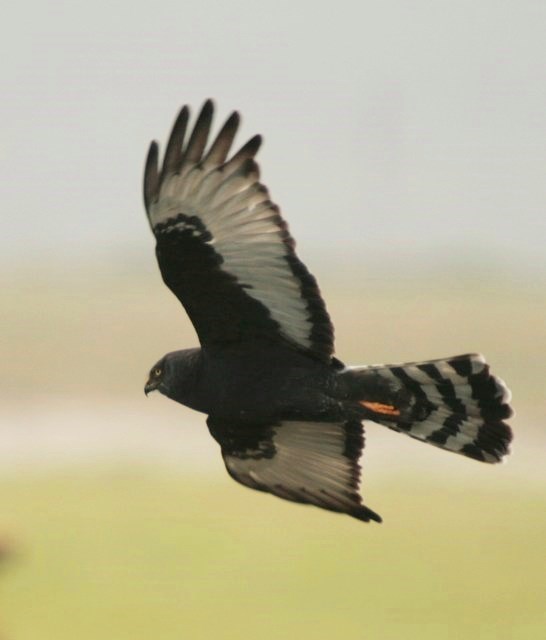
The Black Harrier, Circus maurus, is a distinctive raptor endemic to southern Africa. It thrives in the unique fynbos and Karoo habitats, primarily found in South Africa, Namibia, and Lesotho. With its striking black plumage contrasted by bold white wing bars and a white rump, this bird is both a visual marvel and an ecological specialist. The Black Harrier is a medium-sized bird of prey, measuring around 44 to 50 cm in length, with a wingspan reaching up to 105 cm. Its population, while relatively small, plays a crucial role in maintaining the ecological balance within its native habitats by controlling small mammal and bird populations through predation. The bird's significance extends beyond its ecological role, as it serves as an indicator species; its presence often signifies the health of its native habitats. The Black Harrier's breeding season spans from August to November, correlating with the southern hemisphere's spring. During this time, it exhibits elaborate aerial displays, showcasing its agility and prowess in the skies. Unlike many other raptors, the Black Harrier often nests on the ground, typically in dense vegetation to conceal its nest from potential predators. This ground-nesting behavior makes it vulnerable to habitat disturbance and destruction. The Black Harrier's reliance on specific habitats such as the fynbos and Karoo makes it particularly susceptible to environmental changes. As the fynbos ecosystem faces threats from urban expansion, agriculture, and invasive species, the Black Harrier's future hangs in a delicate balance. Conservation efforts are vital for the preservation of both this species and the unique habitats it inhabits. Efforts to protect and restore native vegetation can have a positive impact on the Black Harrier's population, ensuring that this remarkable bird continues to soar through the African skies.
The Black Harrier belongs to the family Accipitridae, within the order Accipitriformes. These birds typically live average 12-14 years..
How to Identify a Black Harrier
The Black Harrier is easily identifiable due to its striking black plumage, accented by prominent white wing bars and a white rump. Adult males and females share similar coloration, though females are typically larger, a common trait among raptors. Juveniles, on the other hand, display a more mottled brown plumage with less pronounced white markings, aiding in camouflage. In flight, the Black Harrier exhibits a distinctive V-shaped silhouette, with long, broad wings held in a shallow dihedral. This flight pattern, combined with its slow, buoyant wingbeats, sets it apart from other raptors in its range. When perched, the Black Harrier maintains an upright posture, often observed scanning the surroundings for prey. Its unique coloration and behavior reduce the likelihood of confusion with other harrier species, like the African Marsh Harrier, which lacks the stark black and white contrast. The Black Harrier's presence in open habitats further aids in its identification, as it contrasts sharply against the backdrop of the fynbos or Karoo landscapes.
Having trouble telling birds apart? Upload a photo to our bird identification tool for an instant species match.
Black Harrier Habitat and Range
Preferred Habitat
The Black Harrier inhabits a variety of open landscapes, predominantly favoring the fynbos and Karoo ecosystems of southern Africa. These regions provide the dense ground cover necessary for nesting and abundant prey resources. The fynbos, a Mediterranean-type shrubland found in the Western and Eastern Cape provinces of South Africa, offers a unique floral diversity that supports a range of prey species. The Karoo, a semi-desert region, provides vast open spaces with scattered low shrubs and grasses. The Black Harrier's preference for these habitats often keeps it away from urban areas, though it may occasionally venture into agricultural lands in search of food. During the breeding season, it is more frequently observed in areas with dense native vegetation, as it relies on these for nesting. Seasonal shifts in habitat use are minimal, but the bird may move locally in response to prey availability, especially during drier periods.
Geographic Range
The Black Harrier's range is confined to southern Africa, with its breeding grounds primarily located in South Africa's Western and Eastern Cape provinces. It also inhabits parts of Namibia and Lesotho. Within these regions, the bird is more commonly found in the fynbos and Karoo landscapes, where it breeds and hunts. The bird's range does not extend into tropical Africa, making it a true southern African endemic. Population density is higher in regions where its preferred habitats remain intact, such as the coastal fynbos and certain protected areas. There is no significant migratory movement observed in the Black Harrier; however, it may undertake local dispersal outside the breeding season, likely in response to prey availability. This localized movement ensures that the Black Harrier remains within the confines of its preferred habitats throughout the year.
Want to know which birds visit your area? Browse our backyard birds by location guides for region-specific species lists.
What Does the Black Harrier Eat?
The Black Harrier primarily preys on small mammals and birds, with its diet varying seasonally based on availability. Rodents form a significant part of its diet, especially during breeding when the nutritional demands are highest. Birds such as larks and other ground-nesting species also feature prominently. The Black Harrier employs a low, quartering flight pattern to hunt, using its keen eyesight to detect movement below. Once prey is spotted, it executes a swift, controlled descent to capture it. Invertebrates, though less common, may supplement the diet, particularly during leaner months. The Black Harrier's feeding schedule is largely diurnal, with peak hunting activity occurring during early morning and late afternoon when prey is most active. This opportunistic feeding strategy allows the Black Harrier to adapt to varying prey abundance, ensuring its survival in the diverse landscapes it inhabits.
Black Harrier Behavior and Social Structure
The Black Harrier exhibits solitary behavior outside of the breeding season, maintaining large territories that it actively defends against intruders. During the breeding season, pairs form strong bonds, engaging in courtship displays that include aerial acrobatics and food exchanges. These displays not only strengthen pair bonds but also serve to establish and maintain territories. The Black Harrier's territorial nature extends to aggressive encounters with other raptors, including its larger relatives. Despite its solitary nature, the Black Harrier may join loose flocks during non-breeding periods, especially when foraging in areas with high prey density. Predation threats primarily come from larger birds of prey and ground-based predators, especially given its ground-nesting habits. In response to potential threats, the Black Harrier employs alarm calls and diversionary tactics to protect its nest and young. Its daily activity pattern aligns with its diurnal nature, with most hunting and territorial activities occurring during daylight hours.
Black Harrier Nesting and Reproduction
The Black Harrier constructs its nest on the ground, typically within dense vegetation that provides concealment from predators. The nest itself comprises a shallow depression lined with grass, twigs, and other plant material. Nest site selection is crucial, with pairs often choosing locations that offer both seclusion and proximity to abundant prey resources. The typical clutch size ranges from two to four eggs, with incubation lasting approximately 35 days. Both parents share incubation duties, though the female takes a more active role, particularly at night. After hatching, the young remain in the nest for six to seven weeks, during which time both parents contribute to feeding. The fledging period coincides with peak prey availability, ensuring the young have the best chance of survival. The Black Harrier generally produces one brood per year, though in exceptionally favorable conditions, a second brood may be attempted.
Black Harrier Sounds and Vocalizations
The Black Harrier's vocalizations are less complex than those of songbirds but are nonetheless distinctive. Its primary call is a series of short, sharp 'kek-kek-kek' notes, often delivered in rapid succession. These calls serve as communication between mates and as a territorial signal to other harriers. Alarm calls, used to deter potential predators or intruders, carry a harsher, more urgent tone. During dawn and dusk, when the Black Harrier is most active, a series of these calls may be heard as the bird patrols its territory. The Black Harrier's vocalizations, though not melodious, play an essential role in its social structure and territorial interactions.
Interesting Facts About the Black Harrier
- 1The Black Harrier has one of the largest home ranges of any harrier species, sometimes covering up to 100 square kilometers.
- 2Despite its name, the Black Harrier's plumage can appear dark brown in certain lighting conditions, an adaptation that aids in camouflage.
- 3The Black Harrier is one of the few harrier species that prefers to nest on the ground, often in areas with dense vegetation.
- 4Its flight style, with a distinct V-shaped wing position, allows it to glide effortlessly over vast distances while hunting.
- 5The Black Harrier's population is estimated at fewer than 1,000 breeding pairs, highlighting its rarity and conservation importance.
- 6A member of the Accipitridae family, the Black Harrier is closely related to hawks, eagles, and other birds of prey.
- 7The fynbos biome, home to the Black Harrier, is one of the world's richest regions for plant biodiversity, supporting over 9,000 plant species.
Black Harrier Conservation Status
The IUCN currently lists the Black Harrier as Near Threatened, primarily due to habitat loss and fragmentation. The population trend is concerning, with a gradual decline observed over recent decades. Primary threats include agricultural expansion, urban development, and the introduction of invasive plant species that alter its native habitats. Conservation efforts focus on habitat protection and restoration, with several protected areas established in key regions. Monitoring programs aim to track population changes and identify critical threats. Historically, the Black Harrier enjoyed a more stable population, but ongoing environmental pressures necessitate continued conservation action to ensure its long-term survival.
Other Accipitridae Species


Birds Similar to the Black Harrier
These species are often confused with the Black Harrier due to similar appearance or overlapping range.
