
Black-headed Greenfinch
Chloris ambigua
Order: Passeriformes / Family: Fringillidae
Wikimedia Commons
About the Black-headed Greenfinch
The Black-headed Greenfinch (Chloris ambigua) is a striking member of the finch family, Fringillidae, characterized by its vibrant green plumage and contrasting black head. This species is predominantly found in montane and submontane regions of Asia, including parts of China, India, and Nepal. It thrives in deciduous and mixed forests, where it plays a crucial role in seed dispersal, particularly of coniferous trees. The Black-headed Greenfinch is a resident bird, with some altitudinal movements during the colder months. Its presence indicates healthy forest ecosystems, as it relies on abundant food sources and suitable nesting sites. The bird's ecological role extends beyond seed dispersal; it also contributes to pest control by consuming insects. In spring and summer, the Black-headed Greenfinch engages in elaborate courtship displays, which involve singing and flitting movements to attract mates. These displays are not just for reproduction but also help maintain pair bonds. As the seasons change, the bird's diet shifts from primarily seeds to a mix of insects and fruits, reflecting its adaptability. The Black-headed Greenfinch is a vital component of its habitat, promoting biodiversity and aiding in maintaining ecological balance.
The Black-headed Greenfinch belongs to the family Fringillidae, within the order Passeriformes. These birds typically live average 5-7 years, with a max recorded of 9 years.
How to Identify a Black-headed Greenfinch
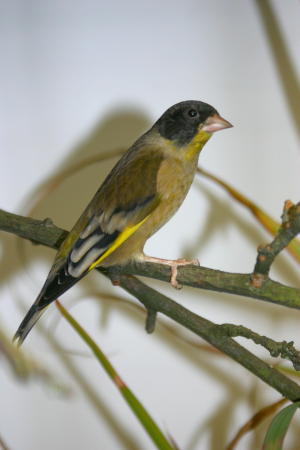
The Black-headed Greenfinch is easily recognizable by its vivid green body and contrasting black cap, which extends from the forehead to the nape. Adult males typically have more pronounced coloration, with a brighter green and a more defined black head. Females and juveniles, while similar in overall coloration, tend to have a more muted appearance, with less distinct black on the head. When perched, this finch displays a robust, stocky silhouette with a short, conical bill ideal for seed consumption. In flight, the black tail with white edges becomes noticeable, providing a distinctive marker. This bird can be confused with the closely related European Greenfinch; however, the Black-headed Greenfinch's black cap is a clear differentiator. Its perching posture is often upright, allowing for optimal vigilance while feeding or resting.
Having trouble telling birds apart? Upload a photo to our bird identification tool for an instant species match.
Black-headed Greenfinch Habitat and Range
Preferred Habitat
The Black-headed Greenfinch inhabits a variety of forested environments, primarily favoring deciduous and mixed woodlands. In regions such as the Himalayan foothills, it can be found at elevations ranging from 1,000 to 2,500 meters. During winter, it may descend to lower altitudes or move to more sheltered areas where food is abundant. This species adapts well to rural environments and is occasionally seen in urban parks with sufficient tree cover. While primarily a forest dweller, the Black-headed Greenfinch can also be spotted in shrublands and orchards, particularly when searching for food.
Geographic Range
The Black-headed Greenfinch's range spans across several Asian countries, notably China, India, Nepal, and Bhutan. It breeds primarily in the temperate zones of the Himalayas and adjacent mountain ranges. While it does not undertake long-distance migrations, it exhibits altitudinal movements, descending to lower elevations during the colder months. Within its range, the bird is most densely populated in regions with abundant coniferous forest cover. Populations are generally stable, though habitat destruction poses a potential threat.
Want to know which birds visit your area? Browse our backyard birds by location guides for region-specific species lists.
What Does the Black-headed Greenfinch Eat?
The diet of the Black-headed Greenfinch consists mainly of seeds from a variety of plants, including conifers and deciduous trees. In the spring and summer, it supplements its diet with insects, which provide necessary protein for breeding and raising young. The bird uses its strong, conical bill to crack open seeds and access their nutritious contents. Foraging typically occurs in the early morning and late afternoon when temperatures are cooler, and food is more accessible. During times of food scarcity, the Black-headed Greenfinch may venture into orchards and gardens to feed on available fruits and seeds.
Black-headed Greenfinch Behavior and Social Structure
The Black-headed Greenfinch exhibits a range of social behaviors, often forming small flocks outside the breeding season. These flocks provide safety in numbers and increase foraging efficiency. During the breeding season, pairs become territorial, engaging in vocal displays to defend their nesting area. Courtship involves elaborate displays, where the male sings while performing aerial maneuvers to attract a mate. Once paired, the birds maintain close bonds, often for consecutive breeding seasons. In response to predators, these finches issue sharp alarm calls, prompting flock members to take cover. They are diurnal, with peak activity during the cooler parts of the day.
Black-headed Greenfinch Nesting and Reproduction
The Black-headed Greenfinch constructs cup-shaped nests, using materials like grass, twigs, and feathers. Nests are typically situated in tree forks or dense shrubbery, providing concealment from predators. A typical clutch consists of 3 to 5 eggs, which are incubated primarily by the female for about two weeks. Both parents participate in feeding the hatchlings, which fledge after approximately 14 to 16 days. The species usually raises one or two broods per year, depending on food availability and climatic conditions. Parental care continues post-fledging, with the young accompanying adults during foraging.
Black-headed Greenfinch Sounds and Vocalizations
The song of the Black-headed Greenfinch is a melodious series of trills and warbles, delivered with a clear, ringing quality. Males sing from perches to establish territory and attract mates. The call notes are sharp and metallic, serving as communication within flocks. Alarm calls are distinct, a rapid series of 'tink-tink' sounds that alert other birds to danger. During the dawn chorus, the finch's song contributes to the symphony of forest sounds, marking the beginning of a new day.
Interesting Facts About the Black-headed Greenfinch
- 1The Black-headed Greenfinch is known for its acrobatic flight displays, which are part of its courtship ritual.
- 2Despite its bright appearance, the Black-headed Greenfinch can be surprisingly difficult to spot in dense foliage.
- 3The species can be seen at elevations up to 3,000 meters, showcasing its adaptability to montane environments.
- 4Its conical bill is perfectly adapted for cracking seeds, a primary component of its diet.
- 5The Black-headed Greenfinch contributes significantly to seed dispersal, aiding forest regeneration.
- 6This finch often joins mixed-species flocks, enhancing its foraging success.
- 7The bird's vibrant plumage serves both as camouflage in the dappled forest light and as a signal during displays.
Black-headed Greenfinch Conservation Status
The Black-headed Greenfinch is currently listed as Least Concern by the IUCN, with stable population trends. The primary threats include habitat loss due to deforestation and agricultural expansion. Conservation efforts focus on preserving forest habitats and promoting sustainable land-use practices. Historically, populations have fluctuated with habitat availability, but recent trends show stable numbers thanks to conservation measures.


