Black-headed Weaver
Ploceus melanocephalus
Order: Passeriformes / Family: Ploceidae
Wikimedia Commons
About the Black-headed Weaver
The Black-headed Weaver (Ploceus melanocephalus) is a captivating species renowned for its vibrant plumage and intricate nesting behaviors. This bird belongs to the family Ploceidae and is widely distributed across sub-Saharan Africa, thriving in a variety of habitats including savannas, wetlands, and forest edges. Characterized by its striking black head and bright yellow body, the Black-headed Weaver plays a crucial ecological role as both a seed disperser and insect control agent. Its presence is significant in regions such as West Africa, particularly in countries like Nigeria and Senegal, where it is a common sight in both rural and urban landscapes. During the breeding season, which typically aligns with the rainy months, the Black-headed Weaver becomes particularly active, with males constructing elaborate nests to attract females. These nests, woven from grasses and reeds, hang from trees and over water, providing a secure environment for raising young. The Black-headed Weaver's adaptability to various environments underscores its resilience and ecological importance. While they are generally sedentary, some local movements occur in response to seasonal food availability. Additionally, their social nature often leads to large, noisy colonies, which are a hallmark of their breeding behavior. By participating in ecosystems as seed dispersers, they contribute to plant diversity and regeneration, particularly in regions affected by deforestation. Despite their abundance, the Black-headed Weaver faces challenges from habitat loss due to agricultural expansion and urban development. Conservation efforts focus on protecting wetlands and ensuring sustainable land use practices to maintain viable populations of this vibrant and ecologically valuable species.
The Black-headed Weaver belongs to the family Ploceidae, within the order Passeriformes. These birds typically live average 5 years with a maximum recorded of 8 years..
How to Identify a Black-headed Weaver
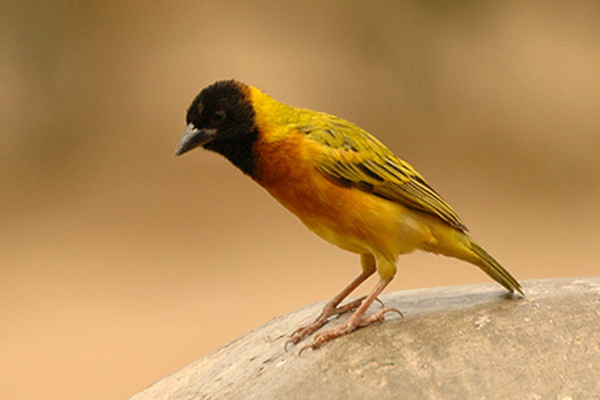
Identifying the Black-headed Weaver involves recognizing its distinctive coloration and size. Adult males are most striking, with a jet-black head, contrasting sharply with a bright yellow body and wings. Their eyes are typically red, adding another vivid element to their appearance. Females and juveniles are more subdued, lacking the black head and exhibiting a mostly yellow-green plumage with pale underparts, which can lead to confusion with other weaver species. However, careful observation of their broader shoulders and tail shape can assist in accurate identification. The Black-headed Weaver's flight is characterized by rapid, direct movements, often seen in flocks as they commute between feeding and nesting sites. When perching, these weavers exhibit a slight forward tilt, often observed in trees near water or in tall grasses. While they may be confused with the Village Weaver, the latter typically has a black mask rather than a full black head. The robust body and strong, conical bill of the Black-headed Weaver are adapted for seed and insect consumption, distinguishing it from other, slimmer passerines.
Having trouble telling birds apart? Upload a photo to our bird identification tool for an instant species match.
Black-headed Weaver Habitat and Range
Preferred Habitat
The Black-headed Weaver thrives in a variety of habitats, predominantly in sub-Saharan Africa. Its preferred environments include open savannas, wetlands, and forest edges, where it can find ample food and nesting sites. Wetlands, such as those found in the Niger Delta, provide a rich array of insect life and aquatic vegetation. In savannas, their presence is often marked by the construction of nests in acacia trees, which offer both elevation and protection. While commonly found at low to mid elevations, they can occasionally be seen at higher altitudes during specific seasonal movements. The Black-headed Weaver is adaptable to both rural and urban areas, frequently inhabiting parks and gardens where ornamental trees mimic their natural habitat features. During the dry season, they may shift closer to water sources, ensuring access to their primary food sources. Their ability to utilize both natural and human-modified landscapes demonstrates their ecological versatility, although wetland and riparian zones remain their most critical habitats.
Geographic Range
The Black-headed Weaver's range encompasses much of sub-Saharan Africa, with notable populations in West Africa, particularly in countries such as Nigeria, Ghana, and Senegal. Their breeding range is extensive, taking advantage of the variable climates across these regions. While they do not undertake long migratory journeys, they exhibit local movements, often influenced by food availability and breeding conditions. In East Africa, their presence extends into Uganda and Kenya, where they inhabit similar environments, showcasing their adaptability. The highest population densities are often found in areas where wetlands intersect with agricultural lands, providing a rich mosaic of food and nesting opportunities. Although generally not migratory, some populations may move seasonally within their range to exploit emerging food sources brought about by fluctuating water levels and seasonal rains. Their broad distribution and adaptability to various ecosystems contribute to their status as one of the more common weavers in Africa.
Want to know which birds visit your area? Browse our backyard birds by location guides for region-specific species lists.
What Does the Black-headed Weaver Eat?
The diet of the Black-headed Weaver is largely omnivorous, comprised primarily of seeds and insects. During the wet season, when insects are abundant, these weavers exhibit a preference for protein-rich prey such as caterpillars, beetles, and grasshoppers. Their foraging technique involves both gleaning from foliage and capturing insects mid-flight, demonstrating their agility and adaptability. In the dry season, their diet shifts more heavily toward seeds from grasses and cultivated crops such as maize and millet. This seasonal variation ensures a consistent food supply throughout the year. Feeding typically occurs in flocks, especially in the early morning and late afternoon, reducing predation risks while maximizing foraging efficiency. The Black-headed Weaver's strong, conical bill is well-suited to cracking seeds, enabling them to exploit a wide range of plant species, which is crucial for surviving in both natural and agricultural landscapes.
Black-headed Weaver Behavior and Social Structure
Social by nature, Black-headed Weavers are often seen in large colonies, particularly during the breeding season. Their social structure is polygynous, with males building multiple nests to attract several females. These colonies can be quite noisy, with continuous chatter as birds communicate and compete. Territorial behaviors are prominent during the breeding season, with males aggressively defending their nesting areas from rivals. Courtship displays involve males showcasing their nests and fluttering their wings to attract potential mates. Outside the breeding season, Black-headed Weavers may form mixed-species foraging flocks, a strategy that enhances feeding success and predator detection. Their response to predators involves alarm calls and collective mobbing, particularly against avian threats. Daily activity patterns start at dawn with feeding, followed by periods of rest and preening during the hottest part of the day, resuming activity in the cooler late afternoon.
Black-headed Weaver Nesting and Reproduction
The nesting habits of the Black-headed Weaver are a fascinating aspect of their biology. Males are responsible for constructing the nests, weaving them from grasses and strips of reed, which they suspend from branches, often over water or in dense foliage. This location choice provides protection from ground predators and a measure of climate control. The nests are globular with a side entrance, designed to deter predators and maintain temperature stability. A typical clutch consists of 2-4 eggs, which the female incubates for approximately 12-14 days. After hatching, both parents participate in feeding the chicks, which fledge about 17-20 days post-hatching. The number of broods per year can vary, often dependent on environmental conditions, with some pairs raising multiple broods if conditions are favorable. Parental roles are distinct, with males continuing to construct and repair nests while females focus on rearing the young.
Black-headed Weaver Sounds and Vocalizations
The vocalizations of the Black-headed Weaver are a key component of their social interactions. The primary song is a series of rapid, high-pitched notes, often described as a chattering sequence that can be both melodic and mechanical in quality. These songs serve multiple purposes, from attracting mates to establishing territory. Call notes are more succinct, typically sharp 'chik' sounds used for communication within flocks. Alarm calls are louder and more strident, serving as a warning signal to others in the vicinity of potential danger. During the dawn chorus, males are particularly vocal, using this time to reinforce territory boundaries and attract potential mates. The variety and complexity of their vocal repertoire are comparable to other weaver species, yet distinct enough to aid in identification by sound alone.
Interesting Facts About the Black-headed Weaver
- 1The Black-headed Weaver constructs its nests in just a few days, showcasing impressive speed and skill.
- 2Males may build multiple nests to attract several females, demonstrating polygynous behavior.
- 3A typical colony can consist of dozens to hundreds of nests, creating a vibrant and noisy community.
- 4These weavers can adjust their diet seasonally, shifting from insects to seeds as availability changes.
- 5Their strong, conical bill is perfectly adapted for both seed cracking and insect catching.
- 6The Black-headed Weaver's vibrant yellow and black plumage makes it one of the most striking weavers in Africa.
- 7The nests hanging from trees are designed to deter predators and maintain a stable microclimate for the eggs.
Black-headed Weaver Conservation Status
The Black-headed Weaver is currently classified as Least Concern by the IUCN, reflecting its stable global population. However, certain local populations face pressures from habitat destruction due to agricultural expansion and urbanization. Wetland drainage and pesticide use also pose significant threats. Conservation efforts are primarily focused on habitat preservation, particularly the protection of wetlands and riparian zones. Initiatives to promote sustainable agricultural practices are also in place, aiming to reduce the impact of farming on their habitats. Historical population changes have seen fluctuations based on land use patterns, but overall, the species remains widespread and adaptable. Continued monitoring and habitat conservation are essential to ensure the species does not become threatened.