
Black-throated Sparrow
Amphispiza bilineata
Order: Passeriformes / Family: Passerellidae
Wikimedia Commons
About the Black-throated Sparrow
The Black-throated Sparrow, known scientifically as Amphispiza bilineata, is a small but striking bird that captivates birders across its range. Known for its bold black throat and white facial stripes, this sparrow inhabits arid regions of the southwestern United States and northern Mexico. Its presence in deserts, shrublands, and scrubby terrains highlights its adaptability and resilience in harsh climates. The bird's role as both a seed disperser and insect controller underscores its ecological significance in desert ecosystems. During the breeding season, from early spring to mid-summer, the Black-throated Sparrow becomes especially vocal, with males singing persistently to establish territories and attract mates. Outside of the breeding season, this sparrow remains relatively sedentary, showing only minor local movements. Its preference for sparsely vegetated areas with low shrubs and open ground aligns with its feeding habits, which include foraging for seeds and insects. As one of the few sparrows that thrive in extreme desert conditions, the Black-throated Sparrow's ability to conserve water and forage efficiently makes it a model of adaptation. Throughout its range, this bird's presence is a reliable indicator of healthy desert habitats, where it contributes to the ecological balance by controlling insect populations and facilitating plant reproduction. Its adaptability to climate variations and habitat changes speaks to its evolutionary success and importance within its ecosystem.
The Black-throated Sparrow belongs to the family Passerellidae, within the order Passeriformes. These birds typically live average lifespan is around 3-4 years, with a maximum recorded lifespan of 6 years..
How to Identify a Black-throated Sparrow
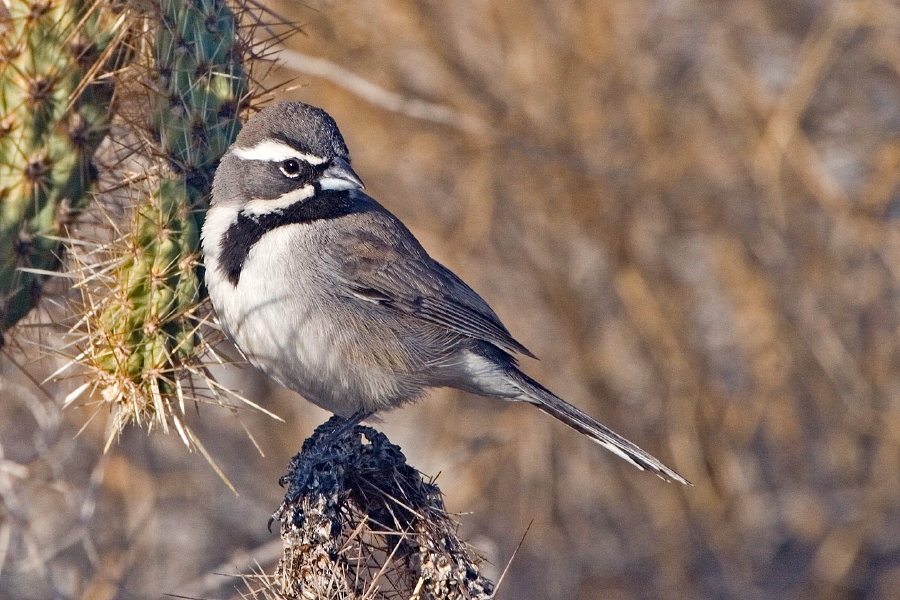
Adult Black-throated Sparrows possess a distinctive appearance that facilitates easy identification. The defining feature is the bold black throat patch, accompanied by white lines running from the bill over the eyes, creating a striking contrast against the gray head. The bird's back is a soft brownish-gray, while its underparts are pale with grayish flanks. Juveniles resemble adults but have a more muted coloration, lacking the stark black throat and possessing more diffuse facial markings. Males and females are similar in appearance, though males may exhibit slightly more vibrant plumage during the breeding season. This sparrow's compact size and rounded wings contribute to a distinctive silhouette in flight, often characterized by rapid, short bursts interspersed with glides. When perched, the Black-throated Sparrow adopts an upright posture, frequently seen atop low shrubs or bushes. Confusion may arise with other sparrows, such as the Sagebrush Sparrow, but the Black-throated's bold facial pattern and black throat are reliable distinguishing features.
Having trouble telling birds apart? Upload a photo to our bird identification tool for an instant species match.
Black-throated Sparrow Habitat and Range
Preferred Habitat
The Black-throated Sparrow thrives in arid and semi-arid environments, favoring open desert scrub, sagebrush plains, and rocky slopes. It is particularly common in regions such as the Sonoran and Chihuahuan Deserts, where low vegetation provides both food and cover. This sparrow can be found at elevations ranging from sea level to 6,000 feet, adjusting to a variety of desert microhabitats. While primarily associated with rural and undeveloped areas, it occasionally ventures into suburban landscapes with suitable native vegetation. Seasonal habitat shifts are minimal, with the species maintaining a strong preference for dry, open areas throughout the year.
Geographic Range
The Black-throated Sparrow's breeding range extends from the southwestern United States, including Arizona, New Mexico, Texas, and parts of California, into northern Mexico. It occupies a wide geographical swath across states such as Nevada and Utah, reaching as far south as Zacatecas in Mexico. During winter, some populations may move slightly southward, although many individuals remain in their breeding territories year-round. Migration corridors are primarily localized, with little broad-scale movement. Population density is highest in desert regions, where it is considered a common resident species.
Want to know which birds visit your area? Browse our backyard birds by location guides for region-specific species lists.
What Does the Black-throated Sparrow Eat?
Primarily granivorous, the Black-throated Sparrow's diet consists of seeds from a variety of desert plants, including grasses and forbs. Insects and other arthropods become a crucial food source during the breeding season, providing necessary protein for both adults and chicks. Its foraging technique involves gleaning from the ground and low vegetation, often seen hopping between shrubs in search of food. The sparrow's feeding schedule is most active during the cooler parts of the day, avoiding the intense midday heat. Prey size varies, with insects such as beetles and caterpillars forming part of its diet in the warmer months.
Want to attract Black-throated Sparrows to your yard? See our recommended feeders and seed types for the best results.
Black-throated Sparrow Behavior and Social Structure
Black-throated Sparrows exhibit a predominantly solitary or loosely paired social structure, especially during the breeding season when males become highly territorial. Courtship involves a display of singing and flight maneuvers, with males often performing short, fluttering flights to attract females. Outside the breeding season, these sparrows may form small, loose flocks, particularly when foraging. Their response to predators includes alarm calls and evasive maneuvers, often retreating to dense shrubbery. Daily activity patterns revolve around the cooler parts of the day, with increased foraging activity at dawn and dusk.
Black-throated Sparrow Nesting and Reproduction
The Black-throated Sparrow constructs cup-shaped nests primarily using grasses, twigs, and plant fibers. Nests are typically placed low in shrubs or cactus, well-concealed from potential predators. The clutch size ranges from 2 to 5 eggs, with incubation lasting approximately 12 to 15 days. Both parents participate in feeding the young, which fledge about 9 to 11 days after hatching. These sparrows often raise two broods per year, capitalizing on the availability of food resources during the extended desert breeding season.
Black-throated Sparrow Sounds and Vocalizations
The Black-throated Sparrow's song is a series of clear, musical notes, often described as a tinkling, melodic phrase that can be heard echoing across the desert landscape. Its primary call note is a sharp 'chip,' used frequently for communication between mates or as an alarm signal. During the dawn chorus, males sing persistently, their voices carrying over long distances in the quiet desert air. The song's rhythm and quality are reminiscent of a finch's, yet distinct in its repetition and tone.
Interesting Facts About the Black-throated Sparrow
- 1The Black-throated Sparrow can survive on minimal water, obtaining moisture primarily from its food.
- 2This sparrow's song can be heard up to a mile away in the quiet desert morning air.
- 3Despite its name, the Black-throated Sparrow does not migrate long distances, instead making small local movements.
- 4It can endure the harsh desert temperatures due to specialized physiological adaptations.
- 5The Black-throated Sparrow's diet shifts seasonally, with a significant increase in insect consumption during breeding season.
- 6These sparrows are known to use cacti and thorny shrubs as nesting sites to deter predators.
- 7The species is sometimes called the 'Desert Sparrow' due to its strong association with arid landscapes.
Black-throated Sparrow Conservation Status
Classified as Least Concern by the IUCN, the Black-throated Sparrow maintains a stable population across its range. While not currently threatened, habitat degradation and climate change pose potential risks to its desert habitats. Conservation efforts focus on preserving native desert landscapes and mitigating the effects of human encroachment. Historically, this sparrow's populations have fluctuated in response to environmental changes, but its adaptability has allowed it to persist across varied conditions.
Attracting Black-throated Sparrows to Your Feeder
The Black-throated Sparrow is a regular visitor to backyard bird feeders across its range. At the Eye On The Fly feeding station, we observe Black-throated Sparrows regularly and capture footage with our feeder cameras.
Other Passerellidae Species


Birds Similar to the Black-throated Sparrow
These species are often confused with the Black-throated Sparrow due to similar appearance or overlapping range.


