
Black-winged Lory
Eos cyanogenia
Order: Psittaciformes / Family: Psittacidae
Wikimedia Commons
About the Black-winged Lory
The Black-winged Lory, scientifically known as Eos cyanogenia, is a vibrant member of the Psittacidae family, renowned for its striking red plumage and contrasting black wing feathers. These birds inhabit the lowland rainforests and coastal mangroves of New Guinea and several surrounding islands, playing a crucial role in these delicate ecosystems. Their presence in these habitats aids in the pollination of various native plant species, thanks to their specialized feeding habits. The Black-winged Lory's ecological importance cannot be overstated, as they contribute to maintaining the health and diversity of their environment.
As primarily canopy dwellers, Black-winged Lories exhibit remarkable adaptability to their surroundings. They are often found in regions where flowering plants are abundant, such as the rainforests of Misool and the islands of Raja Ampat. These birds are known for their acrobatic skills, which enable them to access nectar from a wide range of flowering trees and shrubs. Seasonally, they may move between different altitudinal zones in pursuit of blooming flora, showcasing their dynamic interaction with the ecosystem.
The Black-winged Lory's vibrant coloration and energetic behavior make it a favorite among birdwatchers and researchers alike. Despite their beauty, these lories face numerous challenges, including habitat destruction and the illegal pet trade. Conservation efforts focus on protecting their natural habitats and curbing illegal poaching activities. Understanding the Black-winged Lory's ecological role and ensuring their survival is vital, not only for the preservation of the species but also for the health of their native habitats.
The Black-winged Lory belongs to the family Psittacidae, within the order Psittaciformes. These birds typically live average 15-20 years, with a maximum recorded of 30 years..
How to Identify a Black-winged Lory
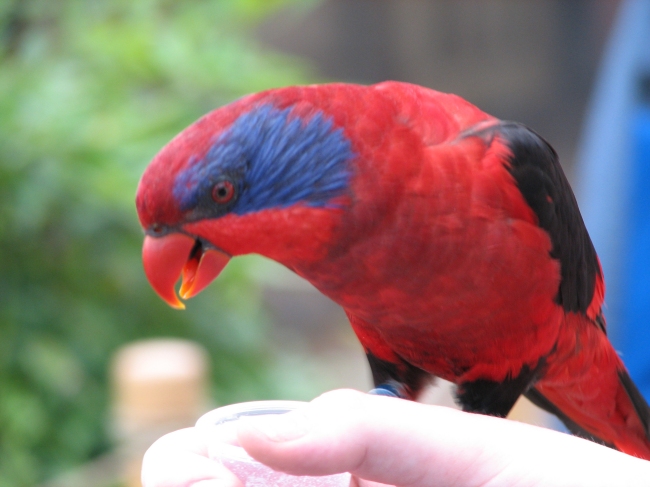
The Black-winged Lory is distinguished by its vivid red body, which contrasts sharply with its black wings and tail. Adult lories display a uniform red coloration with subtle blue markings around the eyes that add to their striking appearance. Juveniles are generally similar in appearance to adults but may exhibit slightly duller plumage until they reach maturity.
Male and female Black-winged Lories do not exhibit significant sexual dimorphism, making visual identification between sexes challenging without closer inspection. Both sexes share the same brilliant red and black coloration. In flight, their silhouette is characterized by pointed wings and a slightly elongated tail, which aids in swift and agile movements through the forest canopy.
Confusion with other lory species can occur, particularly with the Red Lory, but the Black-winged Lory's distinctive black wings serve as a definitive field mark. When perched, their robust stance and bold coloration make them relatively easy to spot against the lush greenery of their forested habitat.
Having trouble telling birds apart? Upload a photo to our bird identification tool for an instant species match.
Black-winged Lory Habitat and Range
Preferred Habitat
Black-winged Lories inhabit the lowland rainforests and mangrove forests of New Guinea and the surrounding islands. These environments provide the necessary resources for their survival, including abundant flowering plants and fruit-bearing trees. They thrive at elevations up to 1000 meters, although they are most commonly found in the lower altitudes where their preferred food sources are plentiful.
During the flowering season, these lories may exhibit movements within their range to track blooming events, ensuring a constant supply of nectar and pollen. Their presence in both primary and secondary forests illustrates their adaptability to different levels of habitat disturbance. While primarily forest dwellers, Black-winged Lories have occasionally been observed near human settlements, particularly where gardens or plantations offer additional feeding opportunities.
Geographic Range
The Black-winged Lory is native to the biogeographical region of New Guinea, including both the mainland and several nearby islands such as Salawati and Misool. Their range is predominantly restricted to these areas, where they are considered residents, not undertaking long-distance migrations.
Within their range, the Black-winged Lory is most frequently encountered in lowland rainforests and coastal mangroves, though they may venture into higher altitudes in search of food during certain times of the year. The population density is typically higher in regions with abundant flowering trees and fewer human disturbances. Conservation areas within their range play a critical role in safeguarding their populations, as these provide essential protection against habitat loss.
Want to know which birds visit your area? Browse our backyard birds by location guides for region-specific species lists.
What Does the Black-winged Lory Eat?
The Black-winged Lory primarily feeds on nectar and pollen, which they obtain from a variety of flowering plants. Their specialized brush-tipped tongues are well-adapted for extracting nectar, allowing them to feed efficiently on the forest's floral offerings. Besides nectar, they also consume fruits, seeds, and occasionally insects, providing a well-rounded diet that supports their energetic lifestyle.
Seasonal changes in their habitat influence their diet, with shifts in available food sources prompting changes in foraging behavior. During peak flowering periods, lories may focus intensely on nectar consumption, whereas in other seasons, fruits and seeds may comprise a larger portion of their intake. These lories often engage in active foraging throughout the day, visiting multiple feeding sites to satisfy their dietary needs.
Black-winged Lory Behavior and Social Structure
Black-winged Lories are known for their social nature and are frequently observed in pairs or small flocks, especially when feeding. Their social structure fosters cooperative feeding and vigilant predator awareness, enhancing their survival. These lories exhibit strong territorial behaviors, often defending their feeding and nesting sites from intruders with vocal displays and aerial maneuvers.
Courtship displays involve elaborate vocalizations and synchronized movements, strengthening pair bonds. Once paired, mates remain close, often seen preening each other as a sign of affection. During the day, Black-winged Lories are highly active, engaging in regular foraging and social interactions, while at night, they roost in tree cavities or dense foliage to evade predators.
Their response to threats typically involves swift, coordinated flight into the dense canopy, where they can easily blend with the foliage. Their communal nature also includes shared vigilance, with individuals alerting others to potential dangers through distinct alarm calls.
Black-winged Lory Nesting and Reproduction
Black-winged Lories nest in tree cavities, often selecting sites high above the ground for protection against predators. They prefer natural hollows in large trees, occasionally adapting abandoned nests of other birds. The nesting materials primarily consist of wood dust and chewed-up plant fibers, providing a soft lining for their eggs.
A typical clutch comprises two eggs, which both parents incubate for about 24 to 26 days. During this period, the male often forages for food, bringing back sustenance for the incubating female. After hatching, the chicks remain in the nest for approximately 8 to 10 weeks, during which both parents participate in feeding and caring for the young.
Black-winged Lories typically raise one brood per year, although in particularly food-rich environments, a second brood is possible. Their nesting success heavily depends on the availability of suitable nesting sites and the abundance of food resources in their habitat.
Black-winged Lory Sounds and Vocalizations
The Black-winged Lory's vocal repertoire is varied and includes sharp, high-pitched calls that are often repeated in quick succession. Their primary songs feature a rhythmic pattern that can carry over long distances, serving to maintain contact between flock members. During courtship, males may produce softer, more melodious notes designed to attract and communicate with potential mates.
Alarm calls are distinct, typically louder and more abrupt, alerting others to the presence of predators or other threats. At dawn, these lories often participate in a chorus of calls, signaling the start of their daily activities and reinforcing social bonds within the flock. Their vocalizations, while diverse, share a quality reminiscent of mechanical sounds, akin to the rapid clicking of gears.
Interesting Facts About the Black-winged Lory
- 1Black-winged Lories can use their brush-tipped tongues to feed on nectar, similar to how a paintbrush absorbs liquid.
- 2These lories have a lifespan of up to 20 years in the wild, allowing them to form long-term pair bonds.
- 3Unlike many parrots, Black-winged Lories do not mimic human speech, focusing on their natural calls instead.
- 4They can fly at speeds of up to 40 kilometers per hour, making them agile navigators of dense forests.
- 5Their striking plumage not only aids in attracting mates but also helps in camouflage among red flowers.
- 6Black-winged Lories contribute to the pollination of over 30 species of flowering plants in their native range.
- 7During courtship, lories engage in mutual preening, which strengthens pair bonds and ensures cooperative breeding.
Black-winged Lory Conservation Status
The International Union for Conservation of Nature (IUCN) currently lists the Black-winged Lory as Near Threatened. The population trend is decreasing, primarily due to habitat destruction and illegal trapping. Logging and agricultural expansion pose significant threats to their rainforest habitats, reducing available nesting and feeding sites. Conservation efforts focus on habitat preservation and law enforcement to minimize illegal trade. Protected areas within their range, such as national parks and wildlife reserves, provide crucial refuges. Despite these efforts, continued monitoring and increased awareness are necessary to prevent further declines and ensure the long-term survival of the species.
Other Psittacidae Species


Birds Similar to the Black-winged Lory
These species are often confused with the Black-winged Lory due to similar appearance or overlapping range.

