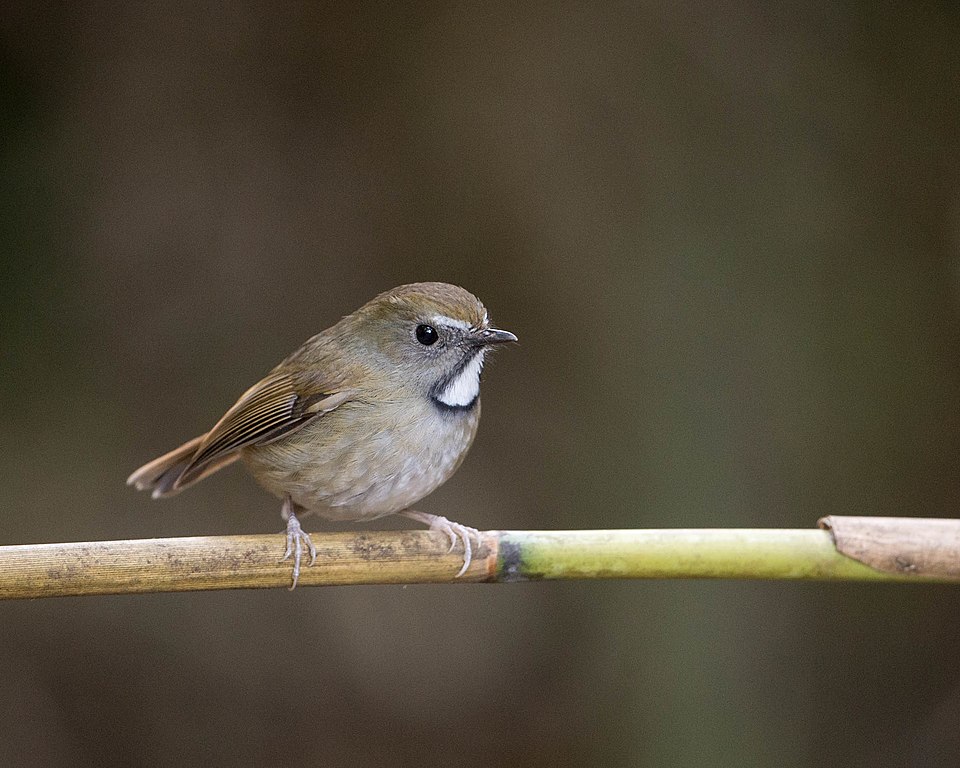
Blackthroat
Luscinia obscura
Order: Passeriformes / Family: Muscicapidae

Wikimedia Commons
About the Blackthroat
The Blackthroat, Luscinia obscura, is a striking passerine bird in the Muscicapidae family, known for its vibrant blue plumage accented by a stark black throat. This bird occupies a very restricted range and is primarily found in the montane forests of central China, particularly in the provinces of Shaanxi, Sichuan, and Gansu. The Blackthroat's habitat preference for dense undergrowth in subtropical and temperate forests makes it an elusive species, often heard rather than seen. The significance of the Blackthroat extends beyond its rarity, as it is a flagship species for conservation in its limited habitat. The dense bamboo thickets and rhododendron shrubs that it favors are critical for its breeding and feeding activities. This bird plays an essential ecological role by aiding in insect population control and serving as a bioindicator for the health of its montane forest ecosystem. Its presence or absence can signal changes in the forest environment, such as deforestation impacts or climate change effects. The Blackthroat's seasonal behaviors include altitudinal migrations in response to harsh winter conditions. During the breeding season, typically late spring to early summer, it occupies higher elevations, while in winter, it descends to lower altitudes where the climate is milder. This altitudinal migration reflects its adaptation to the seasonal availability of food and suitable nesting sites. The conservation status of the Blackthroat is particularly concerning due to its restricted range and the fragmentation of its habitat. Deforestation and human encroachment pose significant threats to its survival. Conservation efforts are critical for maintaining the ecological integrity of its habitat, which is not only vital for the Blackthroat but also for a host of other endemic species sharing the same environment.
The Blackthroat belongs to the family Muscicapidae, within the order Passeriformes. These birds typically live average 5-7 years with a maximum recorded of 10 years..
How to Identify a Blackthroat
The Blackthroat is a medium-sized songbird, measuring about 16 cm in length. Adult males are particularly striking with a deep black throat and face, complemented by a rich blue upper body and tail. The underparts are a paler grayish-blue, creating a sharp contrast that makes identification easier. Females and juveniles, however, present a more subdued appearance. Females lack the black throat and have a brownish-olive color overall, with a lighter throat and breast, making them resemble other thrush-like birds. Juveniles resemble the females but have spots on the breast and more mottled plumage. These differences can lead to confusion with other thrushes or nightingales, particularly in the dimly lit forest undergrowth they inhabit. In flight, the Blackthroat has a swift, direct flight pattern with rapid wing beats. Its perching posture is upright, often on branches that provide a clear view of its surroundings, aiding in territory defense and mate attraction. The distinction between sexes is critical in field identification, particularly given the bird’s elusive nature.
Having trouble telling birds apart? Upload a photo to our bird identification tool for an instant species match.
Blackthroat Habitat and Range
Preferred Habitat
The Blackthroat inhabits subtropical and temperate montane forests, primarily in central China. It prefers dense undergrowth within coniferous and mixed forests, often at altitudes ranging from 1,500 to 3,000 meters. These habitats are characterized by thick bamboo underbrush and rhododendron thickets, which provide cover and foraging opportunities. During winter, the Blackthroat descends to lower elevations, around 800 to 1,500 meters, where the climate is milder, and food is more accessible. This seasonal habitat shift is crucial for its survival, as the bird relies on the availability of insects and suitable microhabitats year-round. The Blackthroat is generally absent from urban areas, favoring remote forested regions where human disturbance is minimal.
Geographic Range
The Blackthroat has a very limited range, primarily breeding in the montane forests of central China, especially in the provinces of Shaanxi, Sichuan, and Gansu. During the breeding season, it is found at higher elevations in these regions. In winter, it descends to lower altitudes within the same general geographic area, though precise wintering locations are less well-documented due to its elusive nature. There is no evidence of long-distance migration beyond these areas. The population density is highest in well-preserved forest tracts, where suitable habitat remains intact. Fragmented populations are at risk due to habitat loss, making conservation in its core range a priority.
Want to know which birds visit your area? Browse our backyard birds by location guides for region-specific species lists.
What Does the Blackthroat Eat?
The diet of the Blackthroat primarily consists of insects and other invertebrates, which it forages from the forest floor and lower branches. During the breeding season, it consumes a high volume of caterpillars, beetles, and spiders, which provide the necessary protein for raising young. In winter, when insect activity declines, the Blackthroat supplements its diet with berries and seeds. Foraging behavior involves both ground gleaning and aerial sallying, especially during the warmer months when insect activity is higher. Its feeding schedule is most active during the early morning and late afternoon, coinciding with peak insect activity in its montane forest habitat.
Blackthroat Behavior and Social Structure
The Blackthroat exhibits typical territorial behavior during the breeding season, with males establishing and defending territories through song and display flights. Males sing from prominent perches within their territories to attract females and deter rivals. Courtship displays are elaborate, involving wing fluttering and tail fanning to showcase plumage. While generally solitary outside the breeding season, the Blackthroat may form small foraging groups during migration to lower elevations. Its response to predators includes staying motionless in dense cover or emitting harsh alarm calls to warn of danger. Daily activity peaks in the early morning and late afternoon, with midday rest periods during the hottest parts of the day.
Blackthroat Nesting and Reproduction
Blackthroats build cup-shaped nests primarily from twigs, leaves, and moss, lined with finer materials like grass and feathers. They prefer nesting sites on the ground or low in bushes, well-concealed by dense vegetation. The typical clutch size is 3-5 eggs, incubated by the female for about 12-14 days. Both parents participate in feeding the chicks, which fledge approximately 12-15 days after hatching. The species typically raises one brood per year, though favorable conditions may allow for a second. The choice of nesting sites in dense cover reduces predation risk, offering protection for the young.
Blackthroat Sounds and Vocalizations
The Blackthroat's primary song is a melodious and varied series of whistles and trills, often delivered from a concealed perch. The pitch is medium-high, with a rhythmic, flute-like quality that can carry through the forest. Call notes are sharp and metallic, used for communication between mates or signaling alarm. During the dawn chorus, the Blackthroat's song stands out among other forest birds, helping establish territory and attract a mate. Its alarm calls are harsher and more abrupt, used when a predator is near.
Interesting Facts About the Blackthroat
- 1The Blackthroat's striking black and blue plumage makes it one of the most visually distinctive members of the Muscicapidae family.
- 2Despite its vibrant appearance, the Blackthroat is elusive and often more easily heard than seen due to its secretive nature.
- 3The Blackthroat is considered a flagship species for conservation efforts in the montane forests of central China.
- 4This bird's altitudinal migration is a fascinating adaptation that allows it to exploit different ecological niches seasonally.
- 5The Blackthroat's song is complex and melodious, capable of competing with the calls of other forest birds during the dawn chorus.
Blackthroat Conservation Status
The Blackthroat is currently listed as Vulnerable on the IUCN Red List due to its restricted range and declining population. Habitat loss from deforestation and land conversion for agriculture are the primary threats. Conservation efforts focus on habitat protection and restoration, particularly in key breeding areas. Historically, the population has been stable, but recent pressures from human activities necessitate increased conservation measures to ensure its survival. Maintaining forest integrity in central China is crucial for the Blackthroat and other species sharing its habitat.