
Blue-bellied Parrot
Triclaria malachitacea
Order: Psittaciformes / Family: Psittacidae
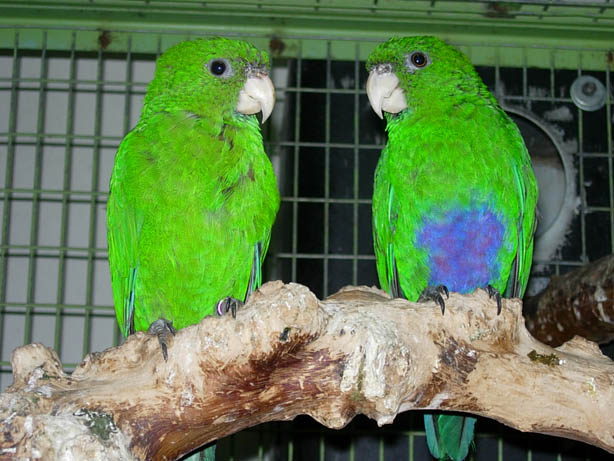
Wikimedia Commons
About the Blue-bellied Parrot
The Blue-bellied Parrot, scientifically known as Triclaria malachitacea, is an intriguing member of the family Psittacidae. This medium-sized parrot is endemic to the Atlantic Forest of southeastern Brazil. It inhabits a range that extends through the states of Rio de Janeiro, São Paulo, Paraná, and Santa Catarina. The bird's significance lies not only in its striking appearance but also in its role as a seed disperser in its native forests, contributing to the ecological health and regeneration of these biodiverse areas.
This parrot is particularly notable for its bright blue belly, contrasting with its predominantly green plumage. The Blue-bellied Parrot thrives in the canopy of humid tropical and subtropical forests, where it forages for fruits, seeds, and flowers. Its presence is a testament to the health of its habitat, as it relies heavily on well-preserved forest ecosystems for survival.
Throughout the year, the Blue-bellied Parrot exhibits seasonal behaviors that reflect its adaptation to the changing food availability in its environment. During the breeding season, which typically spans from September to February, these parrots become more vocal and active as they establish territories and seek mates. Outside of the breeding season, they may form small flocks, enhancing their foraging efficiency and offering protection from predators.
The Blue-bellied Parrot plays a vital role in the seed dispersal of various plant species, aiding in the maintenance of the forest structure. By consuming fruits and then excreting the seeds elsewhere, it helps ensure the propagation of many tree species. This ecological interaction underscores the importance of preserving their natural habitat, as the decline in parrot populations could have cascading effects on the forest's biodiversity.
The Blue-bellied Parrot belongs to the family Psittacidae, within the order Psittaciformes. These birds typically live typically around 15 years, with some individuals reaching up to 20 years in captivity..
How to Identify a Blue-bellied Parrot
The Blue-bellied Parrot is distinguishable by its vivid blue abdomen, which sets it apart from other parrots within its range. The adult plumage is predominantly green, with a noticeable blue tint on the underparts. Males and females look similar, although males may show slightly more vibrant colors. Juveniles, on the other hand, are generally duller, lacking the bright blue belly until they mature.
In terms of size, the Blue-bellied Parrot measures around 28 centimeters in length, making it a medium-sized parrot. Its tail is relatively short, and its robust build is characteristic of parrots in the Psittacidae family. When perched, it maintains an upright posture, often seen in pairs or small groups.
The Blue-bellied Parrot can be confused with the Scaly-headed Parrot, another resident of the Atlantic Forest. However, the latter lacks the distinctive blue belly and displays a scaly pattern on its head. In flight, the Blue-bellied Parrot has a strong and direct silhouette, with rapid wingbeats typical of many forest-dwelling parrots.
Having trouble telling birds apart? Upload a photo to our bird identification tool for an instant species match.
Blue-bellied Parrot Habitat and Range
Preferred Habitat
The Blue-bellied Parrot primarily resides in the lowland and montane Atlantic Forests of Brazil. It thrives in humid tropical and subtropical forests, preferring the dense canopy where it can find abundant food and shelter. These forests are characterized by high biodiversity and complex ecosystems, providing ideal conditions for this species.
Elevation-wise, the Blue-bellied Parrot occupies a range from sea level to approximately 1,200 meters. It shows some adaptability to habitat fragmentation, occasionally venturing into secondary forests and forest edges, although it remains heavily reliant on well-preserved primary forests.
While it primarily inhabits rural and less disturbed areas, increasing deforestation and habitat degradation pose significant threats. The Blue-bellied Parrot is not commonly found in urban settings, as it favors the rich resources and cover provided by forested areas.
Geographic Range
The Blue-bellied Parrot is endemic to the Atlantic Forest of southeastern Brazil. Its range encompasses the states of Rio de Janeiro, São Paulo, Paraná, and Santa Catarina. Within this range, the species shows a preference for well-preserved forest habitats, although it can adapt to some degree of habitat disturbance.
The parrot's breeding range aligns closely with its overall distribution, as it tends to remain in the same general areas year-round. There is no significant migratory behavior observed in this species, although local movements within its range may occur in response to food availability and seasonal changes.
Population density hotspots typically occur in regions where the forest remains relatively intact, such as protected reserves and national parks. These areas offer a refuge from the ongoing threat of deforestation and habitat loss, which have historically reduced the extent of suitable habitat available to the Blue-bellied Parrot.
Want to know which birds visit your area? Browse our backyard birds by location guides for region-specific species lists.
What Does the Blue-bellied Parrot Eat?
The diet of the Blue-bellied Parrot primarily consists of fruits, seeds, and flowers. Its foraging behavior is highly adapted to the canopy of the Atlantic Forest, where it selectively feeds on the fruits of various tree species. This diet not only sustains the parrot but also plays a crucial role in seed dispersal.
Seasonal changes influence the availability of food sources, prompting the Blue-bellied Parrot to adjust its diet accordingly. During the breeding season, when energy demands are higher, the parrot may increase its intake of nutrient-rich seeds and fruits.
Foraging typically occurs in the early morning and late afternoon when the parrot is most active. The Blue-bellied Parrot employs a deliberate and methodical technique, using its strong beak to crack open tough shells and access the nutritious contents inside. It rarely descends to the ground, preferring to feed within the safety of the forest canopy.
Blue-bellied Parrot Behavior and Social Structure
The Blue-bellied Parrot exhibits fascinating social behaviors, often seen in pairs or small family groups. It maintains a strong pair bond, with partners engaging in mutual preening and vocalizations to reinforce their connection. During the breeding season, the parrot becomes more vocal and territorial, using calls to establish and defend nesting areas.
Courtship displays include synchronized flying and mutual feeding, which strengthen the pair bond. These displays are vital for successful mating, ensuring both partners are committed to raising offspring together.
While generally not aggressive, the Blue-bellied Parrot will defend its territory from intruders, particularly during nesting. Its response to predators includes loud alarm calls and evasive flight, seeking cover in dense foliage.
Daily activity patterns show peaks in the early morning and late afternoon, coinciding with feeding times. The parrot often rests during the heat of midday, conserving energy and avoiding potential threats.
Blue-bellied Parrot Nesting and Reproduction
The Blue-bellied Parrot typically nests in tree cavities, often using existing holes created by woodpeckers or natural decay. These cavities provide a secure environment for raising young, offering protection from predators and harsh weather.
Nesting sites are usually located high in the canopy, reflecting the parrot's preference for elevated, secluded areas. The female lays a clutch of 2 to 4 eggs, which she incubates for approximately 24 to 26 days. During this time, the male provides food and support, ensuring the female can remain on the nest.
Once hatched, the chicks remain in the nest for about 7 to 8 weeks, receiving care and feeding from both parents. The fledging period is a critical time, as young birds learn essential skills for survival. The Blue-bellied Parrot generally raises one brood per year, although conditions may allow for a second if resources are abundant.
Blue-bellied Parrot Sounds and Vocalizations
The primary song of the Blue-bellied Parrot is a series of melodious whistles, characterized by a clear, rising and falling pattern. These calls serve both to communicate with mates and to establish territory boundaries.
Call notes are typically short and sharp, used to maintain contact with flock members or signal alarm. When threatened, the parrot emits a loud, harsh screech, alerting others to potential danger.
During the dawn chorus, the Blue-bellied Parrot becomes particularly vocal, with individuals joining in a symphony of calls that resonate through the forest. This behavior not only strengthens social bonds but also asserts presence in the territory.
Interesting Facts About the Blue-bellied Parrot
- 1The Blue-bellied Parrot's blue belly is unique among its family, making it a sought-after sighting for birdwatchers.
- 2This parrot is an important seed disperser, playing a key role in the regeneration of Brazil's Atlantic Forest.
- 3Despite its striking appearance, the Blue-bellied Parrot can be elusive, often staying hidden in the dense forest canopy.
- 4The species' vocalizations are complex and varied, with each parrot having its own unique set of calls.
- 5The Blue-bellied Parrot forms strong pair bonds, with partners often staying together for life.
- 6It has a relatively long lifespan for a parrot, often living up to 30 years in the wild.
- 7The parrot's diet shifts seasonally, adapting to the availability of fruits and seeds throughout the year.
Blue-bellied Parrot Conservation Status
The Blue-bellied Parrot is currently listed as Near Threatened on the IUCN Red List. Its population is decreasing, with habitat loss due to deforestation posing the most significant threat. Conservation efforts focus on protecting the remaining tracts of the Atlantic Forest, a biodiversity hotspot crucial to the parrot's survival. Historically, the parrot's range has contracted due to extensive logging and land conversion for agriculture. Conservation initiatives include the establishment of protected areas and reforestation projects, aiming to restore and preserve critical habitats. Public awareness campaigns emphasize the importance of the Atlantic Forest and its inhabitants, encouraging sustainable land-use practices and the protection of natural resources.


