
Blue Bunting
Cyanocompsa parellina
Order: Passeriformes / Family: Cardinalidae
Wikimedia Commons
About the Blue Bunting
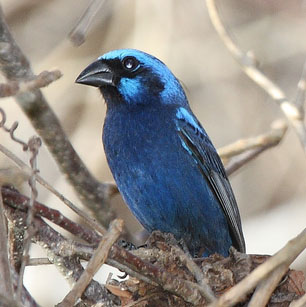
The Blue Bunting (Cyanocompsa parellina) presents itself as a vibrant splash of color across the landscape of Central America. This medium-sized songbird belongs to the Cardinalidae family and is renowned for its striking male plumage, featuring a rich cobalt-blue hue that captivates birders and nature enthusiasts alike. Found predominantly in the lowland tropical forests of southern Mexico to northern Nicaragua, the Blue Bunting favors dense thickets and forest edges, where it can forage discreetly and remain sheltered from predators. Despite its vibrant appearance, it is often heard before it is seen, as its melodious song carries through the underbrush.
The ecological role of the Blue Bunting is multifaceted, contributing to seed dispersion and insect population control within its habitat. As an omnivore, it consumes a varied diet that includes seeds, fruits, and insects, thus playing a significant role in the health and maintenance of its ecosystem. The bird's song is not only a means of communication but also a critical component of its breeding behavior, as males sing to establish territories and attract mates. Seasonal behaviors of the Blue Bunting include local movements within its range to exploit food sources and suitable nesting sites.
The Blue Bunting's presence in these regions highlights the rich biodiversity of Central American ecosystems and underscores the importance of conservation efforts to preserve these habitats. As human activities continue to encroach upon natural landscapes, the preservation of the Blue Bunting's habitat becomes increasingly crucial. This species serves as an indicator of environmental health, and its well-being reflects the overall condition of the forest ecosystems it inhabits. Through careful observation and study of the Blue Bunting, researchers gain insights into the broader ecological dynamics at play in tropical regions.
The Blue Bunting belongs to the family Cardinalidae, within the order Passeriformes. These birds typically live average 4-6 years, with a maximum recorded of 8 years..
How to Identify a Blue Bunting
Identifying the Blue Bunting involves observing several key field marks. Adult males display a vivid cobalt-blue plumage that covers the head, back, and wings, with slightly darker wing and tail feathers. In contrast, females and juveniles exhibit more subdued coloration, tending towards olive-brown or gray tones with some faint blue hints, especially in older females. This sexual dimorphism makes it easier to distinguish between sexes in the field.
The Blue Bunting's stout, conical bill is another identifying feature, typical of the Cardinalidae family, adapted for seed cracking. Observers can also note the bird's relatively short tail and compact body structure, which contribute to its agile movement through dense foliage. In flight, its silhouette is characterized by rapid wing beats and a fluttering motion, making it less streamlined than migratory species.
Confusion with similar species, such as the Indigo Bunting or the Blue Grosbeak, can occur, particularly in overlapping ranges. However, the Blue Bunting's more vivid blue and unique song patterns assist in distinguishing it from these relatives. While perched, the Blue Bunting maintains an upright posture, often remaining still for several moments as it surveys its surroundings.
Having trouble telling birds apart? Upload a photo to our bird identification tool for an instant species match.
Blue Bunting Habitat and Range
Preferred Habitat
The Blue Bunting thrives in tropical and subtropical environments, particularly favoring dense thickets, forest edges, and semi-open woodlands at low to mid-elevations, typically ranging from sea level to about 1,500 meters. These habitats provide ample cover and foraging opportunities, essential for both feeding and breeding.
During the breeding season, the Blue Bunting frequents humid, lowland forests and riparian zones, where the lush undergrowth offers ideal nesting sites. In contrast, during non-breeding periods, it may venture into slightly more open areas, such as secondary forests and even coffee plantations, which mimic its natural habitat in structure and resource availability.
Though primarily a forest dweller, the Blue Bunting occasionally appears in rural gardens and orchards, especially those adjacent to forested areas. Its presence in urban settings is rare, as it prefers the natural complexity and resource abundance found in undisturbed habitats.
Geographic Range
The range of the Blue Bunting spans from southern Mexico through Central America, reaching as far south as northern Nicaragua. In Mexico, it is predominantly found in the states of Veracruz, Oaxaca, and Chiapas, where suitable forest habitats are abundant.
During the breeding season, populations concentrate in dense forested regions to take advantage of the resources needed for raising young. However, the species does not undertake long migrations; instead, it exhibits localized movements within its range in response to food availability and environmental conditions.
Population density hotspots include the tropical lowland forests of Guatemala and Honduras, where the Blue Bunting is a common sight in appropriate habitats. Though not considered migratory, its movements can still be influenced by seasonal changes, leading to shifts in local distribution patterns within its established range.
Want to know which birds visit your area? Browse our backyard birds by location guides for region-specific species lists.
What Does the Blue Bunting Eat?
The Blue Bunting's diet is diverse, reflecting its omnivorous nature. Primarily, it consumes a variety of seeds and fruits, which form the bulk of its diet during the non-breeding season. These food sources provide essential nutrients and energy, particularly when insects are less abundant.
In the breeding season, the Blue Bunting's diet shifts to include a higher proportion of insects and other small invertebrates, which are crucial for feeding growing chicks. The bird employs a variety of foraging techniques, such as gleaning insects from leaves and branches or capturing prey mid-air with agile flight.
Prey size generally includes small insects like beetles, caterpillars, and ants. The Blue Bunting tends to feed during the cooler parts of the day, such as early morning and late afternoon, when insects are more active and temperatures are less extreme.
Blue Bunting Behavior and Social Structure
The Blue Bunting exhibits complex social and territorial behaviors, particularly during the breeding season. Males establish and defend territories through vocal displays, often perching conspicuously while singing to deter rivals and attract potential mates. This territoriality ensures access to resources like food and nesting sites, critical for successful reproduction.
Courtship displays involve both visual and auditory signals. Males may engage in a series of fluttering flights or display their vibrant plumage by spreading wings and tail. These behaviors are accompanied by soft calls and songs directed towards the female.
Outside the breeding season, the Blue Bunting tends to be more solitary or seen in loose, mixed-species flocks. This behavior allows them to exploit food resources more efficiently and reduces the risk of predation. The bird's daily activity patterns include periods of foraging interspersed with rest and preening, typically following a routine dictated by the availability of resources and environmental conditions.
Blue Bunting Nesting and Reproduction
The Blue Bunting constructs its nest in dense vegetation, often selecting low shrubs or small trees within its forest habitat. The nest is a cup-shaped structure composed of twigs, grasses, and leaves, sometimes lined with softer materials like feathers or hair to provide cushioning for the eggs.
Clutch size typically ranges from two to four eggs, which the female incubates over a period of approximately 12 to 14 days. The eggs are pale with subtle speckling, providing some camouflage against potential predators.
After hatching, both parents participate in feeding the chicks, bringing a mixture of seeds and insects to meet the nutritional needs of their growing offspring. The fledging period lasts about 12 to 16 days, during which time the chicks develop the strength and skills necessary for independence. The Blue Bunting may produce one to two broods per year, depending on environmental conditions and food availability.
Blue Bunting Sounds and Vocalizations
The primary song of the Blue Bunting is a melodious series of clear, whistling notes that rise and fall in pitch, creating a harmonious and fluid sequence. This song serves multiple purposes, from territory establishment to mate attraction, and can vary slightly between individual males.
Call notes are typically sharp and metallic, often described as 'chip' or 'tsip' sounds, used for communication between individuals or as alarm signals. When threatened, the Blue Bunting may emit a rapid series of these notes to alert others of potential danger.
During the dawn chorus, males are particularly vocal, taking advantage of the calm morning air to project their songs over greater distances. The quality and rhythm of their songs are sometimes compared to those of other cardinal relatives, though with a distinctive timbre that sets the Blue Bunting apart.
Interesting Facts About the Blue Bunting
- 1The Blue Bunting's vibrant male plumage is a result of structural coloration, not pigmentation.
- 2Females of the species can produce a single clutch of eggs each breeding season, usually containing 2 to 4 eggs.
- 3Despite their bright colors, Blue Buntings can be elusive, often staying hidden in dense foliage.
- 4They are known to form mixed-species flocks outside the breeding season for improved foraging success.
- 5The Blue Bunting's song is a key factor in territory establishment and can be heard over considerable distances.
- 6Males and females share responsibilities in feeding their young, highlighting their cooperative breeding strategy.
- 7Their preferred habitats include tropical lowland forests, often at elevations below 1,500 meters.
Blue Bunting Conservation Status
Currently, the Blue Bunting is listed as Least Concern on the IUCN Red List, with a stable population trend. However, habitat destruction due to deforestation and agricultural expansion poses a significant threat to its long-term survival. Conservation efforts focus on preserving and restoring natural habitats, particularly in regions with high biodiversity. Protected areas and national parks play a crucial role in maintaining suitable environments for the Blue Bunting and other forest-dependent species. Historical population data suggest that while the Blue Bunting has maintained relatively stable numbers, localized declines have occurred in areas where habitat loss is pronounced. Continued monitoring and habitat management are essential to ensure the species remains a vibrant part of Central America's avian community.


