
Blue-chested Hummingbird
Polyerata amabilis
Order: Apodiformes / Family: Trochilidae
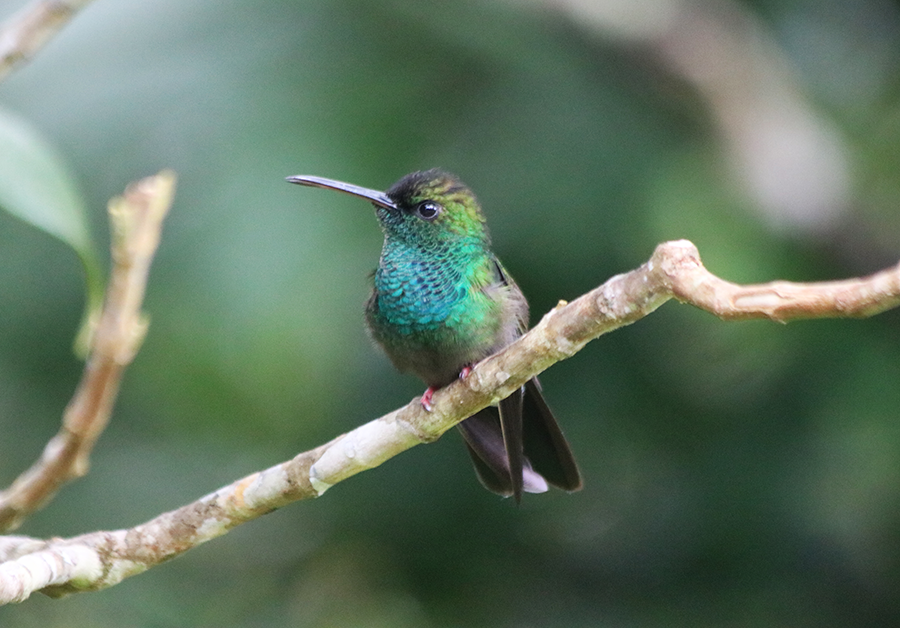
Wikimedia Commons
About the Blue-chested Hummingbird
The Blue-chested Hummingbird (Polyerata amabilis) is a small, vibrant bird that belongs to the family Trochilidae and the order Apodiformes. This species is native to the humid lowland forests and edges of Central and South America, where its presence is significant in the delicate ecological balance of these regions. The Blue-chested Hummingbird plays a crucial role as a pollinator, aiding in the reproduction of numerous tropical plant species. Typically found from eastern Honduras through Nicaragua, Costa Rica, and Panama, this hummingbird's range extends into the northern parts of Colombia and Ecuador. Polyerata amabilis often frequents the lower and mid-canopy of forested areas, where it can access its preferred food sources. The hummingbird's ecological role extends beyond pollination; it serves as prey for a variety of predators, thus contributing to the food web of its habitat. During the breeding season, which aligns with the rainy season in many parts of its range, the Blue-chested Hummingbird exhibits territorial behavior, establishing and defending feeding areas. These territories not only support their nutritional needs but also attract potential mates. Outside of the breeding season, the Blue-chested Hummingbird may display some seasonal movement in response to food availability, although it is largely considered a non-migratory species. By understanding the habits and habitats of this hummingbird, conservationists can better protect the biodiversity of its ecosystem.
The Blue-chested Hummingbird belongs to the family Trochilidae, within the order Apodiformes. These birds typically live average 4-6 years, with some individuals living up to 8 years..
How to Identify a Blue-chested Hummingbird
The Blue-chested Hummingbird is a small bird, measuring approximately 9-10 centimeters in length. Adults are characterized by their metallic green upperparts and a striking blue throat patch, which is more pronounced in males. Females, while similar, often have a less vibrant throat, appearing grayish or pale blue. Juveniles resemble females but lack the full brilliance of adult plumage. Both sexes have a white underbelly and flanks that may show a faint green wash. The tail is slightly forked and dark with white tips, aiding in identification. In flight, the Blue-chested Hummingbird's silhouette is compact, with rapid wingbeats typical of the hummingbird family. When perching, they exhibit a slightly hunched posture with tails often flicking. Due to its vibrant throat and green plumage, this hummingbird can be confused with species like the Blue-throated Goldentail. However, the latter has a more robust body and a different tail coloration. Observing the overall size and specific throat coloration helps distinguish the Blue-chested Hummingbird in the field.
Having trouble telling birds apart? Upload a photo to our bird identification tool for an instant species match.
Blue-chested Hummingbird Habitat and Range
Preferred Habitat
The Blue-chested Hummingbird primarily inhabits humid lowland forests and forest edges. It is commonly found at elevations ranging from sea level up to 1,200 meters. This bird is well-adapted to living in tropical environments, where it frequents areas rich in flowering plants and trees. In addition to primary forests, it also thrives in secondary growth and plantation areas, demonstrating some adaptability to habitat disturbance. While it is less common in dense urban environments, the Blue-chested Hummingbird can occasionally be found in gardens and parks that feature abundant flowering plants. Seasonal habitat shifts are minimal, as the bird tends to remain in regions where food sources are consistently available throughout the year.
Geographic Range
The Blue-chested Hummingbird's range extends from eastern Honduras through Nicaragua, Costa Rica, and Panama, reaching into the northern regions of Colombia and Ecuador. This bird occupies both the Caribbean and Pacific slopes in these countries, favoring lowland areas and foothills. It does not undertake long-distance migrations, but it may move locally in search of flowering plants. The population density of this species is highest in areas with lush vegetation and abundant floral resources, such as the lowland rainforests of Costa Rica and Panama. The hummingbird's presence in these regions supports its role in the pollination of various plant species, making it a critical component of the local ecosystems.
Want to know which birds visit your area? Browse our backyard birds by location guides for region-specific species lists.
What Does the Blue-chested Hummingbird Eat?
The Blue-chested Hummingbird primarily feeds on nectar from a wide range of flowering plants, including heliconias, bromeliads, and various species of flowering trees. The bird's long, specialized bill and tongue are adapted for extracting nectar deep within flowers. In addition to nectar, this hummingbird consumes small insects and spiders, providing essential protein and other nutrients. These insects are often caught in flight or picked off leaves and bark. Seasonal diet changes are driven by the availability of flowering plants, with the hummingbird adapting to the bloom cycles of its environment. The Blue-chested Hummingbird typically forages during daylight hours, with peak feeding occurring in the early morning and late afternoon when flowers are most abundant and nectar-rich.
Want to attract Blue-chested Hummingbirds to your yard? See our recommended feeders and seed types for the best results.
Blue-chested Hummingbird Behavior and Social Structure
The Blue-chested Hummingbird is primarily solitary, although it may be seen in loose aggregations where food sources are plentiful. Males are particularly territorial during the breeding season, aggressively defending feeding areas from intruders. Courtship displays involve aerial acrobatics, with males performing rapid dives and showcasing their vibrant throat patches to attract females. Outside of breeding, these hummingbirds are less territorial but remain vigilant against potential threats. When faced with predators, they rely on their agility and speed to evade capture. Daily activity patterns are largely dictated by the availability of food, with periods of intense foraging interspersed with rest periods in shaded perches. This hummingbird's social interactions are minimal, with communication largely limited to visual displays and occasional vocalizations.
Blue-chested Hummingbird Nesting and Reproduction
The Blue-chested Hummingbird constructs small, cup-shaped nests using plant fibers, spider silk, and lichen, camouflaging them against tree branches. These nests are typically located 1-3 meters above the ground, often on thin, horizontal branches or within dense foliage. The female is solely responsible for nest building, incubation, and rearing of the young. A typical clutch consists of two white eggs, with an incubation period of approximately 14-16 days. After hatching, the chicks remain in the nest for about 20-22 days before fledging. The female continues to feed and care for the fledglings for several weeks post-fledging. The Blue-chested Hummingbird usually raises one to two broods per year, depending on environmental conditions and food availability.
Blue-chested Hummingbird Sounds and Vocalizations
The Blue-chested Hummingbird's vocalizations include a series of high-pitched, rapid chips and twitters, often heard during territorial disputes or courtship displays. The primary song consists of a fast, repetitive sequence, varying slightly in pitch and intensity. Alarm calls are sharp and penetrating, serving to alert other birds of potential threats. During the dawn chorus, these hummingbirds can be heard singing persistently, contributing to the cacophony of sounds typical of tropical forests. While their calls may not be as melodious as those of songbirds, the Blue-chested Hummingbird's vocalizations play a crucial role in communication and territory defense.
Interesting Facts About the Blue-chested Hummingbird
- 1Despite their small size, Blue-chested Hummingbirds can beat their wings up to 80 times per second, creating a humming sound.
- 2The Blue-chested Hummingbird's heart beats over 1,200 times per minute during flight, supporting its rapid energy demands.
- 3Unlike other birds, the Blue-chested Hummingbird can fly backward and hover, thanks to its unique wing structure.
- 4This species has a high metabolism and must consume twice its body weight in nectar daily to maintain energy levels.
- 5The Blue-chested Hummingbird's iridescent plumage results from microscopic platelets in its feathers, reflecting light.
- 6During courtship, male Blue-chested Hummingbirds perform a unique U-shaped aerial display to attract females.
- 7The Blue-chested Hummingbird can enter a state of torpor to conserve energy during periods of cold or food scarcity.
Blue-chested Hummingbird Conservation Status
The Blue-chested Hummingbird is currently listed as Least Concern by the IUCN, with populations considered stable. However, habitat loss due to deforestation and land conversion poses ongoing threats. Conservation efforts focus on preserving critical habitats and promoting sustainable land-use practices. Protection of lowland forests in Central and South America is vital for maintaining population stability. Historically, this species has shown resilience to moderate habitat changes, but continued deforestation could lead to declines. Monitoring population trends and implementing conservation strategies will help ensure the long-term survival of the Blue-chested Hummingbird.
Attracting Blue-chested Hummingbirds to Your Feeder
The Blue-chested Hummingbird is a regular visitor to backyard bird feeders across its range. At the Eye On The Fly feeding station, we observe Blue-chested Hummingbirds regularly and capture footage with our feeder cameras.


