
Blue-crowned Chlorophonia
Chlorophonia occipitalis
Order: Passeriformes / Family: Fringillidae
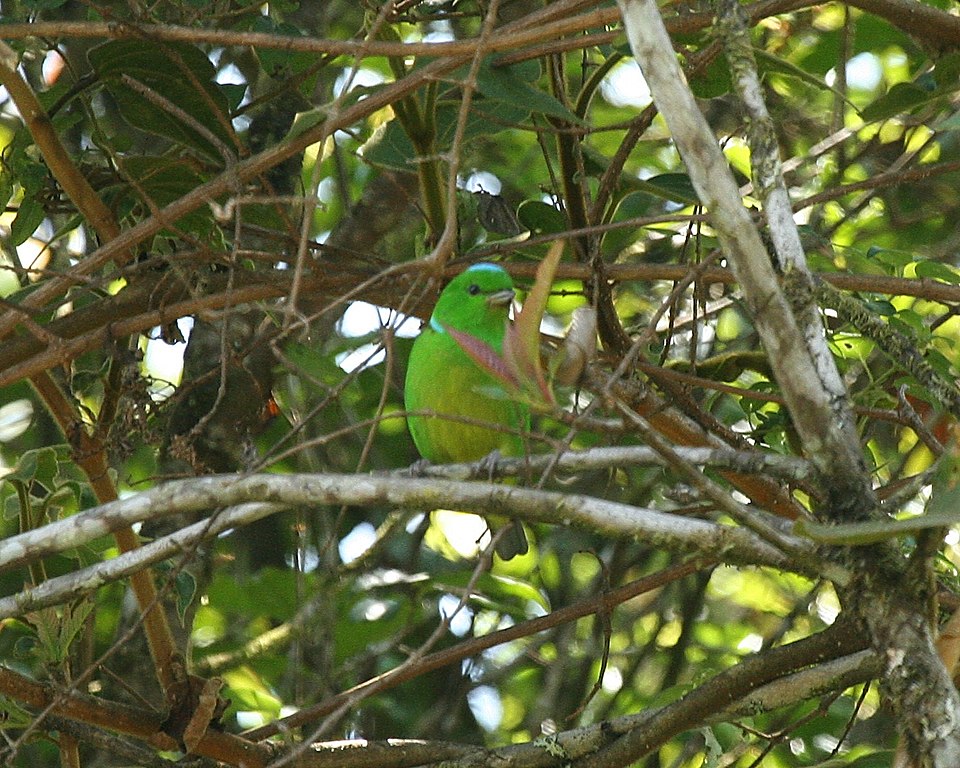
Wikimedia Commons
About the Blue-crowned Chlorophonia
The Blue-crowned Chlorophonia (Chlorophonia occipitalis) is a vibrant, small songbird belonging to the Fringillidae family. This bird is primarily found in the humid montane forests of Central America, stretching from southern Mexico through Guatemala, and into Honduras and Nicaragua. Its striking colors make it an eye-catching resident of the canopy, where it plays a significant ecological role as a frugivore. The bird primarily consumes a variety of fruits and berries, aiding in the dispersal of seeds throughout the forest ecosystem. By feeding on these fruits, the Blue-crowned Chlorophonia contributes to the maintenance of plant diversity and forest regeneration. During the breeding season, which typically occurs from March to June, they become more vocal and territorial. Males often engage in courtship displays to attract females, showcasing their vivid plumage. Outside the breeding season, these birds tend to form small flocks, roaming the forest in search of food. The Blue-crowned Chlorophonia's ecological role extends beyond seed dispersal. It also serves as a prey species for larger birds and mammals, playing a part in the food web dynamics. Despite its ecological importance, the bird's population faces challenges from habitat destruction and fragmentation. Deforestation for agriculture and urban development poses significant threats to its natural habitat. Conservation efforts aimed at preserving tropical montane forests are crucial for the survival of the Blue-crowned Chlorophonia and the myriad of other species that share its habitat. These birds are typically found at elevations ranging from 900 to 2,500 meters, favoring areas with dense foliage and abundant fruit resources.
The Blue-crowned Chlorophonia belongs to the family Fringillidae, within the order Passeriformes. These birds typically live average 6 years, with a maximum recorded of 9 years..
How to Identify a Blue-crowned Chlorophonia
The Blue-crowned Chlorophonia is easily identified by its bright green body and distinctive blue crown, a feature that sets it apart from other birds in its range. Adult males display more vibrant coloration than females, with a deeper blue on the crown and more pronounced green on the back. Females, while similar in size, have a slightly duller appearance, lacking the intensity of the male's plumage. Juveniles resemble females but may exhibit even less distinct coloration, blending more into the leafy backdrop of their forest home. In flight, the Blue-crowned Chlorophonia presents a compact silhouette with relatively short wings and a squared-off tail, allowing it to maneuver deftly through the dense canopy. When perched, these birds often adopt an upright posture, their bright colors making them conspicuous against the greenery. The Blue-crowned Chlorophonia can be confused with other green and blue birds within its range, such as certain species of manakins or euphonias. However, the combination of its specific crown color and overall size is distinctive. Observers should note the bird's size, which is small, typically around 13 cm in length, making it one of the smaller members of its family.
Having trouble telling birds apart? Upload a photo to our bird identification tool for an instant species match.
Blue-crowned Chlorophonia Habitat and Range
Preferred Habitat
Blue-crowned Chlorophonias inhabit the humid, montane forests of Central America. They prefer areas with dense canopy cover where fruiting trees are abundant. These birds are generally found at elevations between 900 and 2,500 meters, often in cloud forests or at the edges of highland forests. While they are predominantly forest dwellers, they occasionally venture into adjacent secondary growth and plantations, particularly if fruiting trees are present. During the breeding season, their habitat preferences remain consistent, as they require the same resources for feeding and nesting. Seasonal shifts in habitat are minimal for this species, as they do not migrate long distances. However, they may move within their range in search of food. Urban presence of the Blue-crowned Chlorophonia is rare, given their preference for forested environments, though they may be encountered in forested parks or green spaces within rural or semi-urban areas.
Geographic Range
The Blue-crowned Chlorophonia's range is relatively restricted to the montane forests of Central America. They breed and reside year-round in southern Mexico, particularly in the states of Chiapas and Oaxaca, extending through Guatemala and into Honduras and Nicaragua. These birds are non-migratory, generally remaining within their altitudinal range throughout the year. In terms of population density, they are often more numerous in undisturbed forest areas with abundant fruiting trees. However, their presence can be patchy, influenced by the availability of suitable habitat and food resources. Despite their limited range, they are considered fairly common within appropriate habitats, although localized declines have been observed in areas subjected to deforestation.
Want to know which birds visit your area? Browse our backyard birds by location guides for region-specific species lists.
What Does the Blue-crowned Chlorophonia Eat?
The diet of the Blue-crowned Chlorophonia is predominantly frugivorous, consisting mainly of small fruits and berries. They are particularly fond of mistletoe berries and the fruits of various forest trees. Occasionally, they supplement their diet with insects, providing an important source of protein. These birds forage actively, often seen hopping through the foliage or hanging upside down to reach fruits. Their foraging behavior is methodical, and they tend to feed in the early morning and late afternoon when temperatures are cooler and fruit activity is high. During the dry season, when fruit availability may be lower, the Blue-crowned Chlorophonia may expand its diet to include a higher proportion of insects and other invertebrates. They tend to forage alone or in pairs during the breeding season but may join mixed-species flocks at other times, which can increase foraging efficiency and reduce predation risk.
Blue-crowned Chlorophonia Behavior and Social Structure
The Blue-crowned Chlorophonia exhibits a variety of social and territorial behaviors. During the breeding season, males become highly territorial, often seen defending their chosen area with frequent vocalizations and displays. These displays include fluffing of feathers and rapid wing flapping to showcase their vibrant plumage. Courtship involves elaborate song duets between males and females, strengthening pair bonds. Outside the breeding season, these birds are more social, forming small flocks that traverse the forest in search of food. They exhibit a degree of site fidelity, often returning to the same areas to forage and nest. Their daily activity pattern is generally diurnal, with peak activity in the early morning and late afternoon. In response to predators, the Blue-crowned Chlorophonia relies on its agility and cryptic plumage, which can blend with the canopy leaves. They also exhibit alarm calls to warn other birds of dangers. Although not highly aggressive, they defend their nesting territory vigorously from potential threats.
Blue-crowned Chlorophonia Nesting and Reproduction
The nesting habits of the Blue-crowned Chlorophonia involve the construction of a well-concealed nest, typically placed in the dense foliage of a tree or shrub. The nest is a cup-like structure made from a combination of moss, leaves, and fine rootlets, providing excellent camouflage among the greenery. Females primarily undertake nest building, although males may assist by gathering materials. The clutch size usually consists of 2 to 3 eggs, which the female incubates for approximately 14 days. During this period, the male may help by bringing food to the nesting female. Once hatched, the chicks remain in the nest for about 18 to 21 days before fledging. Both parents participate in feeding the chicks, ensuring a balanced diet of fruit and insects. Typically, the Blue-crowned Chlorophonia raises one brood per year, although in favorable conditions, a second brood may be attempted.
Blue-crowned Chlorophonia Sounds and Vocalizations
The primary song of the Blue-crowned Chlorophonia is a series of clear, melodious whistles that rise and fall in pitch, creating a lilting rhythm that travels well through the forest canopy. These songs are often delivered from high perches, especially during the breeding season. Call notes are soft chirps and trills, used primarily for communication between mates or flock members. Alarm calls are sharp and abrupt, serving to alert other birds of potential threats, such as predators. During the dawn chorus, the Blue-crowned Chlorophonia becomes particularly vocal, contributing to the rich tapestry of sounds that characterize tropical forests. Their song can be compared to the mellow whistles of certain tanagers, though with a more varied pitch.
Interesting Facts About the Blue-crowned Chlorophonia
- 1The Blue-crowned Chlorophonia's diet of mistletoe berries aids in the propagation of this parasitic plant, contributing to forest biodiversity.
- 2These birds are known to occasionally join mixed-species flocks, benefiting from the increased vigilance and foraging success of such groups.
- 3Despite their vibrant colors, Blue-crowned Chlorophonias can be surprisingly difficult to spot in the dense canopy due to their excellent camouflage.
- 4Their song, while melodious, has a unique pattern that researchers use to identify individuals within a population.
- 5The Blue-crowned Chlorophonia's small size, around 13 cm, makes it one of the more diminutive members of the Fringillidae family.
- 6These birds are predominantly found at elevations between 900 and 2,500 meters, thriving in humid montane environments.
- 7The name 'Chlorophonia' derives from Greek, meaning 'green voice', a nod to both their plumage and vocal abilities.
Blue-crowned Chlorophonia Conservation Status
Currently, the Blue-crowned Chlorophonia is listed as Least Concern by the IUCN, although population trends indicate a gradual decline due to habitat destruction. The primary threat to this species is deforestation for agriculture, logging, and urban expansion. Conservation efforts focus on preserving montane forest habitats and establishing protected areas. Initiatives to restore degraded habitats are also in place, aiming to provide these birds with suitable environments for feeding and nesting. Historically, populations may have been more widespread before extensive deforestation reduced available habitat. Continued monitoring and habitat conservation are necessary to ensure the long-term survival of the Blue-crowned Chlorophonia.


