
Blue-throated Piping-Guan
Pipile cumanensis
Order: Galliformes / Family: Cracidae
Wikimedia Commons
About the Blue-throated Piping-Guan
The Blue-throated Piping-Guan (Pipile cumanensis) is a striking bird native to the lush tropical forests of South America. Known for its vibrant blue throat and distinctive white-spotted plumage, this bird belongs to the Cracidae family, which includes other guans, chachalacas, and curassows. These birds play an essential ecological role as seed dispersers in their habitats, contributing to forest regeneration and plant diversity. Found primarily in lowland regions, the Blue-throated Piping-Guan thrives in countries such as Brazil, Peru, Bolivia, and Venezuela. Its preference for dense forest canopies makes it a somewhat elusive species, often more easily heard than seen. These birds are non-migratory, residing in their tropical habitats throughout the year. They occupy varied forest types, including terra firme forests, seasonally flooded forests, and disturbed habitats near riverine areas. During the breeding season, which coincides with the wet season, the Blue-throated Piping-Guan's calls become more frequent and conspicuous, as males vocalize to establish territories and attract mates. The species is primarily arboreal, spending most of its time in the upper canopy layers where it forages for fruits, leaves, and seeds. Their role as frugivores is vital; by consuming a range of fruiting plants, they contribute significantly to the dispersal of seeds across vast forested areas. This function is crucial for maintaining the biodiversity and structural complexity of tropical ecosystems. The Blue-throated Piping-Guan, although not currently listed as threatened, faces challenges due to habitat destruction and hunting. Deforestation for agriculture and logging poses a significant threat, as it leads to habitat fragmentation and loss. In some regions, hunting for meat also impacts local populations. Conservation efforts focus on habitat preservation and sustainable land use practices. The presence of these guans often indicates healthy forest ecosystems, making them important focal species for conservation initiatives. Observing this bird in its natural setting offers insight into the complex web of interactions within tropical forests, highlighting the interconnectedness of species and the importance of preserving biodiversity.
The Blue-throated Piping-Guan belongs to the family Cracidae, within the order Galliformes. These birds typically live typically 15 years, with some individuals living up to 20 years..
How to Identify a Blue-throated Piping-Guan
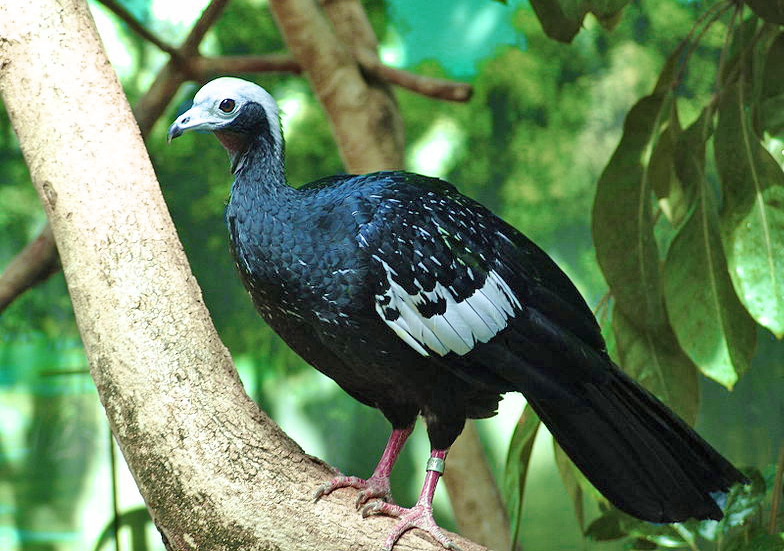
The Blue-throated Piping-Guan is a medium-sized bird measuring between 70 to 80 cm in length. Its plumage predominantly features black feathers adorned with white spots, especially noticeable on the wings and back. The most striking feature is the vivid blue throat, which contrasts sharply with the overall dark plumage. The face and crown are primarily black, with a slight iridescent sheen. In terms of sexual dimorphism, males and females appear similar, though males may be slightly larger and more robust. Juveniles are generally duller, lacking the fully developed blue throat and having more muted spotting. In flight, the Blue-throated Piping-Guan displays broad, rounded wings and a long tail, which aid in its maneuverability through dense forest canopies. Its flight silhouette can resemble that of a large pigeon, but its distinct throat coloration and call set it apart from similar species. When perched, this guan often holds an erect posture, allowing for easier recognition of its distinctive throat patch. Confusion may arise with other guan species, such as the Spix's Guan, but the Blue-throated Piping-Guan’s unique throat coloration is a reliable field mark for differentiation.
Having trouble telling birds apart? Upload a photo to our bird identification tool for an instant species match.
Blue-throated Piping-Guan Habitat and Range
Preferred Habitat
The Blue-throated Piping-Guan primarily inhabits lowland tropical forests, favoring dense, humid environments. It thrives in terra firme forests, which remain unflooded throughout the year, as well as in seasonally flooded varzea and igapó forests. These birds can often be found at elevations ranging from sea level to approximately 800 meters. While they predominantly prefer forest interiors, they occasionally venture into secondary growth and disturbed habitats near water bodies. Despite their adaptability to different forest types, they are less commonly found in urban areas, where habitat fragmentation is more pronounced. During the rainy season, increased food availability in forest canopies may influence some seasonal shifts within their range, but they remain largely sedentary year-round.
Geographic Range
The Blue-throated Piping-Guan has a distribution that spans several countries in northern and central South America. Its range includes Brazil, Peru, Bolivia, Ecuador, Colombia, and Venezuela. Within these countries, the bird occupies a range of forested habitats from the Amazon Basin to the eastern slopes of the Andes. The species does not exhibit long-distance migration but may show some local movements in response to seasonal food availability. Population densities are highest in undisturbed forest areas, though they can also persist in fragmented habitats if sufficient canopy cover remains. The absence of major migratory behavior means that their presence is relatively constant across their range, contributing to their role as a stable component of tropical forest ecosystems.
Want to know which birds visit your area? Browse our backyard birds by location guides for region-specific species lists.
What Does the Blue-throated Piping-Guan Eat?
The diet of the Blue-throated Piping-Guan is primarily frugivorous, consisting mainly of fruits and leaves. These birds favor a wide variety of fruiting trees and plants, playing a crucial role in seed dispersal. They are known to consume fruits from Cecropia, Ficus, and Spondias species, among others. Their feeding habits vary with the seasons, as they take advantage of different fruiting cycles within the forest. During the wet season, when fruit availability peaks, their diet becomes more diverse. Blue-throated Piping-Guans forage by moving methodically through the forest canopy, using their strong bills to pluck fruits and leaves. Occasionally, they descend to the forest floor to consume fallen fruits, but they spend most of their foraging time in the trees. Their foraging activity peaks during the early morning and late afternoon, aligning with cooler temperatures and the availability of ripened fruits.
Blue-throated Piping-Guan Behavior and Social Structure
The Blue-throated Piping-Guan exhibits intriguing social behaviors, often seen in small family groups or pairs. These birds are generally non-territorial but can become more vocal and assertive during the breeding season, as males defend their chosen areas through vocal displays. The males' calls, a series of piping notes, serve as both territorial declarations and courtship displays to attract females. Courtship involves elaborate displays where the male fans its tail and bows while vocalizing. These displays occur primarily in the early morning hours. Blue-throated Piping-Guans exhibit a diurnal activity pattern, spending daylight hours foraging and resting. Their response to predators involves vigilant behavior and the use of dense foliage for cover. When threatened, they rely on their cryptic plumage to blend into the forest backdrop. Though primarily arboreal, they occasionally descend to the ground, especially when accessing water sources or fallen fruits.
Blue-throated Piping-Guan Nesting and Reproduction
The nesting behavior of the Blue-throated Piping-Guan involves selecting high, secluded branches within dense forest canopies. Their nests are typically constructed from sticks and twigs, lined with leaves for added comfort and insulation. Female guans are primarily responsible for nest building. A typical clutch consists of two to three eggs, which are cream-colored with a slight sheen. The incubation period lasts about 24 to 28 days, during which the female performs most of the incubation duties. The male remains nearby, providing protection and occasionally assisting in feeding once the chicks hatch. After hatching, the chicks are cared for by both parents, with fledging occurring about six weeks post-hatching. This species usually raises one brood per year, coinciding with the wet season when food resources are abundant.
Blue-throated Piping-Guan Sounds and Vocalizations
The primary song of the Blue-throated Piping-Guan is characterized by a series of clear, piping notes which can be heard reverberating through the forest canopy. These notes have a melodious, flute-like quality, repeated in a rhythmic pattern. Their calls serve multiple purposes, including mate attraction and territory establishment during the breeding season. In addition to their primary song, they emit a variety of call notes used for communication within groups, ranging from soft clucks to harsher alarm calls when predators are near. During the dawn chorus, their vocalizations become more frequent, creating a vibrant soundscape as they join other forest inhabitants in a morning symphony. These calls, while distinctive, can be confused with those of other guan species, but their unique pitch and rhythm often aid in proper identification.
Interesting Facts About the Blue-throated Piping-Guan
- 1The Blue-throated Piping-Guan can live up to 15 years in the wild, indicating its adaptability to the forest environment.
- 2These birds are crucial seed dispersers, aiding in the propagation of over 60 plant species within their range.
- 3The Blue-throated Piping-Guan is often mistaken for a turkey due to its size and shape, despite being unrelated.
- 4Their striking blue throat serves not only as a field mark but also plays a role in courtship displays.
- 5Despite their size, Blue-throated Piping-Guans are adept at navigating dense forest canopies with surprising agility.
- 6This species' vocalizations can be heard over 500 meters away, making it easier to locate them within thick forests.
- 7Unlike many forest birds, Blue-throated Piping-Guans do not exhibit significant migratory behavior, remaining year-round residents.
Blue-throated Piping-Guan Conservation Status
The Blue-throated Piping-Guan is currently listed as Least Concern by the IUCN, with a stable population trend. However, its survival faces threats from habitat destruction and hunting. Deforestation for agricultural expansion and logging continue to fragment their habitat, reducing available living space and food sources. Hunting, although less widespread, still poses a threat in some regions where the guans are sought for their meat. Conservation efforts focus on habitat protection and sustainable land management practices, aiming to preserve the remaining forested areas and maintain ecological balance. Monitoring population trends and promoting awareness among local communities remain crucial for ensuring the long-term survival of this species. Historically, the Blue-throated Piping-Guan maintained a more extensive range, but habitat loss has led to localized declines in certain areas.


