
Blyth's Hawk-Eagle
Nisaetus alboniger
Order: Accipitriformes / Family: Accipitridae
Wikimedia Commons
About the Blyth's Hawk-Eagle
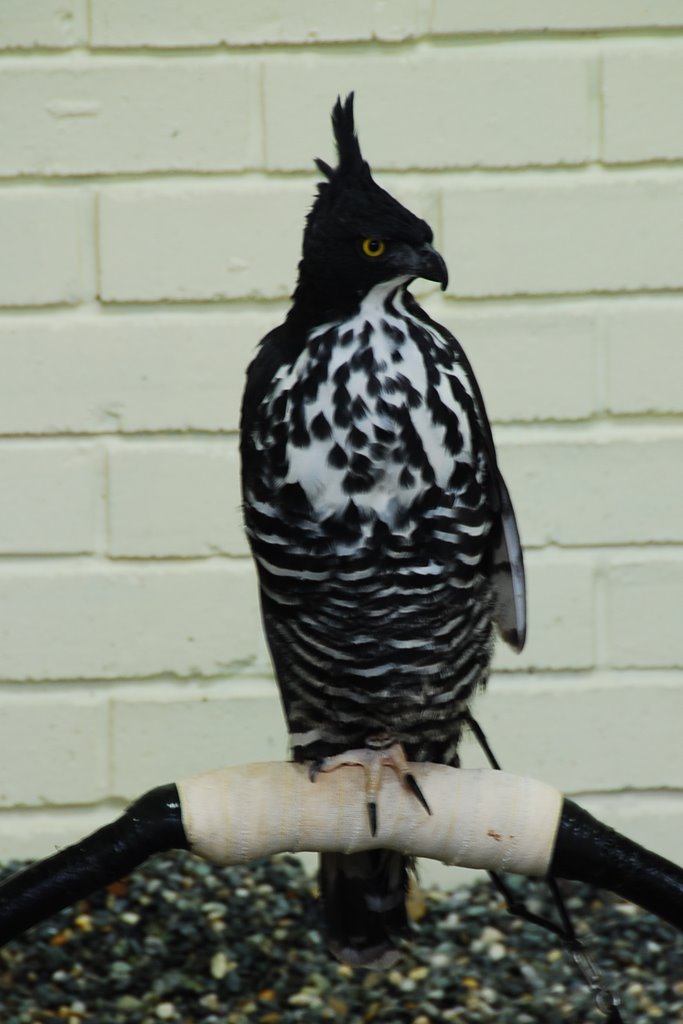
The Blyth's Hawk-Eagle, scientifically known as Nisaetus alboniger, is a captivating bird of prey belonging to the Accipitridae family. It is found primarily in Southeast Asia, inhabiting the dense forests and mountainous regions of countries such as Malaysia, Indonesia, and Thailand. This eagle is medium-sized, measuring about 50 to 65 centimeters in length, with a wingspan of approximately 110 to 135 centimeters. Its striking appearance, characterized by a black and white plumage pattern, makes it a fascinating subject for ornithologists and bird enthusiasts alike.
Blyth's Hawk-Eagle plays a significant role in its ecosystem as a top predator, helping to regulate the populations of various prey species. Its diet mainly consists of small mammals, birds, and reptiles, which it hunts with remarkable agility and precision. The presence of this eagle indicates a healthy, biodiverse environment, as it requires a robust prey base and intact forest habitats to thrive.
This species exhibits some seasonal behaviors, such as moving to lower elevations during the rainy season when food becomes scarce at higher altitudes. Despite its adaptability, the Blyth's Hawk-Eagle faces threats from habitat destruction and fragmentation due to logging, agriculture, and urban expansion. Conservation efforts focusing on habitat preservation are crucial to ensure the survival of this majestic bird.
The Blyth's Hawk-Eagle's ecological role extends to seed dispersal, as it may inadvertently transport seeds from the fruits consumed by its prey. This contributes to the regeneration of forest areas, further underscoring its importance in maintaining ecosystem balance. Through its predatory activities, the eagle also helps control the population of potential pest species, benefiting agricultural areas adjacent to its forest habitats.
The Blyth's Hawk-Eagle belongs to the family Accipitridae, within the order Accipitriformes. These birds typically live up to 15 years in the wild, with some individuals reaching 20 years..
How to Identify a Blyth's Hawk-Eagle
The Blyth's Hawk-Eagle is easily identified by its bold black and white plumage, which provides excellent camouflage in its forested habitat. Adults possess a distinctive black crown and nape with a short crest, contrasting sharply with their white underparts. The wings and back display a rich, dark brown to black coloration, often with fine barring. Juveniles differ in appearance, exhibiting more mottled brown plumage with less pronounced crest development. As they mature, their plumage gradually shifts to the striking adult pattern.
Sexual dimorphism in Blyth's Hawk-Eagle is subtle, with females generally larger than males but sharing similar plumage characteristics. This size difference aids in identification during field observations, particularly when the pair is sighted together.
In flight, the Blyth's Hawk-Eagle presents a silhouette characterized by broad, rounded wings and a relatively long tail. The underwings are marked with a distinctive black and white patterning that can aid in identification from a distance. When perched, this eagle often adopts an upright posture, exuding an air of alertness and dominance. It may be confused with other raptors like the Mountain Hawk-Eagle, but can be distinguished by its more contrasting coloration and shorter crest.
Having trouble telling birds apart? Upload a photo to our bird identification tool for an instant species match.
Blyth's Hawk-Eagle Habitat and Range
Preferred Habitat
Blyth's Hawk-Eagle inhabits dense tropical forests and mountainous regions, typically within altitudes ranging from 300 to 2,200 meters. It is most commonly found in primary and secondary forests, where sufficient tree cover provides ample hunting opportunities and nesting sites. The species shows a preference for areas with tall, mature trees, which it uses for nesting and as vantage points for scanning the forest floor for prey.
Seasonal habitat shifts occur in response to changes in prey availability and climatic conditions. During the rainy season, the eagle may descend to lower elevations, where prey is more abundant. While predominantly a forest-dweller, Blyth's Hawk-Eagle occasionally ventures into adjacent open areas and agricultural lands, particularly when foraging.
Urban presence is rare for this species, as it relies heavily on intact forest habitats for survival. Conservation of these key habitats is vital, as habitat loss poses a significant threat to its population. Preserving large tracts of forestland will ensure the continued presence of this remarkable raptor.
Geographic Range
The range of Blyth's Hawk-Eagle spans several Southeast Asian countries, including Malaysia, Indonesia, Thailand, and parts of Myanmar and Vietnam. This species is resident, meaning it does not undertake long-distance migrations, although it may exhibit local movements in response to seasonal changes in food resources.
In Malaysia, Blyth's Hawk-Eagle is commonly observed in the northern and central regions, especially in the Titiwangsa Mountain Range, which provides ideal habitat conditions. In Indonesia, it is found on the islands of Sumatra and Borneo, where extensive forest cover supports its ecological needs. Thailand's western forests also host populations of this eagle, although sightings are less frequent compared to other regions.
Population density varies across its range, with higher concentrations typically found in areas where forest cover is extensive and prey is abundant. Conservation hotspots include Malaysia's Endau-Rompin National Park and Indonesia's Gunung Leuser National Park, which offer protected environments crucial for the eagle's survival. The species' preference for remote and rugged terrain often makes field studies challenging, but it also provides some protection from human disturbances.
Want to know which birds visit your area? Browse our backyard birds by location guides for region-specific species lists.
What Does the Blyth's Hawk-Eagle Eat?
The diet of Blyth's Hawk-Eagle primarily consists of small to medium-sized mammals, birds, and reptiles. Common prey items include squirrels, rodents, small primates, and various bird species. The eagle exhibits opportunistic feeding behavior, adjusting its diet based on prey availability, which can vary seasonally.
During the breeding season, when energy demands are higher, the eagle tends to focus on more substantial prey to meet the nutritional needs of its growing young. In contrast, during leaner months, it may resort to smaller, more readily available prey items.
Blyth's Hawk-Eagle employs a variety of foraging techniques, including still hunting from a perch, soaring over forest canopies, and engaging in short, rapid flights to surprise and capture prey. Its acute vision allows it to detect movement from a considerable distance, enhancing its hunting efficiency. Prey size typically ranges from small birds and reptiles to larger mammals weighing several kilograms. The feeding schedule often involves early morning and late afternoon hunts, taking advantage of peak activity periods for many prey species.
Blyth's Hawk-Eagle Behavior and Social Structure
Blyth's Hawk-Eagle exhibits solitary or pair-based social structures, with individuals maintaining distinct territories that they aggressively defend against intruders. Territorial displays include soaring flights accompanied by loud, piercing calls that serve to deter potential rivals.
Courtship behavior in Blyth's Hawk-Eagle is elaborate, involving aerial displays where pairs engage in synchronized flight patterns, including soaring, circling, and occasionally performing talon grappling. These displays reinforce pair bonds and signify reproductive readiness.
The eagle's daily activity pattern generally follows a diurnal schedule, with peak activity occurring during early morning and late afternoon. During the heat of the day, it often takes refuge in dense foliage to avoid high temperatures.
When responding to potential predators or threats, Blyth's Hawk-Eagle employs a combination of vocalizations and aggressive posturing. It may also engage in mobbing behavior with neighboring eagles or other raptor species to drive away larger threats. Flocking is uncommon, as this species typically operates in isolation or with its mate, emphasizing its territorial nature.
Blyth's Hawk-Eagle Nesting and Reproduction
Blyth's Hawk-Eagle constructs large stick nests high in the canopy of tall trees, often selecting sites that provide a commanding view of its territory. Nest materials include sticks, branches, and foliage, providing a sturdy platform for egg-laying and chick-rearing.
The species shows a preference for nesting in primary forest areas, where mature trees offer the necessary height and stability. Clutch size typically consists of one to two eggs, with both parents sharing incubation duties, which last approximately 40 to 45 days.
Upon hatching, chicks are dependent on their parents for food and protection. Both the male and female participate in hunting and feeding the young, demonstrating a strong parental bond. The fledging timeline spans around 60 to 70 days, after which the juveniles begin to explore their surroundings, gradually gaining independence.
Blyth's Hawk-Eagle usually raises a single brood per year, though factors such as food availability and environmental conditions can influence reproductive success. Parental roles are well-defined, with the female primarily attending to the nestlings while the male focuses on securing food.
Blyth's Hawk-Eagle Sounds and Vocalizations
The vocalizations of Blyth's Hawk-Eagle are distinctive, characterized by high-pitched, whistling calls that resonate through the forest canopy. These calls, often described as sharp and piercing, serve multiple functions, including territory defense, mate attraction, and communication between pairs.
Alarm calls are more rapid and intense, signaling the presence of potential predators or threats. During the dawn chorus, these eagles contribute a lively rhythm to the forest soundscape, marking their presence and establishing their territory.
Compared to familiar sounds, the primary song of Blyth's Hawk-Eagle resembles a prolonged whistle, similar to a train's distant horn, but with a more melodious quality. The variety of calls used by this species underscores its complex communication system, vital for maintaining social bonds and coordinating hunting activities.
Interesting Facts About the Blyth's Hawk-Eagle
- 1Blyth's Hawk-Eagle is named after Edward Blyth, a 19th-century English zoologist who contributed significantly to Indian ornithology.
- 2This raptor's talons are incredibly strong, capable of exerting pressure over 300 psi, allowing it to grip and subdue prey efficiently.
- 3Blyth's Hawk-Eagle can spot a moving object from more than a kilometer away, highlighting its exceptional vision.
- 4Despite its powerful build, the eagle's flight is remarkably silent, an adaptation that aids in stealthy hunting.
- 5The species is known to engage in playful aerial maneuvers, such as somersaults and dives, particularly during courtship displays.
- 6Blyth's Hawk-Eagle occasionally consumes fruits indirectly by preying on frugivorous animals, thus aiding in seed dispersal.
- 7In some cultures, the eagle is considered a symbol of strength and keen insight, revered for its hunting prowess.
Blyth's Hawk-Eagle Conservation Status
Blyth's Hawk-Eagle currently holds a conservation status of 'Near Threatened' according to the IUCN Red List. The population is experiencing a decline primarily due to habitat destruction and fragmentation, driven by logging, agricultural expansion, and urban development. Conservation efforts focus on habitat preservation, with protected areas and national parks playing a crucial role in safeguarding remaining populations. Historical data suggest a more widespread distribution in the past, with current trends indicating a contraction of its range. Efforts to mitigate threats include promoting sustainable forestry practices and fostering community awareness about the importance of preserving forest ecosystems. Successful conservation strategies will require collaboration between governments, NGOs, and local communities to address the root causes of habitat loss.
Other Accipitridae Species


Birds Similar to the Blyth's Hawk-Eagle
These species are often confused with the Blyth's Hawk-Eagle due to similar appearance or overlapping range.
