
Bradfield's Swift
Apus bradfieldi
Order: Apodiformes / Family: Apodidae
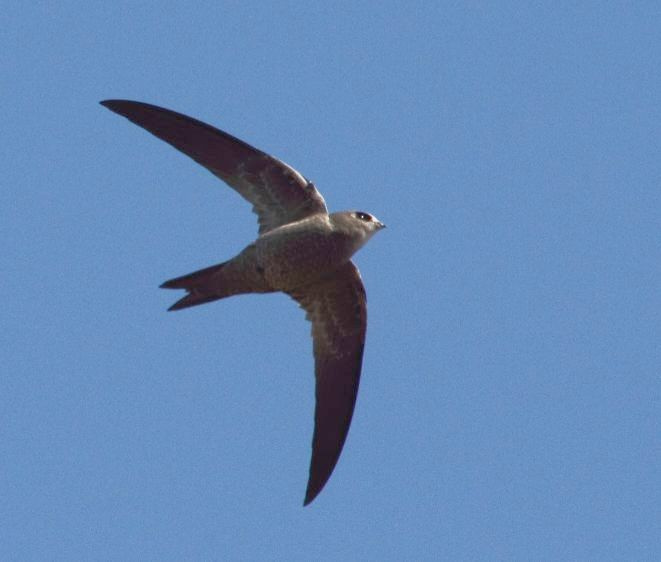
Wikimedia Commons
About the Bradfield's Swift
Bradfield's Swift, Apus bradfieldi, is an impressive bird species belonging to the Apodidae family, which includes some of the most skilled aerialists of the avian world. This swift is primarily found in the arid and semi-arid regions of southwestern Africa, including Namibia, Botswana, Angola, and parts of South Africa. It is a species that thrives in open skies, often seen soaring and gliding over savannas and grasslands. The ecological role of Bradfield's Swift is significant, as it plays a crucial part in controlling insect populations. During the breeding season, these swifts gather in large numbers, creating a spectacle of synchronized flight patterns. The swift's presence is most notable in regions such as the Namib Desert, where it capitalizes on thermal updrafts to sustain its long periods of flight without needing to land frequently. Seasonal behaviors of Bradfield's Swift are adapted to the climates of its native range. Breeding typically occurs during the wetter months, when food sources are more abundant. This timing ensures that their young have an ample supply of insects, particularly flying ants and termites, which form the bulk of their diet. As insectivores, Bradfield's Swifts contribute to the ecological balance by preying on insects that might otherwise reach pest proportions. This swift's reliance on specific weather patterns and insect availability ties its life cycle closely to the environment, making it a sensitive indicator of ecological changes in the region.
The Bradfield's Swift belongs to the family Apodidae, within the order Apodiformes. These birds typically live average 6 years, with a maximum recorded of 14 years..
How to Identify a Bradfield's Swift
The Bradfield's Swift is medium-sized, measuring about 16 to 18 cm in length with a wingspan ranging from 40 to 44 cm. Its plumage is predominantly dark brown to black, offering excellent camouflage against the sky during flight. Unlike many birds, there is minimal sexual dimorphism in this species, meaning males and females look alike. Juveniles can be distinguished by slightly paler plumage and a less glossy appearance compared to adults. The swift's wings are long and scythe-shaped, an adaptation for sustained flight and agility, while its tail is short and forked, assisting in maneuverability. Confusion with other swift species can occur, particularly with the Common Swift (Apus apus) and the African Black Swift (Apus barbatus). However, Bradfield's Swift can be distinguished by its size and slightly forked tail. In flight, it exhibits a rapid, fluttering wingbeat interspersed with glides. When perched, which is a rare sight, the bird clings vertically to surfaces, often in shaded crevices or overhangs, displaying its short legs and wide gape designed for catching insects.
Having trouble telling birds apart? Upload a photo to our bird identification tool for an instant species match.
Bradfield's Swift Habitat and Range
Preferred Habitat
Bradfield's Swift is predominantly found in open habitats like savannas, semi-deserts, and grasslands. It favors areas with wide open skies and minimal obstructions for its aerial lifestyle. Elevation ranges from sea level up to 2,000 meters, with the swift often seen in the Namib Desert and the Kalahari. Seasonal habitat shifts are not drastic, but during breeding, these swifts may move to areas with higher insect activity, often near water sources. In urban settings, they are occasionally spotted flying over towns and cities, especially those near suitable natural habitats. Despite their adaptability, Bradfield's Swifts are less commonly found in densely forested areas, where their flight style is less effective.
Geographic Range
Bradfield's Swift has a range that primarily encompasses southwestern Africa. Its breeding range includes the arid regions of Namibia and Botswana, with populations also present in Angola and South Africa. During the non-breeding season, these swifts remain largely within the same geographic area, although they may travel locally in search of food or favorable conditions. Migration corridors are not well-defined, as the species is largely resident in its range. Population density is highest in areas with abundant insect prey and suitable nesting sites, such as rocky cliffs and gorges found in the Namib Desert and the Waterberg Plateau.
Want to know which birds visit your area? Browse our backyard birds by location guides for region-specific species lists.
What Does the Bradfield's Swift Eat?
The diet of Bradfield's Swift consists mainly of flying insects, making it an important insectivore in its ecosystem. Primary food sources include termites, flying ants, and various beetles. During the wet season, when insect populations peak, these swifts capitalize on the abundance of prey to feed their young. Foraging takes place almost exclusively on the wing, with swifts catching insects in their wide gapes during aerial pursuits. Prey size varies but generally includes small to medium-sized insects, which are captured individually or in small swarms. The feeding schedule is largely dictated by insect activity, with increased hunting during the cooler parts of the day, such as early morning and late afternoon, when insects are more active.
Bradfield's Swift Behavior and Social Structure
Bradfield's Swift exhibits highly social behavior, often forming large flocks that perform stunning aerial displays. These flocks can number in the hundreds, especially during the breeding season. The swift is not particularly territorial, but it does have specific nesting sites that are reused seasonally. Courtship displays involve synchronized flight patterns, with pairs engaging in high-speed chases and acrobatic maneuvers. In response to predators, Bradfield's Swift relies on its speed and agility to evade capture, often diving or zigzagging to escape. Daily activity patterns involve long periods of flight, with swifts rarely perching except during nesting and extreme weather conditions. The swift's day begins at dawn, with feeding and social interactions peaking in the early hours and again at dusk.
Bradfield's Swift Nesting and Reproduction
The nesting habits of Bradfield's Swift are adapted to its aerial lifestyle. Nests are typically constructed in natural rock crevices, cliffs, and occasionally in man-made structures that mimic these features. The nest itself is a simple affair, often a shallow cup made of feathers, grass, and other plant material bonded with saliva. Clutch size is usually two to three eggs, with both parents sharing incubation duties. The incubation period lasts around 18 to 21 days, after which the chicks hatch. Fledging occurs approximately 5 to 6 weeks later, with parental care continuing until the young are capable of sustained flight. Generally, Bradfield's Swifts produce one brood per year, timed to coincide with peak insect availability.
Bradfield's Swift Sounds and Vocalizations
Bradfield's Swift is not known for a melodious song, but its vocalizations are distinctive. The primary call is a high-pitched, twittering series of notes that can be heard during flight. This call serves as a contact signal between individuals, especially within flocks. Alarm calls consist of sharper, more urgent notes that alert others to potential danger. During the dawn chorus, Bradfield's Swift participates with a cacophony of twitters and chirps, creating an audible spectacle that complements its aerial displays. The sound is often compared to a high-pitched whistle or the rapid clicking of keys.
Interesting Facts About the Bradfield's Swift
- 1Bradfield's Swift can spend up to ten months in the air without landing, an adaptation for life in the open skies.
- 2The swift's heart beats over 1,300 times per minute during flight, enabling its rapid, sustained movements.
- 3Bradfield's Swift can travel over 800 kilometers in a single day while foraging, showcasing its stamina.
- 4The species was named after R.D. Bradfield, an ornithologist who made significant contributions to African bird studies.
- 5Bradfield's Swift uses saliva to bond its nest materials, a common practice among swifts for nest construction.
- 6This swift can reach speeds of 100 km/h, utilizing a combination of powerful wingbeats and glides.
- 7Despite its name, Bradfield's Swift is not restricted to Bradfield's discoveries and can be found throughout southwestern Africa.
Bradfield's Swift Conservation Status
The IUCN lists Bradfield's Swift as a species of Least Concern, with stable population trends. However, habitat loss due to urban expansion and agricultural development poses ongoing threats. Conservation efforts focus on preserving key habitats and nesting sites, particularly in protected areas like national parks. Historical population changes are not well-documented, but the swift's adaptability to different environments has likely contributed to its resilience. Continued monitoring is essential to ensure that environmental changes do not adversely impact this species.


