
Buff-fronted Owl
Aegolius harrisii
Order: Strigiformes / Family: Strigidae
Wikimedia Commons
About the Buff-fronted Owl
The Buff-fronted Owl, Aegolius harrisii, is a small and intriguing owl species found primarily in the forested areas of South America. This owl is a member of the family Strigidae, with its closest relatives including the Northern Saw-whet Owl and the Boreal Owl. Known for its striking facial disk, which is buff-colored and stands out against its otherwise darker plumage, this owl plays a significant ecological role as a predator of nocturnal insects and small vertebrates.
Buff-fronted Owls inhabit a range of forest types, from subtropical forests in the lowlands to temperate forests at higher elevations. They are commonly seen in the Andean regions, with populations in countries such as Colombia, Ecuador, Peru, and Bolivia. The owl's presence is not limited to dense forests; it can also be found in secondary growth and forest edges, demonstrating some adaptability to habitat changes. The owl is largely nocturnal, beginning its activities at dusk, and is most often heard rather than seen due to its elusive nature.
Ecologically, the Buff-fronted Owl serves as a vital pest controller, preying on insects and small mammals that can impact forest health. It occupies a niche that helps maintain the balance of its ecosystem, particularly within the biodiverse regions of the Andes. During the breeding season, which aligns with the rainy season in many of its habitats, the Buff-fronted Owl becomes more vocal, using calls to establish territories and attract mates. This owl is an essential part of the avian community, contributing to the rich tapestry of life in South America's forests.
The Buff-fronted Owl belongs to the family Strigidae, within the order Strigiformes. These birds typically live average lifespan is 6-10 years with a maximum recorded lifespan of 12 years..
How to Identify a Buff-fronted Owl
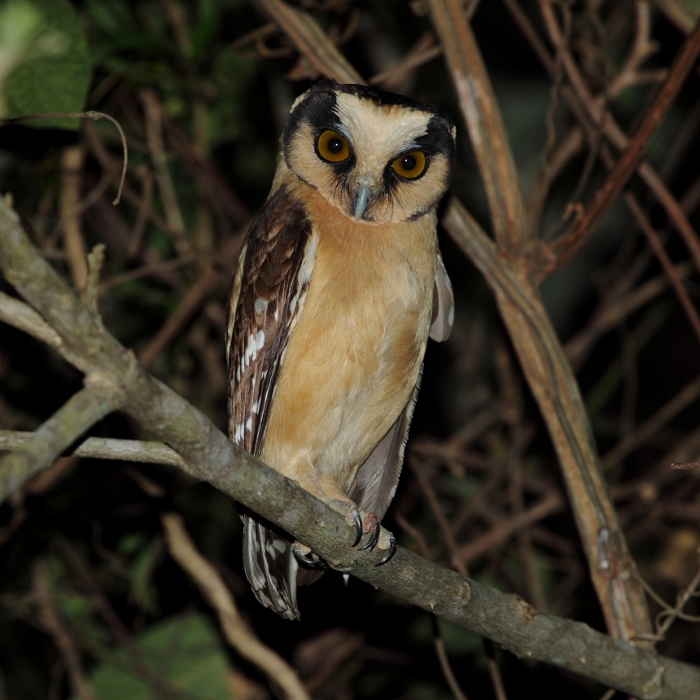
The Buff-fronted Owl is a small owl, measuring approximately 20-25 cm in length with a wingspan of about 50 cm. It is characterized by its buff-colored facial disk, which is bordered by a contrasting dark brown or blackish edge. The rest of its plumage is predominantly brown with white spotting on the upperparts, giving it a mottled appearance that aids in camouflage among the trees. The underparts are lighter, often a pale buff or off-white, with some streaking that varies among individuals.
Juvenile Buff-fronted Owls resemble adults but generally have more prominent spotting and streaking, which fades as they mature. There are no significant differences between the plumage of males and females; however, females tend to be slightly larger, a common trait among owls.
In terms of flight, the Buff-fronted Owl has a distinctive silhouette with rounded wings and a relatively short tail. Its flight is silent and buoyant, typical of many owls, allowing it to hunt effectively in darkness. When perched, the Buff-fronted Owl maintains an upright posture, often remaining motionless for extended periods, blending seamlessly into the forest surroundings. This posture, combined with its cryptic plumage, can make it challenging to spot in the wild.
Having trouble telling birds apart? Upload a photo to our bird identification tool for an instant species match.
Buff-fronted Owl Habitat and Range
Preferred Habitat
The Buff-fronted Owl thrives in a variety of forest habitats, ranging from subtropical lowland forests to temperate montane forests. It is especially prevalent in the montane cloud forests of the Andes, where elevations range from 1,200 to 3,500 meters. These environments provide ample cover and abundant prey resources, which are crucial for the owl's survival.
In addition to primary forests, the Buff-fronted Owl can inhabit secondary forests and forest edges, showcasing its adaptability to disturbed habitats. However, it is less commonly found in open areas or heavily urbanized regions, indicating a preference for wooded environments. During different seasons, particularly in the dry season, the owl may shift to lower elevations where food remains more plentiful, though it generally does not undertake long migrations.
While primarily a resident species, localized movements within its range occur in response to prey availability and environmental conditions. The presence of large trees for roosting and nesting is essential, as these owls rely on cavities for their nesting sites.
Geographic Range
The Buff-fronted Owl is found across several South American countries, with its range extending primarily along the Andes mountain range. Its distribution includes Colombia, Ecuador, Peru, and Bolivia, with some records in northern Argentina and Venezuela. This range corresponds with the presence of suitable forested habitats, particularly the montane and cloud forests where the owl thrives.
While considered a resident species, the Buff-fronted Owl may make short altitudinal migrations in response to seasonal changes in food availability. During the breeding season, territorial males and females establish areas rich in prey and suitable nesting sites, leading to a more concentrated distribution in certain forest patches.
Population densities vary, with higher concentrations in undisturbed forests where prey is abundant and habitat conditions are optimal. In degraded or fragmented habitats, populations might be sparser, highlighting the importance of conservation efforts in maintaining contiguous forest areas to support healthy owl populations.
Want to know which birds visit your area? Browse our backyard birds by location guides for region-specific species lists.
What Does the Buff-fronted Owl Eat?
The Buff-fronted Owl primarily preys on insects and small vertebrates, employing a sit-and-wait hunting strategy from a perch. Its diet consists largely of moths, beetles, and other nocturnal insects, which it catches on the wing with remarkable precision. During certain times of the year, particularly when insect populations decline, the owl also hunts small mammals, such as rodents, and occasionally small birds or amphibians.
Feeding occurs primarily at night, with peak activity shortly after dusk and before dawn. The owl's keen sense of hearing and silent flight allow it to detect and capture prey with minimal effort. Seasonal variations in diet are observed, with a greater reliance on vertebrates during colder months when insects are less accessible.
Buff-fronted Owls play a critical role in controlling insect populations, which can benefit forest ecosystems. This predation helps to keep pest species in check, contributing to forest health and biodiversity.
Buff-fronted Owl Behavior and Social Structure
The Buff-fronted Owl leads a solitary life outside of the breeding season, exhibiting strong territorial behavior. Males and females establish territories by calling, especially during the breeding season, which occurs from late winter to early spring in the Southern Hemisphere. Their vocalizations serve to communicate presence and ward off potential competitors or intruders.
Courtship involves vocal displays and mutual preening, which strengthens pair bonds. Once paired, the owls remain monogamous for the season, with both partners participating in nest defense and chick rearing. The Buff-fronted Owl's response to predators includes alarm calls and distraction displays to protect their young.
Daily activity patterns revolve around nocturnal hunting, with the owls resting in secluded roosts during the day. They select dense foliage or tree cavities to conceal themselves from predators and human observers. Despite their secretive nature, they are curious birds, sometimes investigating unusual sounds or movements in their environment.
Buff-fronted Owl Nesting and Reproduction
Buff-fronted Owls prefer to nest in natural cavities found in large trees, often choosing sites with ample cover from predators and environmental elements. They do not build nests but instead lay their eggs directly on the substrate within the cavity. Ideal nesting sites include old woodpecker holes or natural hollows, which provide safety and insulation.
The typical clutch size ranges from 2 to 4 eggs, with incubation lasting approximately 25 to 30 days. Both parents participate in incubation, though the female takes on the primary role. The male assists by providing food to the female and later to the chicks.
Once hatched, the owlets remain in the nest for about 4 to 5 weeks before fledging. During this period, both parents continue to feed and protect the young, ensuring they develop the necessary skills for survival. The Buff-fronted Owl typically raises one brood per year, with timing aligned to maximize resource availability.
Buff-fronted Owl Sounds and Vocalizations
The primary song of the Buff-fronted Owl consists of a series of short, whistling notes that ascend in pitch and intensity. This song is most commonly heard during the breeding season, serving as both an advertisement to potential mates and a territorial warning to other owls.
Their call notes include a variety of sharp chirps and hoots, used for communication between mates and as alarm calls when threatened. Unlike some owl species, their dawn chorus is subtle, with calls interspersed between periods of silence.
The Buff-fronted Owl's vocalizations have a distinctive quality, somewhat reminiscent of a soft, distant whistle, making them a unique identifier for birdwatchers familiar with the species.
Interesting Facts About the Buff-fronted Owl
- 1The Buff-fronted Owl is one of the smallest owl species in South America, measuring just 20-25 cm in length.
- 2Despite its small size, the Buff-fronted Owl has a wingspan of approximately 50 cm, allowing for agile flight.
- 3This owl is primarily nocturnal, yet it occasionally hunts during overcast days when prey is abundant.
- 4Buff-fronted Owls rely heavily on their excellent hearing, which allows them to pinpoint the location of prey in complete darkness.
- 5The species was named after Edward Harris, an American ornithologist who made significant contributions to bird study in the 19th century.
- 6Unlike many other owl species, the Buff-fronted Owl exhibits little sexual dimorphism, making it challenging to distinguish between males and females.
- 7Buff-fronted Owls are known to engage in 'mobbing' behavior, where they harass potential predators to protect their territory and young.
Buff-fronted Owl Conservation Status
The Buff-fronted Owl currently holds a status of Least Concern on the IUCN Red List, reflecting a stable population trend. However, ongoing habitat loss poses a significant threat, particularly due to deforestation and land conversion in the Andes. Conservation efforts focus on preserving large tracts of forest and promoting sustainable land-use practices. Protected areas in the owl's range contribute to safeguarding critical habitats. Historically, the species has faced pressures from habitat fragmentation, but awareness and conservation initiatives have helped mitigate some impacts. Continued monitoring and habitat management are essential to ensure the owl's long-term survival.


