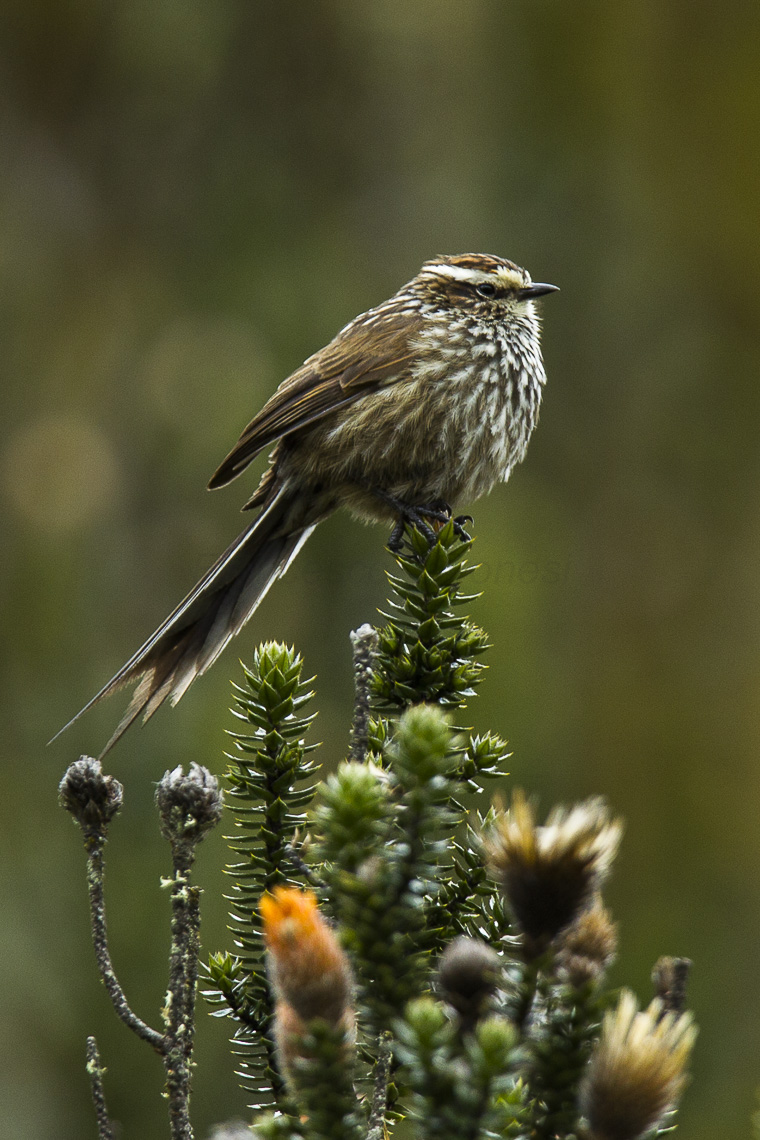
Buffy Tit-spinetail
Leptasthenura berlepschi
Order: Passeriformes / Family: Furnariidae
About the Buffy Tit-spinetail
The Buffy Tit-spinetail, scientifically known as Leptasthenura berlepschi, is a passerine bird from the family Furnariidae. This species is endemic to the montane forests of the Andes, primarily found in regions of Ecuador and northern Peru. Its ecological role is significant as it contributes to the control of insect populations within its habitat. The Buffy Tit-spinetail is often seen in mixed-species flocks, a behavior that enhances its foraging efficiency and provides safety from predators. Its presence in these flocks is a vital component of the ecological community dynamics, as it interacts with various other bird species, sharing resources and information. Seasonally, the Buffy Tit-spinetail exhibits a degree of altitudinal movement, descending to lower elevations during the colder months. This movement ensures access to food resources throughout the year despite environmental changes. As a member of the diverse Furnariidae family, it is related to other insectivorous birds that share similar ecological niches in Neotropical forests. Its adaptability to different forest types, from humid cloud forests to drier montane environments, underscores its resilience and importance in maintaining the health of these ecosystems.
The Buffy Tit-spinetail belongs to the family Furnariidae, within the order Passeriformes. These birds typically live average 3-5 years with a maximum recorded of 7 years..
How to Identify a Buffy Tit-spinetail
Identifying the Buffy Tit-spinetail involves noting its buffy, almost cinnamon-colored plumage, which contrasts with its paler underparts. Adult birds exhibit a distinctively long, graduated tail with whitish tips, aiding in field identification. The Buffy Tit-spinetail's wings are relatively short, and its flight is undulating, a characteristic of many Furnariids. Juvenile birds resemble adults but may show slightly duller plumage. Males and females appear similar, making sexing in the field challenging without behavioral context, such as courtship displays. This species can be confused with similar spinetails, but its unique coloration and longer tail distinguish it from others such as the Rusty-crowned Tit-spinetail. When perched, it often flicks its tail, a behavior that, along with its distinctive plumage, aids in identification. Observers should focus on these traits to avoid confusion with other sympatric spinetail species.
Having trouble telling birds apart? Upload a photo to our bird identification tool for an instant species match.
Buffy Tit-spinetail Habitat and Range
Preferred Habitat
The Buffy Tit-spinetail thrives in montane forest habitats, particularly those within an elevation range of 1,800 to 3,500 meters. It favors areas with dense undergrowth and abundant epiphytic growth, which are rich in insect prey. These forests, often characterized by their lush canopy and substantial moss coverage, provide ample nesting and foraging opportunities. While primarily a resident of rural and remote mountainous areas, the Buffy Tit-spinetail occasionally ventures into more disturbed habitats, indicating some adaptability. Seasonal habitat shifts may occur as individuals move to lower elevations during colder periods, searching for optimal feeding conditions. Despite this adaptability, it remains predominantly associated with Andean cloud forests, where the unique microclimates support its ecological needs.
Geographic Range
The Buffy Tit-spinetail's range is restricted to the eastern slope of the Andes, specifically within Ecuador and northern Peru. It occupies a relatively narrow altitudinal band, making its distribution somewhat limited. Within this range, population densities are highest in undisturbed cloud forests, where diverse flora and fauna create a rich ecosystem. Despite its limited range, the Buffy Tit-spinetail does not migrate long distances, instead displaying altitudinal movements in response to seasonal changes. These movements allow it to exploit different ecological niches throughout the year. Its presence in Ecuador is most notable in protected areas, highlighting the importance of conservation efforts in these regions. In Peru, it similarly prefers higher elevation forests but is occasionally observed in transitional zones between cloud forests and drier montane environments.
Want to know which birds visit your area? Browse our backyard birds by location guides for region-specific species lists.
What Does the Buffy Tit-spinetail Eat?
The Buffy Tit-spinetail primarily feeds on insects, with a diet that includes beetles, caterpillars, and spiders. It uses a variety of foraging techniques, such as gleaning from leaves and probing bark crevices, to capture prey. This bird often searches for food in mixed-species flocks, which increases foraging success by reducing time spent in vigilance. During the breeding season, its diet becomes more protein-rich to support the nutritional needs of its young. In non-breeding seasons, the Buffy Tit-spinetail may expand its diet to include small fruits and seeds, reflecting the availability of resources. Its ability to adapt its diet according to seasonal changes is a testament to its ecological adaptability. Feeding occurs primarily during daylight hours, with peak activity in the early morning and late afternoon when insects are most active.
Buffy Tit-spinetail Behavior and Social Structure
The Buffy Tit-spinetail is a social bird, often seen in pairs or small family groups. It exhibits a high degree of territoriality during the breeding season, with pairs defending their nesting sites vigorously. Courtship displays include mutual preening and tail fanning, which reinforces pair bonds. Outside of the breeding season, it joins mixed-species flocks, a behavior that provides increased protection from predators such as hawks and falcons. Flocking also facilitates foraging efficiency, as individuals share information about food sources. The Buffy Tit-spinetail is most active during the day, with a peak in activity during the cooler hours of the morning and late afternoon. It responds to predators with alarm calls and by seeking cover in dense vegetation. This bird's daily activity patterns reflect its adaptation to the dynamic Andean environment.
Buffy Tit-spinetail Nesting and Reproduction
Buffy Tit-spinetails construct their nests in dense vegetation or tree cavities, using materials such as moss, lichen, and plant fibers. They prefer locations that offer protection from predators and harsh weather, often selecting sites within the forest understory. The typical clutch size ranges from two to three eggs, which are incubated by both parents for about 14 to 16 days. After hatching, the chicks remain in the nest for approximately 20 days before fledging. Both parents share in feeding and protecting the young, ensuring their survival in the challenging montane environment. The species typically produces one brood per year, although favorable conditions may allow for a second. This reproductive strategy ensures that the young have ample resources and optimal conditions for growth.
Buffy Tit-spinetail Sounds and Vocalizations
The primary song of the Buffy Tit-spinetail is a series of rapid, high-pitched notes that rise and fall melodically. This song serves to establish territory and attract mates during the breeding season. Its call notes are sharp and metallic, often described as a 'tink-tink' sound, used to communicate with flock members. Alarm calls are more abrupt and harsh, signaling the presence of predators. During the dawn chorus, the Buffy Tit-spinetail's song is particularly prominent, blending with the calls of other forest birds. These vocalizations, while distinctive, may vary slightly between populations, reflecting regional dialects. The complexity and variability of its sounds make it an intriguing subject for study among ornithologists.
Interesting Facts About the Buffy Tit-spinetail
- 1The Buffy Tit-spinetail gets its name from the distinctive buffy color of its plumage, which is rare among spinetails.
- 2This bird often participates in mixed-species flocks, which can include up to 30 individuals of various species.
- 3The Buffy Tit-spinetail's tail is unusually long for its body size, aiding in its agile navigation through dense foliage.
- 4Despite its limited range, the Buffy Tit-spinetail shows remarkable adaptability to different forest habitats.
- 5Studies suggest that the Buffy Tit-spinetail's vocalizations are more complex than those of many related species.
- 6The species is named after Hans von Berlepsch, a German ornithologist known for his work in South America.
- 7Buffy Tit-spinetails are known for their energetic foraging behavior, often seen hanging upside down to reach insects.
Buffy Tit-spinetail Conservation Status
The IUCN currently lists the Buffy Tit-spinetail as Near Threatened, with its population trend considered stable but vulnerable to habitat loss. Deforestation, primarily due to agriculture and logging, poses a significant threat to its habitat. Conservation efforts focus on protecting existing forest areas and promoting sustainable land use practices. Historical population changes are difficult to assess due to limited long-term data, but recent studies emphasize the need for continued monitoring. Conservation programs aim to maintain habitat connectivity, ensuring that the species can move freely between different forest patches. Public awareness campaigns also play a role in highlighting the importance of preserving these unique montane ecosystems.
Other Furnariidae Species


Birds Similar to the Buffy Tit-spinetail
These species are often confused with the Buffy Tit-spinetail due to similar appearance or overlapping range.