
Burnt-neck Eremomela
Eremomela usticollis
Order: Passeriformes / Family: Cisticolidae
Wikimedia Commons
About the Burnt-neck Eremomela
The Burnt-neck Eremomela (Eremomela usticollis) is a diminutive bird that belongs to the family Cisticolidae, thriving predominantly in sub-Saharan Africa. This species exhibits a particular affinity for the miombo woodlands and savannas where it can be observed flitting among the foliage in search of insects. The bird's distinctively colored neck gives it its common name, providing an immediate visual cue for identification. Found across countries such as Angola, Botswana, Zambia, and Zimbabwe, the Burnt-neck Eremomela occupies a significant ecological niche by regulating insect populations, thus contributing to the health of its habitat. Seasonally, these birds exhibit subtle behavioral shifts, adapting to breeding cycles and food availability. During the dry season, when insects are less abundant, Burnt-neck Eremomelas may expand their foraging range or adjust their diet to include more varied food sources. The bird's ecological role is underscored by its interactions within the ecosystem, serving as prey for larger avian predators while also participating in mutualistic relationships with other bird species. The Burnt-neck Eremomela's presence in these landscapes reflects the biodiversity of sub-Saharan regions, where it serves as both a vital component of the food web and an indicator of environmental health.
The Burnt-neck Eremomela belongs to the family Cisticolidae, within the order Passeriformes. These birds typically live average 4-6 years, with a maximum recorded of 8 years..
How to Identify a Burnt-neck Eremomela
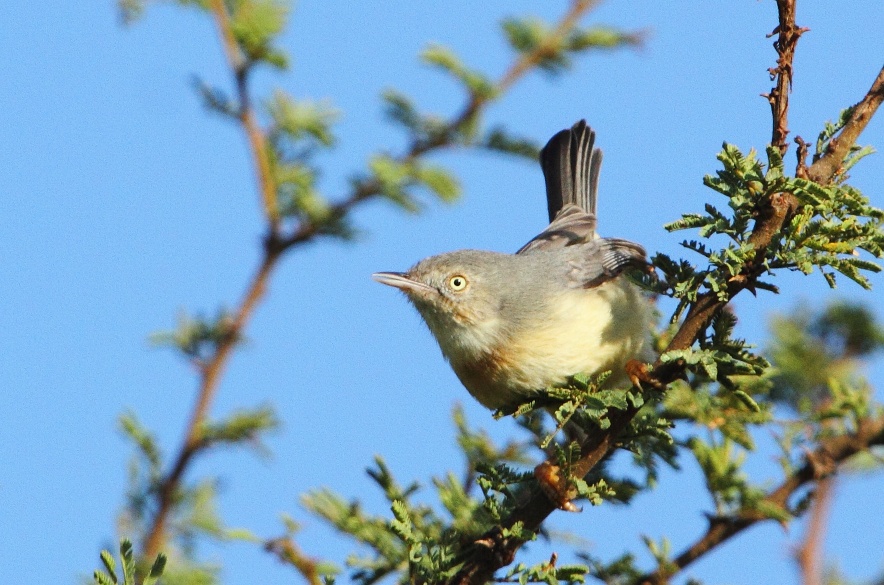
Identifying the Burnt-neck Eremomela begins with noting its small size, measuring around 10 centimeters in length. The bird's plumage is mostly olive-green on the upperparts, transitioning to a paler underbelly. Its namesake feature, the burnt-orange or rufous neck, contrasts sharply with the otherwise subdued color palette, making it a key identification marker. Males and females are similar in appearance, which can pose challenges for gender differentiation in the field. Juveniles, however, may appear slightly duller than adults, lacking the full vibrancy of the rufous neck initially. In flight, the Burnt-neck Eremomela exhibits a rapid, undulating pattern common to many small passerines. When perched, it maintains an upright posture, often flicking its wings and tail nervously. Potential confusion may arise with similar small greenish warblers, though the distinctive neck of the Eremomela, along with its specific call, can aid in distinguishing it from other species.
Having trouble telling birds apart? Upload a photo to our bird identification tool for an instant species match.
Burnt-neck Eremomela Habitat and Range
Preferred Habitat
The Burnt-neck Eremomela primarily inhabits open woodlands and savannas, particularly those dominated by miombo trees. These habitats provide the bird with ample foraging opportunities and nesting sites. Elevation-wise, the species is typically found from sea level up to 1800 meters, adapting to various microclimates within this range. Seasonal habitat shifts are minimal, as the bird remains largely sedentary, though slight movements may occur in response to food availability. While predominantly rural, the Burnt-neck Eremomela occasionally ventures into the edges of urban areas, especially where suitable woodland persists.
Geographic Range
The range of the Burnt-neck Eremomela extends across southern to south-central Africa. It is not a migratory species, tending to remain within its established territories throughout the year. The breeding range includes countries like Zambia, Zimbabwe, Angola, and Botswana, where it thrives in the miombo woodlands. Population density varies, with higher concentrations observed in areas with dense canopies and abundant insect prey. Though the bird is not found in coastal regions, it is well-established in the continental interior, maintaining a steady presence across its preferred habitats.
Want to know which birds visit your area? Browse our backyard birds by location guides for region-specific species lists.
What Does the Burnt-neck Eremomela Eat?
The Burnt-neck Eremomela's diet primarily consists of insects, which it gleans from foliage in a methodical manner. Its foraging technique involves hopping among branches, inspecting leaves and twigs closely. During different seasons, the availability of prey may shift, prompting the bird to adjust its diet. In the rainy season, when insects are plentiful, the Eremomela focuses on smaller arthropods, including caterpillars and beetles. As the dry season approaches, it may incorporate more varied items like spiders and small fruits. Feeding primarily occurs during daylight hours, with peak activity in the early morning and late afternoon when temperatures are more favorable.
Burnt-neck Eremomela Behavior and Social Structure
The Burnt-neck Eremomela exhibits a social structure that is loosely territorial, often seen in small groups or pairs rather than large flocks. During the breeding season, males engage in simple courtship displays, involving vocalizations and subtle posturing to attract mates. Though territorial, these birds are not aggressively defensive, allowing for some overlap of foraging areas among neighboring pairs. Flocking patterns vary, with larger groups forming outside the breeding season, likely as a strategy to increase foraging efficiency and predator vigilance. In response to predators, the Burnt-neck Eremomela relies on swift movements and vocal alarm calls to alert nearby birds. Its activity pattern is diurnal, with the majority of its feeding and social interactions occurring during daylight.
Burnt-neck Eremomela Nesting and Reproduction
The Burnt-neck Eremomela constructs well-camouflaged nests, typically placing them in the fork of a tree or shrub. The nests are cup-shaped, crafted from grass, leaves, and spider webs, providing both insulation and concealment. Clutch size ranges from two to four eggs, with both parents sharing incubation duties. The incubation period lasts approximately 12-14 days, after which the chicks hatch and are cared for by both parents. Fledging occurs around 14-17 days post-hatching, with juveniles remaining dependent on parental care for a short period thereafter. Typically, the Burnt-neck Eremomela produces one to two broods per year, depending on environmental conditions.
Burnt-neck Eremomela Sounds and Vocalizations
The Burnt-neck Eremomela's primary song is a series of high-pitched, melodic notes delivered in rapid succession. The rhythm can be described as quick and energetic, often rising in pitch towards the end. Call notes are sharp and chirpy, serving as communication signals among pairs or group members. Alarm calls are distinctly harsher, used to warn of potential threats. During the dawn chorus, this species contributes with its lively song, adding to the overall symphony of the woodland soundscape. Compared to other birds, its song is relatively simple but recognizable once familiarized.
Interesting Facts About the Burnt-neck Eremomela
- 1The Burnt-neck Eremomela often associates with mixed-species flocks, benefiting from increased foraging efficiency.
- 2Despite its small size, the Burnt-neck Eremomela plays a crucial role in controlling insect populations within its habitat.
- 3This species exhibits remarkable adaptability, capable of surviving in both dry and rainy seasons by altering its diet and foraging behavior.
- 4The Burnt-neck Eremomela's rapid, undulating flight pattern aids in avoiding predators while navigating dense foliage.
- 5Its reddish neck isn't just for show; this distinctive trait helps birders identify it quickly in the field.
- 6The bird's vocalizations can serve as a useful indicator of potential predators, as it often issues alarm calls upon detection.
- 7The Burnt-neck Eremomela has a relatively broad distribution in Africa, yet remains somewhat elusive due to its preference for dense cover.
Burnt-neck Eremomela Conservation Status
The Burnt-neck Eremomela is currently listed as Least Concern by the IUCN, with its population trend considered stable. However, habitat loss due to deforestation and land conversion poses a potential threat. Conservation efforts focus on protecting woodland habitats through sustainable land management practices. Historically, the species maintained a stable population, though localized declines have occurred in areas of significant habitat disturbance. Continued monitoring and habitat preservation are essential to ensure its ongoing survival.


