
Cactus Conure
Aratinga cactorum
Order: Psittaciformes / Family: Psittacidae
Wikimedia Commons
About the Cactus Conure
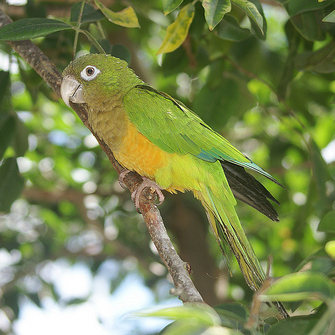
The Cactus Conure (Aratinga cactorum) inhabits the northeastern regions of Brazil, particularly in arid landscapes like Caatinga and other dry forest ecosystems. Its striking green plumage with a hint of blue on the wings and a distinctive red patch on its forehead makes it a captivating sight. This medium-sized parrot, measuring about 25 cm in length, plays a crucial role in its ecosystem by dispersing seeds and thus supporting plant regeneration. The Cactus Conure's adaptability to different habitats, including semi-arid and arid zones, illustrates its resilience and ecological significance.
In the context of the Caatinga biome, the Cactus Conure is more than just a vibrant addition to the landscape; it serves as an indicator species for environmental health. Its presence signifies a balanced ecosystem, as it requires a mixture of open areas with scattered trees and shrubs to thrive. The Cactus Conure is a social bird, often seen in small flocks, which can increase in size outside of the breeding season. This social structure aids in foraging and protection against predators.
The ecological role of the Cactus Conure extends to its interactions with native flora. By feeding on a variety of seeds and fruits, it aids in the dispersal of plant species, contributing to the biodiversity of its habitat. The bird's feeding habits also stimulate the regeneration of plant life, a critical process in maintaining the health of arid ecosystems. During the breeding season, which aligns with the wet season, the Cactus Conure focuses on nesting and raising its young, showcasing a shift in behavior from foraging to reproduction. This seasonal behavior ensures that its chicks benefit from the abundance of food resources, highlighting its adaptability and survival strategies.
The Cactus Conure belongs to the family Psittacidae, within the order Psittaciformes. These birds typically live average 20 years with a maximum recorded of 30 years..
How to Identify a Cactus Conure
The Cactus Conure stands out with its predominantly green plumage, which is marked by blue highlights on the wings and a vibrant red patch on the forehead. This red patch is more prominent in adults, serving as a key identifier in the field. Both males and females exhibit similar coloration, making them visually indistinguishable in terms of gender. Juvenile Cactus Conures, however, can be identified by their slightly duller plumage and less pronounced red forehead patch.
In flight, the Cactus Conure presents a characteristic silhouette with pointed wings and a long tail, allowing for agile and swift movements. When perched, it maintains an upright posture, often flaring its tail feathers, contributing to its distinctive profile. This conure's vocalizations are also notable, consisting of high-pitched, melodic calls that are easily recognizable to experienced birders.
While the Cactus Conure might be confused with similar species like the Sun Conure (Aratinga solstitialis), its habitat preference and the distinctive red forehead patch help to differentiate it. Observers should also note the Cactus Conure's preference for arid and semi-arid regions, a contrast to the more tropical environments favored by some of its relatives.
Having trouble telling birds apart? Upload a photo to our bird identification tool for an instant species match.
Cactus Conure Habitat and Range
Preferred Habitat
The Cactus Conure thrives in the semi-arid and arid regions of northeastern Brazil, primarily within the Caatinga biome. This habitat is characterized by its sparse vegetation, including drought-resistant trees and shrubs, which provide the conures with essential roosting and nesting sites. Unlike many other parrot species, the Cactus Conure is well-adapted to these dry conditions, capable of surviving in regions with limited water availability.
Preferring open areas interspersed with woody plants, the Cactus Conure can be found at elevations ranging from sea level up to 800 meters. It shows a remarkable ability to adapt to different environments, including modified landscapes like agricultural fields and urban areas, where it can exploit new food resources. Despite its adaptability, it still primarily favors natural, undisturbed habitats where it can find adequate nesting sites and food sources.
During the wet season, the Cactus Conure may shift slightly to areas with more abundant fruit and seed availability, demonstrating some seasonal movement within its home range. This behavior ensures that it can exploit the most resource-rich environments throughout the year.
Geographic Range
The Cactus Conure is endemic to Brazil, with its range primarily focused in the northeastern regions, including the states of Bahia, Pernambuco, and Piaui. Its distribution is closely associated with the Caatinga biome, an extensive area of scrubby vegetation unique to this part of the country. Within this range, the conure is a year-round resident, showing little to no significant long-distance migratory behavior.
Although the Cactus Conure's range is somewhat restricted geographically, it is relatively widespread within its suitable habitat, occurring in both protected areas and regions where human development is encroaching. Population densities are highest in undisturbed areas of the Caatinga, where natural food sources and nesting sites are more abundant.
While it is primarily a resident species, the Cactus Conure may undertake local movements in response to seasonal variations in food availability, particularly during the wet season when fruiting trees are more plentiful. These movements, however, do not constitute true migration, as they are limited to shifts within its established range.
Want to know which birds visit your area? Browse our backyard birds by location guides for region-specific species lists.
What Does the Cactus Conure Eat?
The Cactus Conure's diet is primarily composed of seeds, fruits, and berries found in its arid and semi-arid habitat. It shows a marked preference for the seeds of native plants, which it expertly extracts using its strong and dexterous beak. This diet is supplemented by the occasional consumption of flowers and, less frequently, small insects.
During the dry season, the availability of water and food resources can become a challenge, but the Cactus Conure has adapted to survive these conditions by exploiting a wide range of food sources. It forages in flocks, which not only increases feeding efficiency but also provides safety in numbers against potential predators.
The conure's foraging behavior is active and involves both ground feeding and arboreal foraging. It is known to travel considerable distances in search of food, especially during the wet season when it takes advantage of the temporary abundance of fruiting trees and shrubs. This seasonal dietary shift supports the bird's nutritional needs during the breeding season when energy demands are high.
Cactus Conure Behavior and Social Structure
The Cactus Conure exhibits a highly social behavior, often seen in flocks ranging from small family groups to larger congregations of up to 30 individuals. This social structure is particularly evident outside the breeding season, when flocking offers protection from predators and facilitates efficient foraging. Within these groups, the conures communicate through a series of high-pitched calls, which help maintain cohesion and coordinate movements.
Territorial behavior is most pronounced during the breeding season, when pairs establish and defend nesting sites from intruders. Courtship displays involve vocalizations and mutual preening, which strengthen pair bonds. These displays are an integral part of the species' reproductive success, ensuring that pairs are well-coordinated in their nesting efforts.
Daily activity patterns of the Cactus Conure include early morning feeding sessions followed by periods of rest during the hottest part of the day, resuming activity in the late afternoon. This schedule allows the birds to avoid the midday heat while maximizing foraging time. In response to predators, such as raptors, the conures rely on their agility and strength in numbers, often mobbing potential threats to drive them away.
Cactus Conure Nesting and Reproduction
Cactus Conures typically nest in tree cavities, which offer protection from predators and harsh weather conditions. These cavities are often in cacti or trees with soft wood, allowing the birds to enlarge the space to fit their nesting needs. The interior of the nest is unlined, relying on the natural protection of the cavity itself.
The typical clutch size for a Cactus Conure is between 3 to 5 eggs, with both parents sharing incubation duties, which last approximately 24 days. After hatching, both parents continue to care for the chicks, feeding them regurgitated food until they fledge, which occurs around 50 days after hatching.
Cactus Conures usually have one brood per year, timed with the wet season to coincide with peak food availability. This timing ensures that the chicks have access to abundant resources, increasing their chances of survival. Parental care is extended and involves both feeding and teaching the young to forage independently before they join the larger flock.
Cactus Conure Sounds and Vocalizations
The primary vocalizations of the Cactus Conure consist of high-pitched, clear calls that are both melodic and rapid. These calls serve various functions, from maintaining flock cohesion to alerting others of potential threats. The pitch and rhythm of these calls can vary slightly depending on the context, with faster, more urgent calls used as alarm signals.
In addition to these calls, the Cactus Conure engages in softer, more conversational sounds when interacting at close range with mates or within family groups. During the dawn chorus, their vocalizations become more frequent and varied, serving to reinforce social bonds and establish territory.
Compared to other parrot species, the Cactus Conure's calls are distinctive for their clarity and musical quality, making them relatively easy to identify in the field. These sounds are a crucial aspect of their social behavior and communication, particularly in the dense and sometimes acoustically challenging environments of the Caatinga.
Interesting Facts About the Cactus Conure
- 1The Cactus Conure has a lifespan of up to 30 years in captivity, showcasing its longevity.
- 2These conures are known to use tools, such as sticks, to extract seeds from hard-to-reach places.
- 3A flock of Cactus Conures can cover up to 20 kilometers in a day while foraging.
- 4Cactus Conures are monogamous, forming strong pair bonds that last for several breeding seasons.
- 5Despite being non-migratory, Cactus Conures show remarkable adaptability to seasonal food availability.
- 6Their name 'Cactus Conure' reflects their unique adaptation to nesting in cacti, a rare trait among parrots.
- 7In the wild, Cactus Conures play a key role in maintaining the biodiversity of the Caatinga biome.
Cactus Conure Conservation Status
Currently, the Cactus Conure is listed as Least Concern on the IUCN Red List, with population trends observed to be stable. However, habitat loss due to agricultural expansion and deforestation poses a growing threat to its continued survival. Efforts to conserve the Caatinga biome and restore degraded areas are essential in maintaining healthy populations of this species. Historical records indicate that the Cactus Conure's population has experienced fluctuations, largely due to changes in land use and climate patterns. Conservation strategies focus on protecting large tracts of natural habitat and promoting sustainable land management practices. Continued monitoring of population trends and habitat conditions is vital. Community engagement and education are also key components of conservation efforts, fostering local support for the preservation of this iconic species and its unique habitat.


