
Cardinal Myzomela
Myzomela cardinalis
Order: Passeriformes / Family: Meliphagidae
Wikimedia Commons
About the Cardinal Myzomela
The Cardinal Myzomela (Myzomela cardinalis), a member of the Meliphagidae family, is a small, strikingly colorful bird found predominantly in the Pacific region. Known for its vivid red plumage, the Cardinal Myzomela is a significant component of island ecosystems such as those found in the Solomon Islands, Vanuatu, and the Federated States of Micronesia. This species plays a vital role as a pollinator in these regions, facilitating the reproduction of many native flowering plants. The bird's ability to thrive in a variety of forest types, including lowland rainforests, mangrove forests, and forest edges, highlights its adaptability and ecological importance.
In regions like Papua New Guinea, the Cardinal Myzomela is often observed throughout the year, engaging in various seasonal behaviors. During the breeding season, which typically coincides with the local wet season, these birds are particularly active in their courtship rituals. The Cardinal Myzomela utilizes its long, curved bill to extract nectar from flowers, contributing to the cross-pollination necessary for plant diversity. Outside of the breeding season, they may form small, loosely associated groups, though they are generally solitary or found in pairs.
The ecological role of the Cardinal Myzomela extends beyond pollination. As it navigates the dense forest canopy, it also consumes insects, which helps control pest populations. This dual role as both a pollinator and insectivore marks the Cardinal Myzomela as a key player in maintaining the health and balance of its native ecosystems. The bird's presence across a range of islands underscores its resilience and the critical need for continued habitat conservation to ensure its survival.
The Cardinal Myzomela belongs to the family Meliphagidae, within the order Passeriformes. These birds typically live average 5-8 years; max recorded 10 years.
How to Identify a Cardinal Myzomela
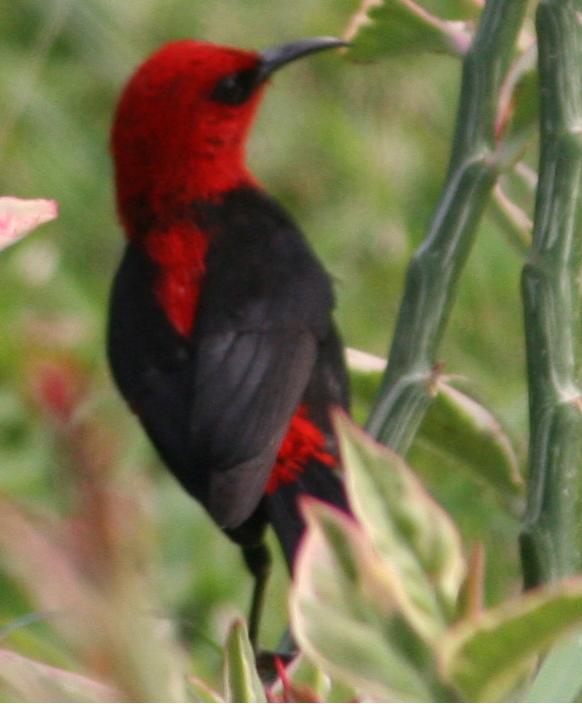
The Cardinal Myzomela is easily identifiable by its bright red plumage, which covers most of its body, allowing it to stand out against the green foliage of its habitat. The adult males are particularly vibrant, with a deep scarlet head, back, and chest, contrasting sharply with their black wings and tail. Females, while also red, tend to have a duller hue with more brownish tones on their backs and wings, which can make them slightly less conspicuous.
Juveniles resemble the adult females but are even duller, with more pronounced brownish-gray tones, which can occasionally lead to confusion with other species in the Myzomela genus. The Cardinal Myzomela's size, at around 12 cm in length, categorizes it as a small songbird. Its distinctive, slightly downcurved bill is a key field mark, adapted perfectly for its nectarivorous diet.
In flight, the Cardinal Myzomela displays a rapid, slightly undulating flight pattern, typical of many small passerines. When perched, it maintains an upright posture, often seen flitting around flowers or resting on thin branches. Its vivid coloration and active behavior make it a delightful sight for birders and nature enthusiasts alike.
Having trouble telling birds apart? Upload a photo to our bird identification tool for an instant species match.
Cardinal Myzomela Habitat and Range
Preferred Habitat
The Cardinal Myzomela inhabits a range of forested environments on various Pacific islands. It thrives in lowland rainforests, which provide abundant nectar sources and dense foliage for shelter. Mangrove forests along coastal areas also support these birds, offering a mix of feeding and nesting opportunities.
This species is adaptable and can be found from sea level up to altitudes of approximately 1,500 meters, though it tends to favor lower elevations where nectar is more readily available. The Cardinal Myzomela shows some degree of urban presence, occasionally visiting gardens and parks where flowering plants are prevalent, but it primarily remains within natural forested areas.
Seasonal habitat shifts are minimal, as the bird is largely non-migratory, although it may move locally in response to flowering cycles. The integrity of its forest habitats is crucial for its continued success, highlighting the importance of conservation efforts in these regions.
Geographic Range
The Cardinal Myzomela's range is confined to the Pacific Islands, where it is a resident bird. It breeds and resides year-round on islands including the Solomon Islands, Vanuatu, and the Federated States of Micronesia. Within these areas, it occupies both main islands and smaller, less disturbed islets.
The species does not undertake long-distance migrations, and its movements are generally limited to local shifts prompted by food availability rather than seasonal temperature changes. This bird is most densely populated in areas where native flora is abundant, providing ample nectar sources.
The presence of the Cardinal Myzomela in specific island habitats underscores the importance of preserving these environments. As an island specialist, the bird's range is inherently limited, making it susceptible to habitat loss and other environmental changes.
Want to know which birds visit your area? Browse our backyard birds by location guides for region-specific species lists.
What Does the Cardinal Myzomela Eat?
The Cardinal Myzomela primarily feeds on nectar, making it an important pollinator for many native plants. It frequents a variety of flowering trees and shrubs, using its long, curved bill to access nectar deep within blossoms. This diet is supplemented by a range of small insects and spiders, which provide additional protein, especially during the breeding season when the demand for nutrients increases.
The diet of the Cardinal Myzomela may shift slightly with the seasons, as it follows the flowering cycles of its preferred plants. During periods when flowers are less abundant, the bird may rely more heavily on insects to sustain itself.
Foraging techniques of the Cardinal Myzomela are both agile and precise. The bird can often be seen hovering briefly in front of flowers before darting to another bloom, demonstrating its adeptness at extracting nectar while on the wing. This behavior is not only a testament to its feeding efficiency but also to its role in facilitating plant reproduction through pollination.
Cardinal Myzomela Behavior and Social Structure
The Cardinal Myzomela exhibits largely solitary behavior, although it is not uncommon to see individuals or pairs feeding in close proximity to others, especially in areas of abundant food. Territorial behavior is evident, with males often defending rich nectar sources through vocal displays and occasional chases.
Courtship displays are a blend of visual and vocal communication, where males sing and perform aerial maneuvers to attract females. Once paired, they tend to maintain monogamous relationships, at least for the duration of the breeding season.
Flocking behavior is minimal, as the Cardinal Myzomela does not form large groups or mixed-species flocks. Its response to predators includes sharp alarm calls and quick evasive flights, retreating to denser foliage when threatened. Daily activity patterns align with daylight hours, being most active in the early morning and late afternoon when temperatures are cooler.
Cardinal Myzomela Nesting and Reproduction
Cardinal Myzomela nests are compact, cup-shaped structures, woven with fine twigs, grasses, and spider webs to provide stability and camouflage. These nests are typically placed high in the fork of a tree branch, often concealed by dense foliage to protect from predators and the elements.
The female lays a clutch of two to three eggs, which are incubated for about 14 days. Both parents participate in feeding the chicks, though the female primarily handles the incubation duties. The fledging period lasts approximately 15 to 18 days, during which the young birds are fed a diet rich in insects to support rapid growth.
Cardinal Myzomelas may raise two broods per year, depending on environmental conditions and food availability. The cooperative efforts of both parents during the nesting period underscore the species' commitment to successful reproduction.
Cardinal Myzomela Sounds and Vocalizations
The primary song of the Cardinal Myzomela is a series of high-pitched, melodious notes that can be described as both sweet and slightly metallic. This song is used primarily by males during the breeding season to establish territory and attract mates.
Call notes are short and sharp, often used as communication between mates or as an alarm when potential threats are nearby. These alarm calls are more abrupt and less musical than their typical song, serving as an effective warning system.
During the dawn chorus, the Cardinal Myzomela's song can be heard resonating through its forested habitats, blending with the calls of other bird species. This vocal behavior not only marks the start of the day but also reinforces territorial claims.
Interesting Facts About the Cardinal Myzomela
- 1The Cardinal Myzomela can hover like a hummingbird, an unusual trait for a honeyeater.
- 2Despite its vivid red coloration, the Cardinal Myzomela can be surprisingly elusive among the dense green foliage it inhabits.
- 3This species has a relatively high metabolic rate, requiring frequent feeding throughout the day to maintain energy levels.
- 4Unlike many songbirds, the Cardinal Myzomela does not migrate, remaining on its native islands year-round.
- 5The Cardinal Myzomela's diet is approximately 70% nectar and 30% insects, showcasing its dual dietary strategy.
- 6This bird's presence is a reliable indicator of healthy, intact forest ecosystems in the Pacific region.
- 7Cardinal Myzomelas are known to engage in 'nectar robbing,' accessing nectar without aiding in pollination.
Cardinal Myzomela Conservation Status
Currently, the Cardinal Myzomela is listed as Least Concern by the IUCN, although its population trend is not well-documented. The primary threats to this species include habitat destruction, particularly from logging and land conversion for agriculture, which reduce available nesting sites and food sources. Conservation efforts focus on habitat protection and management, ensuring that the bird's forest environments remain intact and sustainable. Historical population changes have been minimal, though increased human activity poses a growing risk. Efforts to monitor population sizes and distribution are essential to preemptively address any declines that may arise from environmental pressures. The resilience of the Cardinal Myzomela depends significantly on the preservation of its native island habitats.


