
Channel-billed Toucan
Ramphastos vitellinus
Order: Piciformes / Family: Ramphastidae
Wikimedia Commons
About the Channel-billed Toucan
The Channel-billed Toucan (Ramphastos vitellinus) is a vibrant and charismatic bird of the Ramphastidae family, renowned for its large, colorful bill and striking plumage. Found predominantly in the northern regions of South America, this toucan is a staple of the tropical rainforests, with its presence often signifying a healthy ecosystem. This species plays a pivotal role in seed dispersal, thanks to its frugivorous diet. The Channel-billed Toucan thrives in the humid, dense forests of countries such as Brazil, Guyana, and Venezuela, where it can be seen hopping through the canopy in search of fruit. The species' bright, multicolored bill is not only an instrument for feeding but also a key feature in mate attraction and territorial displays.
The ecological significance of the Channel-billed Toucan extends beyond its role in tropical ecosystems. As a primary consumer, it helps regulate the fruiting cycles of various plant species, contributing to forest regeneration and biodiversity. This bird also serves as prey for larger avian predators, thus maintaining the balance within the trophic levels of its habitat. During the wet season, the abundance of fruit allows these toucans to thrive and play their part in the forest's reproductive cycle. Conversely, in drier periods, the availability of fruit diminishes, prompting the toucans to modify their diet slightly to include more insects and small creatures.
The Channel-billed Toucan also has significant cultural importance in regions where it is found. Indigenous communities often view the toucan as a symbol of the rainforest's vitality and a sign of good fortune. Despite its importance, the bird faces challenges from habitat destruction and fragmentation due to logging and agricultural expansion. Nevertheless, the Channel-billed Toucan remains a resilient species, with adaptable feeding and breeding behaviors that enable it to survive in changing environments. Conservation efforts are essential to ensure that this iconic bird continues to thrive in its natural habitat for generations to come.
The Channel-billed Toucan belongs to the family Ramphastidae, within the order Piciformes. These birds typically live average 15-20 years, with a maximum recorded of 25 years..
How to Identify a Channel-billed Toucan
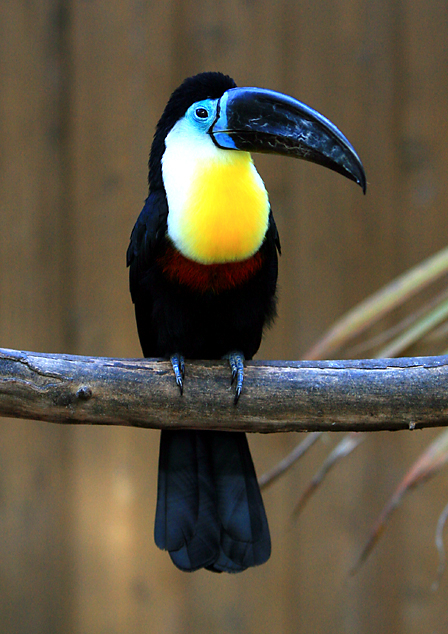
The Channel-billed Toucan is easily recognized by its large, vividly colored bill, which accounts for nearly one-third of its body length. The bill is predominantly yellow with a bold black stripe running along its length, making it a standout feature among the dense foliage. Adult plumage is a striking mix of black, white, and vibrant orange-yellow. The chest and upper breast exhibit a brilliant yellow hue, while the rest of the body is primarily black. Juveniles resemble adults but have shorter bills and duller plumage.
Males and females are similar in appearance, with the male slightly larger in size. This subtle sexual dimorphism is not easily discernible in the field. The Channel-billed Toucan's silhouette in flight is distinctive, with a short tail and broad wings, and the large bill is evident even from a distance. When perched, the toucan often sits in an upright position, using its bill to reach for fruits and insects in the canopy.
Confusion with similar species, such as the Toco Toucan, is possible. However, the Channel-billed Toucan lacks the Toco's prominent white throat patch. Another distinguishing feature is its eye-ring, which is blue, providing a stark contrast against its dark plumage. Observers can use these characteristics to accurately identify the Channel-billed Toucan in its natural habitat.
Having trouble telling birds apart? Upload a photo to our bird identification tool for an instant species match.
Channel-billed Toucan Habitat and Range
Preferred Habitat
The Channel-billed Toucan inhabits the humid, tropical rainforests of northern South America. It thrives in dense, evergreen forests, often at elevations ranging from sea level up to 1,200 meters. Preferring the canopy, this toucan rarely descends to the forest floor, relying on the abundance of fruit-bearing trees above. The species exhibits some adaptability, occasionally venturing into secondary forests and forest edges where fruit is plentiful.
In terms of seasonal habitat shifts, during the wet season, when fruits are abundant, these toucans may move to areas with higher fruiting tree densities. During drier periods, they may venture closer to human habitations, such as plantations and orchards, where they can find alternative food sources. While primarily a forest dweller, the Channel-billed Toucan is sometimes spotted in urban areas, particularly in cities adjacent to large forest tracts. However, it is not a common urban species and prefers the tranquility of the forest canopy.
Geographic Range
The Channel-billed Toucan's range spans the northern part of South America, with the majority of its population found in Brazil. Its distribution extends into eastern Colombia, southern Venezuela, and the Guianas, including Guyana and Suriname. The species does not migrate long distances but may exhibit local movements in search of food. Within its range, the Channel-billed Toucan can be found in both lowland and montane forests, with a preference for humid environments.
Population density is highest in the Amazon Basin, where the extensive forests provide an ideal habitat. In countries such as Peru and Bolivia, the toucan's presence is less prominent, yet it still occupies suitable forested areas. This toucan does not typically range into the Andes, as it favors lower elevations with rich fruiting resources. Overall, the Channel-billed Toucan maintains a fairly stable population, although local declines may occur in areas heavily impacted by deforestation.
Want to know which birds visit your area? Browse our backyard birds by location guides for region-specific species lists.
What Does the Channel-billed Toucan Eat?
The Channel-billed Toucan primarily feeds on a diet of fruits, making it an essential frugivore in its ecosystem. It has a particular fondness for figs, berries, and various tropical fruits, which it plucks from the tree canopy with its long bill. During the wet season, when fruit is abundant, the toucan's diet is almost exclusively frugivorous. However, in drier months, when fruit is scarcer, it supplements its diet with insects, small reptiles, and bird eggs.
Foraging occurs mainly in the early morning and late afternoon, when the bird moves through the canopy in search of ripe fruit. The toucan uses its large bill not only to reach distant fruits but also to deftly manipulate and peel them, a skill that allows it to access a wide variety of food sources. The bird's feeding habits contribute significantly to seed dispersal, as it often drops seeds far from the parent tree, promoting genetic diversity and forest regeneration.
Channel-billed Toucan Behavior and Social Structure
Channel-billed Toucans are social birds, often found in small family groups or pairs. They are known for their playful behavior, engaging in bill fencing and other social interactions that help reinforce group bonds. Territorial behavior is evident during the breeding season, when pairs defend nesting sites from rivals. Courtship displays involve bill tapping and mutual preening, behaviors that strengthen pair bonds.
These toucans exhibit a diurnal activity pattern, with peak activity during the cooler parts of the day. In the presence of predators, such as raptors or snakes, the toucan relies on agility and vocal alarm calls to warn others and evade capture. When not foraging, the Channel-billed Toucan spends time preening or basking in the sun, often seen perched prominently in the canopy. The bird's strong social structure and cooperative behaviors ensure its survival in the competitive forest environment.
Channel-billed Toucan Nesting and Reproduction
The Channel-billed Toucan nests in natural cavities high in trees, often utilizing abandoned woodpecker holes or hollows formed by decay. Nest sites are typically in the forest canopy, offering protection from ground-based predators. During the breeding season, which varies slightly across its range but generally aligns with the late dry season, the female lays 2-4 eggs.
Incubation lasts about 16 days, with both parents sharing the duties of keeping the eggs warm and protecting the nest. After hatching, the chicks remain in the nest for approximately six weeks, during which time both parents provide food and care. The fledging period is critical, as the young toucans learn to fly and forage while remaining close to their parents for guidance. Generally, the Channel-billed Toucan raises one brood per year, although favorable conditions may occasionally allow for a second.
Channel-billed Toucan Sounds and Vocalizations
The Channel-billed Toucan produces a variety of sounds, most notably its primary call, a rhythmic series of croaking notes that can be heard echoing through the forest canopy. This call has a distinctive, harsh quality, resembling a series of 'croak-croak-croak' sounds. In addition to its primary call, the toucan emits various grunts and clicks used in social interactions and alarm situations.
During the dawn chorus, the toucan's calls contribute to the vibrant soundscape of the rainforest, competing with the calls of other toucan species and various songbirds. Alarm calls are sharper and more urgent, serving as warnings to fellow toucans of approaching predators. The bird's vocal repertoire plays a crucial role in maintaining social bonds and coordinating group activities.
Interesting Facts About the Channel-billed Toucan
- 1The Channel-billed Toucan's bill, although large, is surprisingly light due to its hollow structure.
- 2This toucan can consume up to 100 different fruit species, making it a vital seed disperser.
- 3Channel-billed Toucans have a unique heat regulation system, using their bills to dissipate excess body heat.
- 4Their loud calls can be heard up to 800 meters away, aiding in long-distance communication.
- 5Toucans are among the few bird species that use tools, sometimes using sticks to scratch themselves.
- 6Despite their size, Channel-billed Toucans are agile fliers, capable of quick, short bursts between trees.
- 7The vibrant colors of the Channel-billed Toucan serve as a camouflage among the bright tropical foliage.
Channel-billed Toucan Conservation Status
The Channel-billed Toucan is currently listed as Least Concern by the IUCN, with a stable population trend. However, the primary threats to its survival include habitat destruction due to logging and agricultural expansion. These activities lead to the fragmentation of the tropical rainforests that the toucan calls home. Despite these challenges, the species' adaptability to various habitats has helped it maintain stable numbers across its range. Conservation efforts focus on protecting large tracts of rainforest and establishing reserves to ensure the continuity of their natural habitat. Historical population changes have seen fluctuations in local densities, but overall, the Channel-billed Toucan remains a resilient species. Continuous monitoring and habitat preservation are essential to safeguard the future of this iconic bird.


