
Chirping Cisticola
Cisticola pipiens
Order: Passeriformes / Family: Cisticolidae
Wikimedia Commons
About the Chirping Cisticola
The Chirping Cisticola (Cisticola pipiens) is a small passerine bird belonging to the family Cisticolidae, distinguished by its vibrant vocalizations. It is predominantly found in the vast grasslands of sub-Saharan Africa, where it plays a vital role in the ecosystem by controlling insect populations. This bird is a common sight in countries such as Kenya, Tanzania, and Uganda, thriving in open grasslands and savannas. The Chirping Cisticola is not only an important insectivore but also serves as a prey species for larger birds of prey, thus maintaining the ecological balance. During the breeding season, which corresponds with the rainy season in many regions, the Chirping Cisticola becomes particularly vocal, using its song to establish territories and attract mates. These birds are adept at adapting to seasonal changes, as their plumage provides excellent camouflage among the grasses, allowing them to remain concealed from predators. The presence of the Chirping Cisticola indicates healthy grassland ecosystems, as they require specific habitat conditions to thrive. Their populations can serve as indicators of environmental health, particularly in regions undergoing agricultural expansion or habitat degradation. Conservationists closely monitor these birds to ensure that their populations remain stable in the face of habitat loss and climate change. The Chirping Cisticola's role in seed dispersal and pest control further underscores its ecological significance, as it indirectly supports plant regeneration and crop protection. Their distinctive chirping, often heard during the early morning or late afternoon, adds to the rich tapestry of sounds in Africa's grasslands, making them a favorite among birdwatchers and nature enthusiasts.
The Chirping Cisticola belongs to the family Cisticolidae, within the order Passeriformes. These birds typically live average 2-3 years with a maximum recorded of 5 years.
How to Identify a Chirping Cisticola
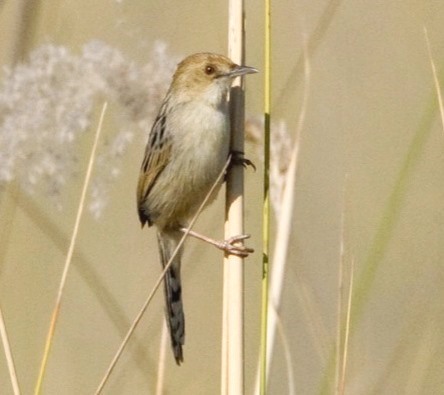
The Chirping Cisticola is a small bird, measuring approximately 10-12 cm in length, with a wingspan of about 15-17 cm. Adult birds exhibit a predominantly brown plumage, with streaked patterns on the back and wings, providing effective camouflage in their grassland habitats. The underparts are generally paler, with a buffy hue, while the tail is relatively short and often held upright. Juvenile birds resemble adults but may exhibit a slightly duller coloration. Males and females are similar in appearance, though males may have slightly longer tails during the breeding season. The Chirping Cisticola's flight is characterized by rapid, fluttering movements, often punctuated by brief glides, and their perching posture is upright, with a pronounced tail flicking motion. This species can be confused with other Cisticolas and small warblers, but its distinct song and size help differentiate it. In the field, observers should note the bird's small size, streaked brown plumage, and characteristic behavior to confirm identification.
Having trouble telling birds apart? Upload a photo to our bird identification tool for an instant species match.
Chirping Cisticola Habitat and Range
Preferred Habitat
The Chirping Cisticola primarily inhabits open grasslands and savannas across sub-Saharan Africa. These birds are typically found at low to moderate elevations, up to about 2000 meters above sea level. They prefer areas with tall grasses interspersed with scattered shrubs, which provide both foraging opportunities and protection from predators. While they are predominantly rural birds, they can also be found on the outskirts of urban areas where suitable grasslands exist. Seasonal habitat shifts may occur in response to changes in food availability or breeding requirements, but these birds generally remain within grassland ecosystems throughout the year.
Geographic Range
The Chirping Cisticola's range extends across sub-Saharan Africa, from Senegal and Gambia in the west to Ethiopia and Somalia in the east, and southward to South Africa. This species occupies a wide variety of grassland habitats within these regions, with population density hotspots in the East African countries of Kenya, Tanzania, and Uganda. The bird does not undertake long-distance migrations, but local movements may occur in response to rainfall patterns and food availability. During the breeding season, they become more territorial and are more frequently observed in suitable grassland areas.
Want to know which birds visit your area? Browse our backyard birds by location guides for region-specific species lists.
What Does the Chirping Cisticola Eat?
The diet of the Chirping Cisticola consists primarily of small insects, which they actively forage for among grasses and low shrubs. Their diet includes grasshoppers, beetles, and caterpillars, which they catch using a combination of gleaning and sallying techniques. Seasonal dietary changes are influenced by the availability of prey, with a higher intake of flying insects during the rainy season. The Chirping Cisticola typically forages throughout the day, with peak activity during the cooler morning and late afternoon hours. Their foraging behavior involves quick, darting movements and occasional short flights to catch airborne insects.
Chirping Cisticola Behavior and Social Structure
Chirping Cisticolas exhibit social behavior during the non-breeding season, often forming small flocks. However, they become more territorial during the breeding season, with males singing persistently to establish territory boundaries and attract females. Their courtship displays include aerial flights and tail flicking, accompanied by their characteristic chirping song. These birds are generally active during the day, with periods of intense activity in the early morning and late afternoon. In response to predators, such as birds of prey, the Chirping Cisticola employs evasive maneuvers and relies on the cover provided by grasslands to avoid detection. Their vocalizations serve as an important communication tool, both for maintaining social bonds and for signaling alarm in the presence of threats.
Chirping Cisticola Nesting and Reproduction
The nesting habits of the Chirping Cisticola involve the construction of a small, cup-shaped nest made of grasses and lined with finer plant materials. Nests are typically located low to the ground, well concealed within dense grass clumps or shrubs. The female lays a clutch of 2-4 eggs, which she incubates for approximately 11-14 days. Both parents participate in feeding the chicks, which fledge after about 12-15 days. The Chirping Cisticola may raise two broods per breeding season, depending on environmental conditions and food availability. Parental roles are well defined, with the female primarily responsible for incubation and the male assisting in feeding the young post-hatching.
Chirping Cisticola Sounds and Vocalizations
The Chirping Cisticola's primary song is a repetitive, high-pitched chirp, delivered in rapid succession. It is melodious yet persistent, serving as both a territorial marker and a mating call. The call notes are sharp and distinctive, often compared to a series of quick, metallic clicks. Alarm calls are harsher and more abrupt, used to alert other birds to potential threats. During the dawn chorus, the Chirping Cisticola is one of the first to sing, contributing to the lively soundscape of the grassland at sunrise.
Interesting Facts About the Chirping Cisticola
- 1Chirping Cisticolas can deliver up to 20 calls per minute during peak singing periods.
- 2Despite their small size, Chirping Cisticolas can be heard from over 100 meters away.
- 3The species name 'pipiens' refers to their distinctive peeping calls.
- 4Chirping Cisticolas are known to mimic other bird species as part of their vocal repertoire.
- 5These birds help control pest populations, benefiting agricultural practices in their habitats.
- 6During breeding season, males may sing for several hours a day to establish territory.
- 7Chirping Cisticolas are found in over 30 countries across Africa, showcasing their adaptability.
Chirping Cisticola Conservation Status
The Chirping Cisticola is currently listed as Least Concern by the IUCN, with populations considered stable. However, habitat loss due to agricultural expansion and urban development poses a potential threat. Conservation efforts focus on preserving grassland habitats and monitoring population trends. Historically, the species has demonstrated resilience to environmental changes, but continued habitat protection is crucial to ensure its long-term survival.


