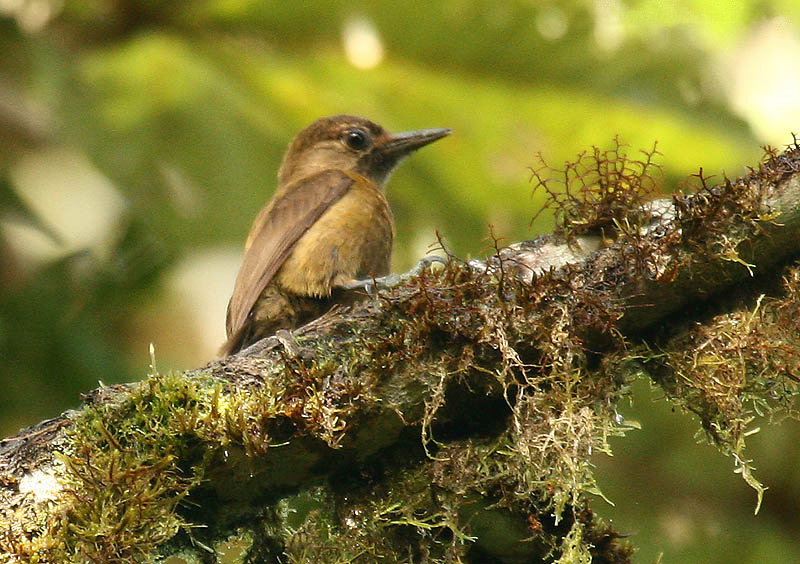
Cinnamon Flycatcher
Pyrrhomyias cinnamomeus
Order: Passeriformes / Family: Tyrannidae

Wikimedia Commons
About the Cinnamon Flycatcher
The Cinnamon Flycatcher (Pyrrhomyias cinnamomeus) is a captivating bird species found predominantly in the montane cloud forests of the Andes. Its striking cinnamon-colored plumage and distinctive behavior make it a favorite among birdwatchers and ornithologists alike. This small flycatcher plays a crucial role in its ecosystem by controlling insect populations, acting as a natural pest regulator in its habitat. The Cinnamon Flycatcher is often observed flitting through the middle and upper strata of the forest, where it demonstrates remarkable agility in capturing flying insects. Its presence is a key indicator of healthy forest ecosystems, reflecting the biodiversity and ecological integrity of its habitats.
The Cinnamon Flycatcher thrives in the humid forested slopes of the Andes, ranging from Venezuela and Colombia in the north, through Ecuador and Peru, and extending into Bolivia. This geographic range highlights its adaptation to the varying elevations and microclimates found along these mountain ranges. The species typically inhabits elevations between 1,500 and 3,500 meters, where the dense foliage and moss-laden branches provide both food and shelter. Seasonal behaviors of the Cinnamon Flycatcher include slight altitudinal migrations, where individuals may move to lower elevations during cooler months to maintain access to plentiful food resources.
In terms of ecological significance, the Cinnamon Flycatcher serves as an important prey species for larger avian predators, contributing to the complex food web of its Andean environment. Its insectivorous diet helps control the populations of various insect species, many of which could become pests if left unchecked. This predation not only benefits the plant life by reducing herbivorous insect pressure but also aids in maintaining a balanced ecosystem. Observing this species offers insights into the dynamics of Andean montane forest ecosystems and underscores the interdependent nature of these complex habitats.
The Cinnamon Flycatcher belongs to the family Tyrannidae, within the order Passeriformes. These birds typically live average lifespan is around 4-5 years, with some living up to 7 years in the wild..
How to Identify a Cinnamon Flycatcher
Identifying the Cinnamon Flycatcher involves noting its distinct plumage and size. Adults display a rich cinnamon color across their body, with a slightly deeper hue on the wings and tail. This coloration makes them relatively easy to distinguish from other flycatchers. The underparts are paler, providing a subtle contrast that enhances the bird's overall vibrancy. Juveniles resemble adults but may exhibit slightly duller plumage until they molt into their full adult colors.
There is little sexual dimorphism in this species, meaning males and females look alike to the casual observer. However, closer inspection can reveal that males might have slightly brighter plumage during the breeding season. The Cinnamon Flycatcher's flight is characterized by agile, darting movements, typical of the Tyrannidae family, and it often perches in an upright posture on exposed branches, scanning for insects.
When comparing the Cinnamon Flycatcher to similar species, one might confuse it with the Rufous-tailed Tyrant or the Slaty-capped Flycatcher. However, the Cinnamon Flycatcher's consistent cinnamon coloring and lack of prominent wing bars serve as distinguishing features. Observers should also note its size, as it is relatively small, measuring about 12 to 13 centimeters in length, fitting comfortably within the small bird category.
Having trouble telling birds apart? Upload a photo to our bird identification tool for an instant species match.
Cinnamon Flycatcher Habitat and Range
Preferred Habitat
The Cinnamon Flycatcher is closely associated with the Andean cloud forests, which provide the humid, dense environments this species favors. These forests are characterized by thick undergrowth, epiphyte-laden branches, and a cool, moist climate which supports a wide array of plant and animal life. Within these habitats, the flycatcher can be found at elevations ranging from 1,500 to 3,500 meters, where it occupies both primary and secondary forests.
During seasonal shifts, the Cinnamon Flycatcher might temporarily move to lower elevations, particularly in response to food availability and climatic conditions. However, it remains a resident species, not undertaking long-distance migrations. While largely a forest dweller, the Cinnamon Flycatcher can occasionally be found at forest edges and in semi-open areas within its range.
Their presence in urban areas is rare, as they prefer the undisturbed forests that provide adequate cover and insect prey. In contrast to some bird species that have adapted to human-modified landscapes, the Cinnamon Flycatcher remains reliant on its native forest habitats for survival.
Geographic Range
The Cinnamon Flycatcher's range encompasses the Andean regions of South America, including countries such as Venezuela, Colombia, Ecuador, Peru, and Bolivia. Within these countries, the bird is predominantly found along the eastern and western slopes of the Andes, where suitable cloud forest habitats are abundant. The species does not undertake long-distance migrations, instead demonstrating altitudinal movements that align with seasonal changes in weather and food availability.
Its breeding range covers much of its overall distribution, as the bird remains in its favored montane environments throughout the year. During cooler months or times of food scarcity, some individuals may descend to lower elevations, though these shifts are generally modest in scale.
Population density varies within this range, with some areas of dense forest offering more abundant resources and thus supporting higher concentrations of Cinnamon Flycatchers. In particular, regions such as the cloud forests of Ecuador and Peru are known hotspots for the species, where they can be observed relatively easily due to their conspicuous behavior and preference for mid-level perching spots within the forest.
Want to know which birds visit your area? Browse our backyard birds by location guides for region-specific species lists.
What Does the Cinnamon Flycatcher Eat?
The Cinnamon Flycatcher primarily feeds on insects, employing agile flight techniques to capture its prey in mid-air. This flycatcher relies heavily on its keen eyesight to detect and pursue flying insects such as moths, flies, and beetles. During certain times of the year, particularly in the breeding season, the bird's diet may expand to include small arthropods and other invertebrates that are abundant in its forest habitat.
The species exhibits a sit-and-wait foraging strategy, often perching quietly until it spots potential prey. Once an insect is identified, the Cinnamon Flycatcher launches a swift, precise aerial pursuit, capturing its target with impressive acrobatics. This method of foraging is particularly energy-efficient, allowing the flycatcher to maintain its active lifestyle without expending unnecessary energy.
During different seasons, slight variations in diet occur based on the availability of prey. For instance, in wetter months, when insects are more plentiful, the flycatcher may increase its feeding activity and diversify its prey selection to include a wider range of insect species. This adaptability in diet ensures that the Cinnamon Flycatcher can thrive in the variable conditions of its montane forest environment.
Cinnamon Flycatcher Behavior and Social Structure
The Cinnamon Flycatcher exhibits a range of behaviors that reflect its adaptation to life in the cloud forests of the Andes. Socially, this species is often observed alone or in pairs, particularly during the breeding season when they establish territories. These territories are defended vigorously, with both vocalizations and physical displays used to deter intruders.
Courtship displays of the Cinnamon Flycatcher can include a series of aerial maneuvers and vocalizations, with males often showcasing their flying skills to attract females. During the non-breeding season, Cinnamon Flycatchers may join mixed-species flocks, which provide added protection from predators and enhance foraging efficiency through cooperative vigilance.
The daily routine of the Cinnamon Flycatcher consists of periods of active foraging interspersed with rest and preening sessions. This species is diurnal, engaging in most of its activities during daylight hours. In response to predators, they rely on their agility and cryptic plumage to avoid detection, often blending seamlessly into the cinnamon and green hues of their environment. Vocalizations play a key role in their communication, serving to maintain pair bonds, signal territorial claims, and alert conspecifics to the presence of threats.
Cinnamon Flycatcher Nesting and Reproduction
The nesting habits of the Cinnamon Flycatcher reflect its adaptation to the dense foliage of the cloud forests. This bird constructs open cup nests, typically using a variety of materials such as moss, lichens, and small twigs, which help the nest blend seamlessly into its surroundings. Nests are usually situated on horizontal branches or in the forks of trees, often at moderate heights to provide protection from ground predators.
A typical clutch consists of two to three eggs, with both parents sharing incubation duties. The incubation period lasts approximately 14 to 16 days, during which the adults take turns warming the eggs and foraging for food. Once hatched, the nestlings are altricial, requiring constant care and feeding from both parents.
Fledging occurs around 15 to 18 days after hatching, with the young birds leaving the nest but still dependent on their parents for sustenance and protection until they become proficient at foraging. The Cinnamon Flycatcher typically raises one brood per year, although in regions with particularly favorable conditions, a second brood may occasionally be attempted.
Cinnamon Flycatcher Sounds and Vocalizations
The vocal repertoire of the Cinnamon Flycatcher includes a variety of calls and songs that are essential for communication within its dense forest habitat. Its primary song is a series of clear, whistling notes that rise and fall in pitch, often described as melodic and somewhat plaintive in quality. These songs serve to establish territory and attract mates, with males vocalizing more frequently during the breeding season.
In addition to its primary song, the Cinnamon Flycatcher emits sharp, short call notes that function as contact calls between individuals, particularly within pairs or family groups. Alarm calls are more abrupt and harsher, alerting other birds to potential threats in the vicinity.
During the dawn chorus, the Cinnamon Flycatcher is an active participant, contributing its voice to the cacophony of sounds that mark the beginning of a new day in the cloud forest. Its calls and songs, although not as varied as those of some passerines, are distinctive enough to aid in its identification by ear.
Interesting Facts About the Cinnamon Flycatcher
- 1The Cinnamon Flycatcher is known for its unique plumage that provides excellent camouflage among the cinnamon and green hues of its forest habitat.
- 2Despite its small size, the Cinnamon Flycatcher plays a big role in controlling insect populations, helping maintain the ecological balance.
- 3The species exhibits altitudinal migration, moving to lower elevations during cooler months to access more abundant food resources.
- 4Cinnamon Flycatchers are often seen in mixed-species flocks, benefiting from group foraging and enhanced protection against predators.
- 5Although visually similar, the Cinnamon Flycatcher's plumage lacks the wing bars seen in some related species, aiding in its identification.
- 6The Cinnamon Flycatcher's primary song consists of a series of melodious whistling notes, easily heard in the dense cloud forests.
- 7Nesting high in trees, the Cinnamon Flycatcher uses materials like moss and lichen to camouflage its open cup nest from predators.
Cinnamon Flycatcher Conservation Status
The Cinnamon Flycatcher currently holds a status of Least Concern according to the IUCN Red List, indicating a stable population trend across its range. While not immediately threatened, the species faces potential risks from habitat loss due to deforestation and agricultural expansion in the Andes. Conservation efforts in the region focus on preserving the integrity of cloud forest ecosystems, which are crucial for the survival of the Cinnamon Flycatcher and countless other species. Protected areas and reserves in countries like Ecuador and Peru play a vital role in safeguarding these habitats. Sustainable forestry practices and reforestation projects also contribute to maintaining the ecological balance necessary for the flycatcher's continued prosperity. Historically, the population of the Cinnamon Flycatcher has remained relatively stable, benefiting from its preference for remote, less disturbed environments. Continued conservation actions are essential to ensure that this stability persists, preventing future declines that could arise from unchecked habitat degradation.
Other Tyrannidae Species


Birds Similar to the Cinnamon Flycatcher
These species are often confused with the Cinnamon Flycatcher due to similar appearance or overlapping range.