
Cinnamon-throated Woodcreeper
Dendrexetastes rufigula
Order: Passeriformes / Family: Furnariidae
Wikimedia Commons
About the Cinnamon-throated Woodcreeper
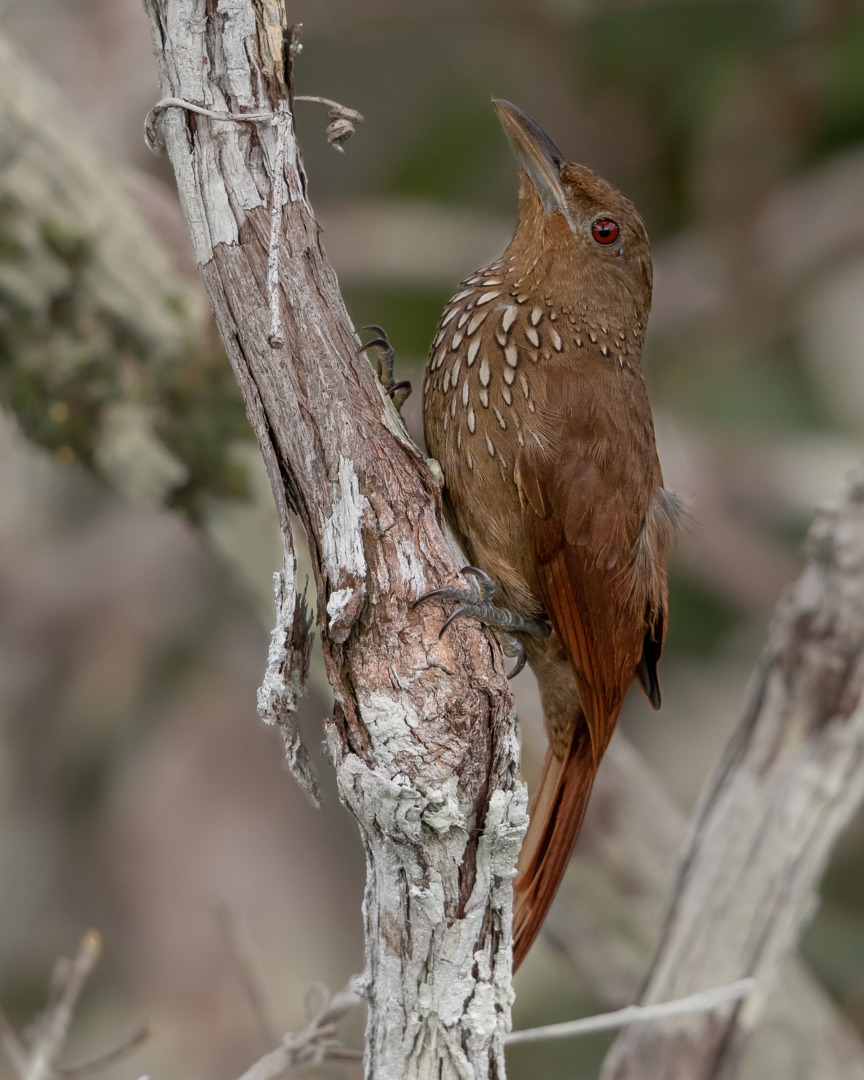
The Cinnamon-throated Woodcreeper, Dendrexetastes rufigula, is a striking member of the Furnariidae family, known for its rich rufous throat and chestnut-brown plumage. Found primarily in the Amazon Basin, this species frequents the dense forests of countries such as Brazil, Peru, Ecuador, and Colombia. Its presence in these biodiverse regions underscores its role in the complex ecological web of tropical rainforests. As an insectivore, the Cinnamon-throated Woodcreeper plays a critical role in controlling insect populations, thus maintaining the health of its forest habitat.
This woodcreeper's ecological significance extends to its interactions with other forest dwellers. It often participates in mixed-species foraging flocks, a behavior that reduces predation risks and increases foraging efficiency. Seasonal behaviors of the Cinnamon-throated Woodcreeper include altitudinal movements, though largely sedentary, it may shift locally in response to food availability or climatic conditions. During the breeding season, which aligns with the regional wet season, these birds become more vocal, making them easier to detect.
The Cinnamon-throated Woodcreeper's adaptations to a life in the dense canopy include its strong feet and sharp claws, essential for navigating vertical tree trunks. Its slender, decurved bill is perfectly adapted for extracting insects from crevices in bark. These adaptations allow it to exploit food resources that are inaccessible to many other species, highlighting its niche specialization. As a part of the Amazon's avian community, the Cinnamon-throated Woodcreeper contributes to the tremendous avian diversity found in this region, a diversity which is crucial for the resilience of these ecosystems.
The Cinnamon-throated Woodcreeper belongs to the family Furnariidae, within the order Passeriformes. These birds typically live average 5-7 years, with some living up to 10 years..
How to Identify a Cinnamon-throated Woodcreeper
The Cinnamon-throated Woodcreeper can be easily identified by its rufous throat and chestnut upperparts, which contrast beautifully against its paler underparts. Adults exhibit a distinctive, slightly curved bill that aids in insect foraging. While both male and female woodcreepers share similar plumage, subtle differences may exist in bill size, with males typically having slightly larger bills.
Juveniles resemble adults but may appear duller, with less intense rufous coloring on the throat and a slightly shorter bill. This species' propensity for clinging to tree trunks can make it difficult to observe in dense foliage, but its habit of moving in mixed-species flocks can aid identification.
In flight, the Cinnamon-throated Woodcreeper displays a characteristically undulating pattern, with short, direct flights between trees. Perched, it maintains an upright posture, using its stiff tail feathers for support against tree trunks. This posture is typical of woodcreepers and helps differentiate them from other arboreal birds.
Having trouble telling birds apart? Upload a photo to our bird identification tool for an instant species match.
Cinnamon-throated Woodcreeper Habitat and Range
Preferred Habitat
Primarily a denizen of lowland tropical rainforests, the Cinnamon-throated Woodcreeper thrives in dense forested areas with rich undergrowth. It is most commonly found at elevations below 1,000 meters, although it may venture higher in hilly areas. The bird prefers primary forests but can also inhabit secondary forests and forest edges if sufficient tree cover remains.
Seasonal habitat shifts are minimal for this species, as it tends to remain within its forested territories year-round. Urban presence is rare, as the woodcreeper relies heavily on large tracts of undisturbed forest for foraging and breeding. The degradation of its rainforest habitat poses a significant threat to its long-term survival.
Geographic Range
The Cinnamon-throated Woodcreeper's range encompasses much of the Amazon Basin, covering vast areas of northern South America. Its breeding range includes countries such as Brazil, Peru, Ecuador, Colombia, and Venezuela. Populations are concentrated in regions with extensive primary forest cover, particularly along river systems that provide rich foraging opportunities.
While not migratory, the species may exhibit local movements in response to food availability or environmental conditions. Its presence in the Amazon contributes to the region's status as a biodiversity hotspot, with high population densities found in pristine forest areas. As deforestation progresses, the woodcreeper's range may contract, limiting its already specialized habitat.
Want to know which birds visit your area? Browse our backyard birds by location guides for region-specific species lists.
What Does the Cinnamon-throated Woodcreeper Eat?
The Cinnamon-throated Woodcreeper primarily feeds on insects, with a diet that includes beetles, ants, and other small arthropods. It employs a specialized foraging technique known as 'creeping,' where it uses its curved bill to probe into bark crevices and under loose bark to extract hidden prey.
During the wet season, the abundance of insects allows for more opportunistic feeding, while in drier months, the woodcreeper may rely more heavily on specific prey types found beneath the bark. The bird typically forages in the mid to upper canopy, often in association with mixed-species flocks, which enhances its foraging success.
This avian insectivore is most active during daylight hours, with peak feeding occurring in the early morning and late afternoon. Its role in controlling insect populations is crucial for maintaining the ecological balance within its forest habitat.
Cinnamon-throated Woodcreeper Behavior and Social Structure
The Cinnamon-throated Woodcreeper exhibits a solitary or pair-based social structure, although it frequently joins mixed-species flocks for foraging. This behavior reduces predation risk and increases foraging efficiency as the bird navigates its complex forest environment.
Territoriality in this species is pronounced during the breeding season, with pairs fiercely defending their chosen nesting sites from rivals. Courtship displays involve vocalizations and subtle movements, strengthening pair bonds. The woodcreeper's daily activities center around foraging and maintaining its territory, with peak activity occurring during the cooler parts of the day.
When threatened by predators, the Cinnamon-throated Woodcreeper relies on its cryptic plumage and tree-clinging abilities to evade detection. Its response to danger often includes freezing in place, blending seamlessly into the bark and foliage. This strategy is effective against avian predators that rely on motion to detect prey.
Cinnamon-throated Woodcreeper Nesting and Reproduction
The Cinnamon-throated Woodcreeper prefers to nest in tree cavities, often utilizing abandoned woodpecker holes or natural crevices. Nest construction involves lining the cavity with plant fibers, moss, and feathers, creating a soft bed for the eggs.
Clutch size typically ranges from two to three eggs, with both parents sharing incubation duties over a period of approximately 15 to 18 days. After hatching, both male and female woodcreepers participate in feeding the nestlings, which fledge after about three weeks.
The species generally raises one brood per year, with nesting timed to coincide with the wet season when food resources are most abundant. The parental investment in ensuring the survival of their young underscores the bird's commitment to its reproductive success.
Cinnamon-throated Woodcreeper Sounds and Vocalizations
The primary song of the Cinnamon-throated Woodcreeper consists of a series of rapid, melodious notes that rise and fall in pitch, creating a rhythmic and musical quality. This song serves as both a territorial and mate attraction call, particularly prominent during the breeding season.
Call notes include a variety of sharp, short chips and twitters, used for communication between mates or within mixed-species foraging flocks. Alarm calls are harsher and more staccato, alerting conspecifics to potential threats. The woodcreeper typically participates in the dawn chorus, its song blending with the cacophony of the forest morning.
Interesting Facts About the Cinnamon-throated Woodcreeper
- 1The Cinnamon-throated Woodcreeper's bill shape is uniquely adapted to pry insects from narrow bark crevices that other birds can't access.
- 2Despite its name, the Cinnamon-throated Woodcreeper's throat is more chestnut than cinnamon, a subtle distinction observed in good light.
- 3This bird often joins mixed-species flocks, a behavior that enhances foraging efficiency and provides safety in numbers.
- 4The species exhibits strong site fidelity, with individuals often remaining in the same territory for years if conditions remain favorable.
- 5The Cinnamon-throated Woodcreeper has a specialized toe arrangement that allows it to cling to vertical surfaces with ease.
- 6Its song is a key identifier, with a distinctive rhythm that helps differentiate it from other woodcreepers in the same habitat.
- 7Unlike many birds, the Cinnamon-throated Woodcreeper does not migrate, instead relying on local environmental shifts for resource availability.
Cinnamon-throated Woodcreeper Conservation Status
Currently, the Cinnamon-throated Woodcreeper is listed as Least Concern by the IUCN. However, its population trend is decreasing due to habitat loss from deforestation and agricultural expansion. The primary threats facing the species include logging and the conversion of forest land to agriculture. Conservation efforts focus on preserving the Amazon's remaining primary forests, crucial for the woodcreeper's survival. Protected areas and sustainable land use practices are vital for maintaining suitable habitats. Historical population changes reflect the impact of human activities on Amazonian biodiversity, underscoring the importance of conservation action.


