
Citron-throated Toucan
Ramphastos citreolaemus
Order: Piciformes / Family: Ramphastidae
Wikimedia Commons
About the Citron-throated Toucan
The Citron-throated Toucan (Ramphastos citreolaemus) is a remarkable species within the family Ramphastidae, known for its striking coloration and distinctive vocalizations. This toucan inhabits the dense tropical forests of northern Colombia and northwestern Venezuela, thriving in regions rich in biodiversity. With their large, colorful bills and vibrant plumage, they play a significant role in their ecosystem by aiding in seed dispersal and maintaining the health of their forest habitats. The Citron-throated Toucan is often found in the canopy layers of these forests, where it utilizes its agile flight to navigate through the trees in search of food.
The presence of the Citron-throated Toucan is indicative of healthy, undisturbed forest environments. As frugivores, they are essential for the propagation of various plant species, consuming fruits and subsequently dispersing seeds over large areas. This natural process supports the regeneration of tropical forests, which are vital for global biodiversity and climate regulation. In addition to their ecological importance, these toucans hold cultural significance in the regions they inhabit. Their vibrant appearance and charismatic presence are often celebrated in local folklore and art.
During the breeding season, which typically coincides with the rainy season, the Citron-throated Toucan becomes more conspicuous as it engages in elaborate courtship displays. These displays involve a combination of vocalizations and physical gestures, such as bill-swinging and hopping. Outside the breeding season, they exhibit more solitary or paired behavior, although small family groups may be observed. The Citron-throated Toucan's adaptability to its environment allows it to thrive in both primary and secondary forests, though it faces threats from habitat destruction and fragmentation. Conservation efforts are crucial in ensuring the survival of this species, as they contribute not only to the ecological balance but also to the cultural heritage of the regions they inhabit.
The Citron-throated Toucan belongs to the family Ramphastidae, within the order Piciformes. These birds typically live average 14 years with max recorded up to 19 years.
How to Identify a Citron-throated Toucan
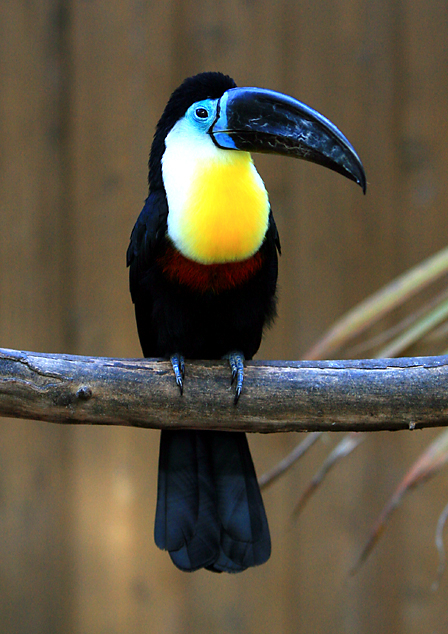
The Citron-throated Toucan is a medium-sized toucan, measuring approximately 42-47 cm in length. Adult plumage is striking, with a black body contrasted by a bright yellow throat and upper breast. The bill is large and colorful, predominantly black with a vivid yellow culmen that can be seen from a distance. The eye is surrounded by a bare patch of light blue skin, adding a splash of color to its facial features. Juvenile birds are similar in appearance but display a duller overall coloration, especially in the throat and bill, which lacks the full vibrancy of adults.
In terms of sexual dimorphism, males and females appear quite similar, making it challenging to distinguish between the sexes visually. However, males tend to be slightly larger than females, a common trait in toucan species. The flight silhouette of the Citron-throated Toucan is distinctive, characterized by its broad wings and short tail, providing a unique profile in the sky. When perched, they exhibit an upright posture, often turning their heads to survey their surroundings.
The Citron-throated Toucan can be confused with other toucan species within its range, such as the White-throated Toucan and the Channel-billed Toucan. However, the citron-yellow throat and distinctive bill pattern are key identifiers that set it apart from its relatives. Observers should note these specific field marks to ensure accurate identification.
Having trouble telling birds apart? Upload a photo to our bird identification tool for an instant species match.
Citron-throated Toucan Habitat and Range
Preferred Habitat
The Citron-throated Toucan primarily inhabits lowland tropical rainforests, favoring areas with dense tree cover and abundant fruiting trees. These forests are typically found at elevations ranging from sea level to around 1,200 meters. Within this range, they show a preference for the upper canopy and edges of the forest, where food resources are plentiful.
During certain times of the year, they may venture into secondary growth and degraded forest areas, demonstrating some adaptability to changing landscapes. However, they are less frequently observed in urban environments, as they rely on the complex structure of natural forests for feeding and nesting.
Seasonally, the availability of fruiting trees may cause slight shifts in the toucan's habitat preferences, although they generally remain within the forested regions of their range. The preservation of these habitats is essential for the continued survival of the Citron-throated Toucan, as deforestation poses a significant threat to their population.
Geographic Range
The Citron-throated Toucan's range is primarily in northern South America, covering parts of Colombia and Venezuela. In Colombia, they are found in the northern departments, including Antioquia and Magdalena, where extensive lowland rainforests provide suitable habitat. In Venezuela, their presence is noted in the northwestern states, such as Zulia and Trujillo.
The species does not exhibit long-distance migrations, instead maintaining relatively stable year-round populations within its range. However, local movements may occur in response to food availability, especially during periods of fruit scarcity or abundance.
Population density hotspots are often correlated with areas of high fruit diversity and availability. Conservation initiatives in these regions focus on habitat preservation and restoration, ensuring that toucans have access to the resources they need to thrive.
Want to know which birds visit your area? Browse our backyard birds by location guides for region-specific species lists.
What Does the Citron-throated Toucan Eat?
The Citron-throated Toucan's diet primarily consists of a wide variety of fruits, making it a key frugivore in its ecosystem. It favors fruits from trees in the families Lauraceae, Moraceae, and Myrtaceae, among others. The toucan uses its large bill to reach and manipulate fruit, even those located on thin branches that cannot support its weight.
Seasonal changes in fruit availability influence dietary habits, with the toucan adjusting its foraging behavior to exploit the most abundant resources. In addition to fruits, the Citron-throated Toucan may occasionally consume small insects and bird eggs, providing a supplementary protein source. These dietary additions are more common during the breeding season when nutritional needs increase.
Foraging typically occurs during the early morning and late afternoon, when the birds are most active. They often feed in mixed-species flocks, which can increase foraging efficiency and reduce the risk of predation. The toucan's feeding habits play a crucial role in seed dispersal, contributing to forest regeneration and biodiversity.
Want to attract Citron-throated Toucans to your yard? See our recommended feeders and seed types for the best results.
Citron-throated Toucan Behavior and Social Structure
The Citron-throated Toucan exhibits a complex social structure, often seen in pairs or small family groups. While generally not highly territorial, they do defend their feeding and nesting sites from conspecifics and other species. During the breeding season, males engage in courtship displays that include mutual preening and food offerings to females, strengthening pair bonds.
Flocking behavior is common when foraging, as mixed-species groups can enhance food-finding efficiency and provide better protection against predators. The toucan's response to predators involves a combination of alarm calls and evasive flight, relying on its agility to navigate through dense forest canopies.
Daily activity patterns show a peak in vocal and foraging behavior during the early morning and late afternoon, with periods of rest and preening in between. The Citron-throated Toucan's interactions with other species, both cooperative and competitive, highlight its adaptability within the complex ecosystem of tropical forests.
Citron-throated Toucan Nesting and Reproduction
The Citron-throated Toucan nests in tree cavities, often selecting sites excavated and abandoned by woodpeckers. They prefer cavities located high in the canopy, which provide protection from ground predators. Nesting materials are minimal, as these birds rely on the natural structure of the cavity.
A typical clutch consists of 2-4 eggs, which both parents incubate for about 16-18 days. After hatching, the altricial chicks remain in the nest for approximately 6-8 weeks, receiving care and feeding from both parents. The diet during this period is rich in fruit, supplemented with insects to provide necessary protein for growing chicks.
The Citron-throated Toucan usually raises one brood per year, although favorable conditions may allow for a second. Parental roles are well-defined, with both males and females contributing to feeding and protection of the young. Successful nesting is crucial for maintaining population stability, given the species' relatively low reproductive output.
Citron-throated Toucan Sounds and Vocalizations
The Citron-throated Toucan's vocalizations are distinctive and varied, characterized by a series of high-pitched, repetitive yelps and croaks. These calls serve multiple purposes, including territorial defense and mate attraction. During the dawn chorus, their calls resonate through the forest, marking their presence and asserting their territory.
In addition to these primary calls, the toucan emits softer, more conversational sounds when interacting with mates or family members. Alarm calls are sharper and more urgent, signaling the presence of predators to other nearby individuals. These vocalizations form an integral part of the toucan's communication system, facilitating social interaction and coordination within its environment.
Interesting Facts About the Citron-throated Toucan
- 1The Citron-throated Toucan's bill can be up to one-third of its body length, aiding in reaching fruits on thin branches.
- 2Despite its large size, the Citron-throated Toucan is a strong flier, capable of navigating dense canopies with agility.
- 3Toucans like the Citron-throated Toucan have serrated bills, which help them peel and manipulate fruit effectively.
- 4The Citron-throated Toucan's colorful appearance has made it a popular subject in local folk art and mythology.
- 5When resting, the Citron-throated Toucan often tucks its large bill under its feathers to conserve heat.
- 6The Citron-throated Toucan's vocalizations can travel long distances, allowing communication over large forested areas.
- 7Unlike many birds, toucans do not build nests, instead relying on natural or woodpecker-excavated tree cavities.
Citron-throated Toucan Conservation Status
The Citron-throated Toucan is currently classified as Least Concern by the IUCN, with populations considered stable. However, ongoing threats such as deforestation and habitat fragmentation pose significant challenges to their long-term survival. These threats are primarily driven by agricultural expansion, logging, and urban development. Conservation efforts focus on habitat preservation and restoration, aiming to protect the large tracts of forest necessary for the toucan's survival. Community-based initiatives and protected areas play a crucial role in these efforts, promoting sustainable land use and biodiversity conservation. Historical population trends have shown resilience, but continued monitoring and proactive conservation strategies are essential to mitigate future risks. The Citron-throated Toucan's presence in protected regions highlights the importance of these areas in maintaining ecological balance and biodiversity.
Attracting Citron-throated Toucans to Your Feeder
The Citron-throated Toucan is a regular visitor to backyard bird feeders across its range. At the Eye On The Fly feeding station, we observe Citron-throated Toucans regularly and capture footage with our feeder cameras.


