
Black-billed Cuckoo
Coccyzus erythopthalmus
Order: Cuculiformes / Family: Cuculidae
Wikimedia Commons
About the Black-billed Cuckoo
The Black-billed Cuckoo (Coccyzus erythropthalmus) is a fascinating member of the Cuculidae family, renowned for its subtle yet distinct presence across North American woodlands. This species holds a unique niche in the ecosystem, acting as both predator and prey, and is particularly valued for its role in controlling pest populations, notably caterpillars. The bird's presence is primarily noted in dense deciduous and mixed forests, where it often remains inconspicuous, favoring the cover of foliage to forage and nest.
During the breeding season, which spans from May through August, the Black-billed Cuckoo inhabits a range extending from southern Canada through the northern and eastern United States. This bird is often associated with moist forest edges, riparian zones, and thickets where caterpillar populations thrive. As a migratory species, it embarks on an impressive journey each autumn, traveling as far south as northern South America, including countries like Colombia and Venezuela, to spend the winter months in warmer climates.
Ecologically, the Black-billed Cuckoo plays a significant role in its habitats. By consuming large quantities of insects, particularly during outbreaks of caterpillar species such as gypsy moths and tent caterpillars, it helps maintain the balance in these ecosystems. The bird's preference for densely vegetated areas also contributes to seed dispersal and the propagation of native plant species. Though elusive, its presence signifies a healthy, functioning forest ecosystem.
The Black-billed Cuckoo belongs to the family Cuculidae, within the order Cuculiformes. These birds typically live 5-6 years with a maximum recorded of 9 years.
How to Identify a Black-billed Cuckoo
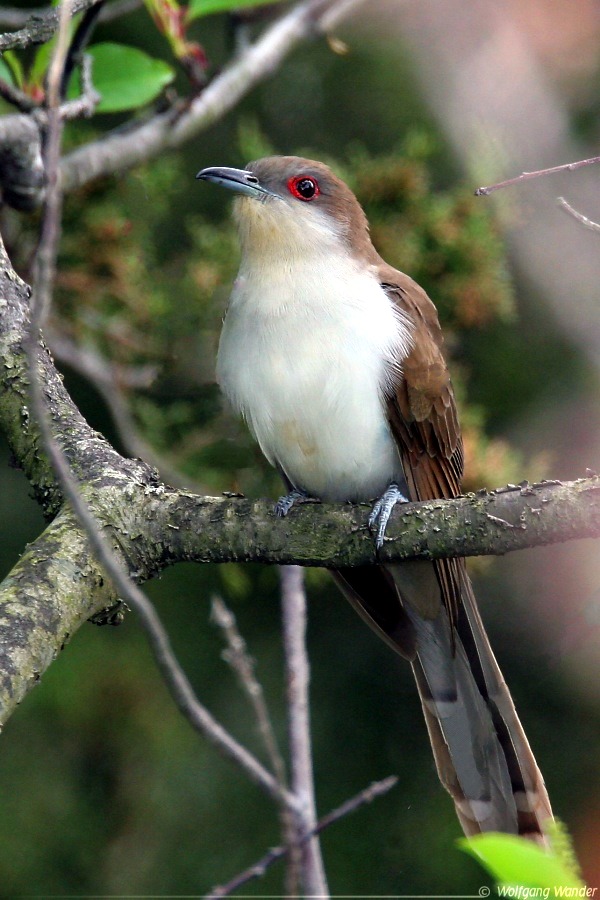
Identifying the Black-billed Cuckoo involves noting several key features. Adults display a relatively slender profile, with a length of 26-30 cm and a wingspan of approximately 38-42 cm. Their plumage is predominantly brown above and white below, providing effective camouflage among the branches. The defining characteristics include a black, slightly curved bill and a striking red eye ring, which can be a useful differentiator from other cuckoos. Unlike the Yellow-billed Cuckoo, the Black-billed lacks yellow on the lower mandible and displays a more uniform coloration.
Juveniles resemble adults but may have a less pronounced eye ring and slightly duller plumage, making them a bit more challenging to identify. In terms of sexual dimorphism, males and females exhibit similar plumage, which makes distinguishing between the sexes in the field difficult without direct observation of behavior.
In flight, the Black-billed Cuckoo's silhouette is marked by long tail feathers and broad, rounded wings. It often perches horizontally on branches, maintaining a still, watchful presence. This subtle posture, along with its preference for dense cover, contributes to its reputation as a 'ghost bird,' rarely seen but often heard.
Having trouble telling birds apart? Upload a photo to our bird identification tool for an instant species match.
Black-billed Cuckoo Habitat and Range
Preferred Habitat
The Black-billed Cuckoo thrives in a variety of wooded habitats, favoring moist deciduous and mixed forests. It is commonly found at elevations ranging from sea level to 1,500 meters, with a strong presence in regions with abundant undergrowth and shrubbery. This species shows a marked preference for riparian zones and forest edges, where insect prey is plentiful. During the breeding season, it occupies dense thickets and young second-growth forests, which offer ample cover for nesting and feeding.
In the winter, the Black-billed Cuckoo migrates to tropical forests and semi-open habitats in northern South America. Unlike some other cuckoo species, it tends to avoid urban environments, preferring the secluded tranquility of rural and wild areas where human disturbance is minimal.
Geographic Range
The Black-billed Cuckoo's breeding range spans southeastern Canada, including provinces like Ontario and Quebec, and extends across the northern and eastern United States down to the Appalachian region. It is most commonly observed during migration in states such as Illinois, Ohio, and Maryland, where it uses well-established corridors to travel between its breeding and wintering grounds.
During the non-breeding season, the Black-billed Cuckoo migrates to the coastal regions of northern South America, including Colombia and Venezuela. This long-distance migration underscores the bird's adaptability and the importance of conserving habitats across its extensive range. Population densities are generally higher in areas with rich insect activity, particularly during caterpillar outbreaks.
Want to know which birds visit your area? Browse our backyard birds by location guides for region-specific species lists.
What Does the Black-billed Cuckoo Eat?
The diet of the Black-billed Cuckoo primarily consists of insects, with a particular emphasis on caterpillars, which it consumes in large quantities. This preference makes it an important biological control agent in ecosystems plagued by caterpillar infestations. The bird's long, slender bill is well-suited for picking insects off leaves and branches, and its diet shifts seasonally to include beetles, grasshoppers, and occasionally small snails.
During the breeding season, when energy demands are high, the cuckoo may also consume small fruits and berries to supplement its insectivorous diet. Feeding typically occurs during daylight hours, with peak activity in the early morning and late afternoon. The Black-billed Cuckoo's methodical foraging style involves quiet, deliberate movements through foliage, where its keen eyesight can detect even the most well-camouflaged prey.
Black-billed Cuckoo Behavior and Social Structure
The Black-billed Cuckoo exhibits solitary and elusive behavior, often remaining hidden in dense foliage. It is generally a solitary bird outside the breeding season, with individuals maintaining territories that they defend against intruders. During the breeding season, males perform subdued courtship displays, including gentle calling and feeding rituals to attract mates.
Territorial disputes are typically resolved through vocalizations rather than physical confrontation. The bird's calls serve as both a territorial marker and a means of communication with potential mates. While generally solitary, the Black-billed Cuckoo may gather in loose flocks during migration, taking advantage of group dynamics for increased protection against predators.
The cuckoo's daily routine involves periods of active foraging interspersed with long periods of rest, where it remains motionless to avoid detection by predators. Its cryptic behavior and preference for dense cover help shield it from avian predators such as hawks and owls.
Black-billed Cuckoo Nesting and Reproduction
Black-billed Cuckoos build their nests in the dense foliage of shrubs or small trees, usually 1-3 meters above ground. The nest is a loose platform of twigs and grasses, often lined with leaves. This simple construction reflects the bird's preference for quick and efficient nesting strategies.
The female typically lays 2-4 eggs, which are pale blue and incubated for about 10-11 days by both parents. The short incubation period reflects a strategy adapted to the bird's migratory lifestyle, allowing for quick fledging. After hatching, the young are altricial, requiring constant care and feeding from both parents. They fledge approximately 14-17 days after hatching.
The Black-billed Cuckoo is capable of raising one to two broods per year, depending on environmental conditions and food availability. Both parents share the responsibilities of feeding and protecting the chicks until they are fully independent.
Black-billed Cuckoo Sounds and Vocalizations
The Black-billed Cuckoo's vocalizations are subtle yet distinctive, characterized by a series of soft, hollow 'cu-cu-cu' notes repeated at intervals. This song, often delivered from a concealed perch, conveys a rhythmic, almost mournful quality. In addition to its primary song, the cuckoo emits sharp 'cuk-cuk-cuk' calls as alarm signals when disturbed.
During the dawn chorus, the Black-billed Cuckoo's calls can be a haunting backdrop to the morning, blending with other forest sounds. Compared to the more exuberant songs of songbirds, its calls are understated, often described as reminiscent of wooden wind chimes.
Interesting Facts About the Black-billed Cuckoo
- 1The Black-billed Cuckoo can consume up to 100 tent caterpillars in a single day, aiding in pest control.
- 2Unlike many birds, the Black-billed Cuckoo does not remove the fecal sacs of its chicks, which is a common hygiene practice in other species.
- 3The species undertakes one of the longest migrations among North American cuckoos, traveling over 5,000 kilometers to reach its wintering grounds.
- 4Black-billed Cuckoos are known to sometimes lay their eggs in the nests of other bird species, although this behavior is less common than in some other cuckoos.
- 5During caterpillar outbreaks, the Black-billed Cuckoo's numbers can temporarily increase in affected areas, showcasing its opportunistic feeding behavior.
- 6The bird's scientific name, Coccyzus erythropthalmus, refers to its distinct red eye ring which is a key field mark.
- 7The Black-billed Cuckoo is one of the few bird species that can digest the toxic hairs of caterpillars, which are harmful to other predators.
Black-billed Cuckoo Conservation Status
Currently, the Black-billed Cuckoo is listed as a species of Least Concern by the IUCN, though it faces several threats that impact its populations. Habitat loss due to deforestation, particularly in its breeding range, poses a significant risk. Climate change, altering insect population dynamics, can also affect food availability for this insectivorous bird. Conservation efforts focus on habitat protection and the management of forested areas to ensure the availability of suitable breeding and foraging grounds. Historical data suggests population fluctuations in response to insect population cycles, but overall trends indicate a stable population, contingent on ongoing conservation measures.


