
Collared Falconet
Microhierax caerulescens
Order: Falconiformes / Family: Falconidae
Wikimedia Commons
About the Collared Falconet
The Collared Falconet, or Microhierax caerulescens, is a captivating bird of prey found predominantly across the varied landscapes of South and Southeast Asia. This diminutive raptor is especially notable for its striking appearance and remarkable hunting prowess, making it a subject of interest among birders and ornithologists alike. The Collared Falconet's significance extends beyond its aesthetic appeal, as it plays a crucial role in its ecosystem by controlling insect populations.
Occupying a range of habitats, the Collared Falconet thrives in open forests, edges of dense woodlands, and areas with scattered trees. Its adaptability allows it to occupy regions from the Indian subcontinent, including parts of India and Nepal, to the forests of Thailand, Myanmar, and into the Malay Peninsula. As a year-round resident, it does not undergo long migratory journeys, but it may exhibit altitudinal movements depending on seasonal food availability.
This falconet is an integral component of its ecological community. By preying on large insects and occasionally small vertebrates, it helps maintain a balance in population sizes of its prey species. Its presence in a region often indicates a healthy, thriving ecosystem, as it requires an abundant supply of prey and suitable perching sites. The Collared Falconet's agile flight and keen eyesight are adaptations that enable it to efficiently exploit its environment.
Seasonal behaviors of the Collared Falconet are closely tied to breeding activities and food availability. During the breeding season, from March to May, their territoriality becomes pronounced, and they engage in intricate courtship displays. Outside of the breeding season, they may be observed in small family groups, demonstrating a level of sociality uncommon among many raptors. Their active hunting and conspicuous perching habits make them a delightful species to observe throughout the year.
The Collared Falconet belongs to the family Falconidae, within the order Falconiformes. These birds typically live average 8-10 years, with a maximum recorded of 12 years..
How to Identify a Collared Falconet
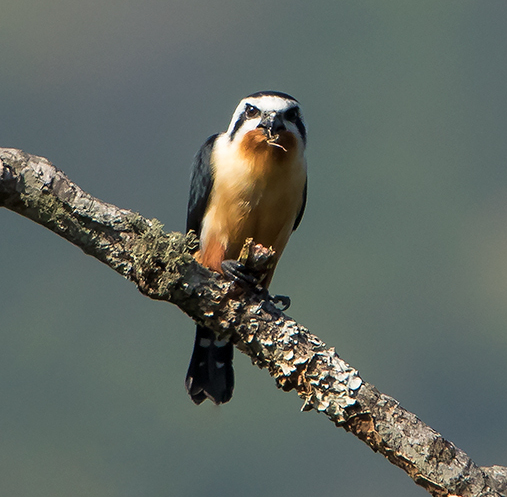
The Collared Falconet is easily identifiable by its distinctive plumage and compact size. Adult falconets display a striking black-and-white color scheme, with a prominent white collar around the neck, contrasting sharply with its black cap and upperparts. The underparts are predominantly white, with subtle black barring on the flanks. Juveniles resemble adults but may exhibit a slightly duller appearance with less defined color contrasts.
Both male and female Collared Falconets share similar plumage, making sex differentiation challenging in the field. However, males tend to be slightly smaller, though this difference is subtle and often requires direct comparison to notice. When perched, the Collared Falconet exhibits an upright stance, often on exposed branches or treetops, from where it scans for prey.
In flight, the Collared Falconet's silhouette is compact, with pointed wings and a relatively short tail. This distinguishes it from other raptors, such as the larger kestrels or sparrowhawks, which have more elongated profiles. The combination of its size, distinctive plumage, and behavior reduces confusion with other species, although it may occasionally be mistaken for the Pied Falconet, which shares part of its range but differs in its more extensive black plumage.
Having trouble telling birds apart? Upload a photo to our bird identification tool for an instant species match.
Collared Falconet Habitat and Range
Preferred Habitat
The Collared Falconet inhabits a variety of forested environments, favoring open woodlands, forest edges, and areas interspersed with open clearings or savannas. It is commonly found in deciduous and mixed forests, where it has access to ample perching sites and a rich supply of prey. Elevations range from lowland areas to mid-elevation forests, typically up to 1500 meters, although it is less common in high-altitude regions.
Unlike some raptors, the Collared Falconet is not commonly found in densely populated urban areas. However, it may occasionally be observed in rural landscapes where suitable habitat features, such as scattered trees or forest fragments, exist. Seasonal habitat shifts are minimal, though they may move locally in response to prey abundance or to altitudinal changes during the breeding season.
Geographic Range
The Collared Falconet's range primarily covers South and Southeast Asia. It is a resident breeder from the Indian subcontinent through parts of Nepal and Bhutan, extending eastward into Bangladesh, Myanmar, and Thailand. Further south, its distribution continues into Laos, Vietnam, Cambodia, and the Malay Peninsula.
Within this range, the Collared Falconet occupies a patchwork of suitable habitats, with population densities varying according to local conditions. While it is generally considered a widespread species, certain areas, particularly those with high prey availability and suitable perching sites, host higher concentrations of individuals. Unlike some migratory raptors, the Collared Falconet does not undertake extensive seasonal migrations, although local movements may occur in response to environmental conditions.
Want to know which birds visit your area? Browse our backyard birds by location guides for region-specific species lists.
What Does the Collared Falconet Eat?
The diet of the Collared Falconet consists primarily of large insects, such as beetles, grasshoppers, and cicadas. It also preys on small birds, reptiles, and occasionally small mammals, displaying a degree of opportunism in its feeding habits. Seasonal variations in prey availability can influence its dietary composition, with a heavier reliance on insects during the warmer months when they are most abundant.
The Collared Falconet employs agile hunting techniques, often launching from a perch to snatch prey in mid-air or from the ground. Its keen eyesight and rapid flight enable it to effectively capture swift-moving prey. Feeding times are typically concentrated during the cooler parts of the day, such as early morning and late afternoon, although it may hunt opportunistically when prey is active.
Collared Falconet Behavior and Social Structure
The Collared Falconet exhibits a complex social structure, particularly during the breeding season. Pairs establish territories and engage in elaborate courtship displays that include aerial acrobatics and food exchanges. These displays serve to strengthen pair bonds and signal reproductive readiness.
Outside of the breeding season, the Collared Falconet may be observed in small groups, often consisting of family units. Such gatherings indicate a level of social tolerance uncommon among many raptors. The species is not particularly aggressive toward conspecifics, though they will defend their nesting territory against intruders.
Daily activity patterns of the Collared Falconet include periods of hunting interspersed with rest and preening. It is primarily diurnal, with peak activity occurring during the morning and late afternoon. In response to predators, it relies on its agility and speed to evade capture, often retreating to dense foliage or tree cavities for protection.
Collared Falconet Nesting and Reproduction
Nesting for the Collared Falconet involves selecting tree cavities, often those created by woodpeckers, as their preferred nesting sites. These cavities provide the necessary protection for their eggs and young. The clutch size typically ranges from 3 to 5 eggs, with incubation lasting approximately 20 to 22 days.
Both parents participate in incubation and feeding the young, highlighting the cooperative nature of their breeding behavior. After hatching, the fledgling period extends for about 4 to 5 weeks, during which the young birds develop the skills necessary for independent survival. The Collared Falconet generally produces one brood per year, although favorable conditions may occasionally lead to a second brood.
Collared Falconet Sounds and Vocalizations
The Collared Falconet's vocalizations are characterized by a series of high-pitched, rapid notes, often described as a 'chee-chee-chee' sound. These calls serve various purposes, such as communication between mates and signaling territory occupancy. The alarm calls are sharper and more urgent, effectively alerting nearby falconets of potential threats.
During the breeding season, vocal activity increases, with males frequently calling to attract mates and establish territories. The dawn chorus features heightened vocal exchanges, serving both social and territorial functions. The falconet's calls, while not as melodious as songbirds, are distinctive and play a crucial role in its behavioral repertoire.
Interesting Facts About the Collared Falconet
- 1The Collared Falconet is among the smallest raptors in the world, with a body length ranging from 15 to 18 centimeters.
- 2Unlike many raptors, the Collared Falconet can hover briefly while hunting, aiding in its capture of agile prey.
- 3Its striking black-and-white plumage often leads to it being mistaken for a larger bird from a distance.
- 4The falconet's large eyes are adapted for excellent vision, crucial for its hunting strategy.
- 5Despite its small size, it is a fierce hunter, capable of taking down prey much larger than its own size.
- 6Collared Falconets are known to adapt to secondary growth forests, showing resilience to some habitat changes.
- 7In some cultures, the Collared Falconet is considered a symbol of agility and precision.
Collared Falconet Conservation Status
The Collared Falconet is currently classified as Least Concern by the IUCN, with a stable population trend. Despite this status, it faces threats from habitat loss due to deforestation and agricultural expansion. Conservation efforts focus on preserving its natural habitats and mitigating the impacts of human activities. Historical data suggest that the Collared Falconet's population has remained relatively stable, although localized declines may occur in areas with significant habitat alteration. Continued monitoring and habitat protection are essential to ensure the ongoing survival of this small but significant raptor.


