
White-winged Dove
Columba leucoptera
Order: Columbiformes / Family: Columbidae
Wikimedia Commons
About the White-winged Dove
The White-winged Dove, scientifically known as Columba leucoptera, is a robust member of the Columbidae family characterized by its adaptability to diverse environments. This species holds particular ecological significance in arid and semi-arid regions of the Americas. It plays an essential role in seed dispersal, particularly for the saguaro cactus in the Sonoran Desert, contributing to the health and propagation of these crucial ecosystems. The White-winged Dove's presence is most prominent in the southwestern United States, including Texas, Arizona, and New Mexico, as well as parts of Central America, such as Mexico and Costa Rica. During breeding season, these doves favor areas with abundant food sources and suitable nesting sites, which often include urban and suburban locales given their increasing adaptability to human-altered landscapes. Migratory in nature, the White-winged Dove often travels great distances between its breeding and wintering grounds. Its migratory behavior is triggered by seasonal changes, with birds moving southward in winter to avoid the harsh conditions of the northern hemisphere. In winter, populations can be found as far south as Central America, where they exploit the more temperate climates and diverse food resources. The ecological role of the White-winged Dove extends beyond seed dispersal, as they serve as prey for various raptors, thus contributing to the food web dynamics of their habitats. Their adaptability to human presence has allowed their populations to thrive in areas where other species may struggle, making them an important indicator species for environmental changes in arid and semi-arid regions.
The White-winged Dove belongs to the family Columbidae, within the order Columbiformes. These birds typically live average 5-6 years, with a maximum recorded of 10 years..
How to Identify a White-winged Dove
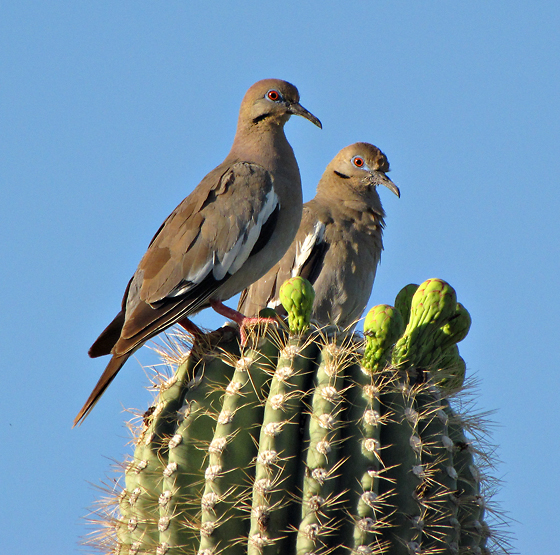
The White-winged Dove is best recognized by its namesake white wing patches, visible in flight and while perched. Adults exhibit a soft gray-brown overall plumage with a distinctive white edge along the wing. A subtle blue orbital ring surrounds the eye, and the bird possesses a characteristic black line that extends from the lower mandible to the eye. Juveniles are similar but lack the blue orbital ring, and their plumage tends to be slightly duller. Males and females share similar plumage, making them difficult to distinguish visually. When observing the bird in flight, its broad wings and square tail become apparent, which are helpful for identification. Compared to the Mourning Dove, the White-winged Dove is bulkier with a less pointed tail. Its perching posture is upright and alert, often seen on power lines and tree branches, providing a stable vantage point for vigilance against predators. In terms of potential confusion with similar species, the Eurasian Collared-Dove shares some habitat ranges but is easily distinguished by its lack of white wing markings and its distinctive black neck collar.
Having trouble telling birds apart? Upload a photo to our bird identification tool for an instant species match.
White-winged Dove Habitat and Range
Preferred Habitat
White-winged Doves thrive in a variety of habitats, from desert scrub and thorn forests to cultivated lands and urban settings. They are particularly abundant in the Sonoran Desert, where they rely on saguaro cacti for both food and nesting sites. Their adaptability allows them to inhabit lower elevations, typically below 5,000 feet, although some populations venture into higher elevations seasonally. As generalists, they occupy both rural and urban areas, often frequenting backyards and parks where food and water are readily available. Seasonal habitat shifts occur as these doves migrate, with wintering grounds expanding into subtropical regions where they exploit the milder climates.
Geographic Range
The breeding range of the White-winged Dove extends across the southwestern United States, including states like Texas and Arizona, down through Mexico and into parts of Central America. During the breeding season, they concentrate in areas with abundant food and nesting opportunities. In winter, their range extends further south, reaching as far as Costa Rica, where they join other migratory bird species in exploiting the favorable conditions. Migration corridors often follow major river valleys and desert oases, providing necessary resources during their journey. Population density hotspots include urban areas in their breeding range, where they benefit from bird feeders and agricultural fields.
Want to know which birds visit your area? Browse our backyard birds by location guides for region-specific species lists.
What Does the White-winged Dove Eat?
The diet of the White-winged Dove primarily consists of seeds and grains, with a particular preference for agricultural crops such as milo and sunflower. In natural settings, they consume seeds of native plants, including those of the saguaro cactus. Seasonal changes influence their diet, with a shift towards more fruits and berries during the breeding season to meet the nutritional demands of raising offspring. Foraging typically occurs on the ground, where they use their robust bills to crack open seeds. Their feeding schedule aligns with dawn and dusk, taking advantage of cooler temperatures and reduced predation risk.
Want to attract White-winged Doves to your yard? See our recommended feeders and seed types for the best results.
White-winged Dove Behavior and Social Structure
The White-winged Dove exhibits a range of social and territorial behaviors. During the breeding season, males perform a display flight, characterized by loud wing clapping, to attract females. Courtship involves bowing displays and gentle cooing. Once paired, they exhibit strong territorial instincts, defending nesting sites from intruders. Outside of the breeding season, these doves form loose flocks, sometimes numbering in the hundreds, which provide collective vigilance against predators. Daily activity patterns are largely diurnal, with peak activity occurring in the early morning and late afternoon. In the presence of predators, such as hawks, these doves take swift flight, relying on their agility and speed to evade capture.
White-winged Dove Nesting and Reproduction
White-winged Doves typically build their nests in trees, shrubs, or cacti, using twigs and grass to form a simple platform. They prefer elevated sites that offer protection from ground predators. The clutch size usually consists of two eggs, which both parents incubate for about 14 to 15 days. After hatching, the young are altricial, requiring substantial care and feeding, which both parents provide. Fledging occurs approximately 14 to 18 days post-hatching, but even after fledging, the young often remain dependent on the parents for several more weeks. In warmer climates, White-winged Doves may produce up to three broods per year, maximizing their reproductive potential.
White-winged Dove Sounds and Vocalizations
The primary song of the White-winged Dove is a distinctive, rhythmic 'who-cooks-for-you' phrase, delivered in a mellow, resonant tone. This song is most often heard during the early morning and late afternoon, especially during the breeding season. Their call notes include soft coos and chuckling sounds, used in various social interactions. Alarm calls are short and sharp, alerting other doves to potential threats. During the dawn chorus, their calls blend with those of other birds, creating a cacophony that signals the start of the day in their habitats.
Interesting Facts About the White-winged Dove
- 1The White-winged Dove has a unique relationship with the saguaro cactus, relying on it for both food and shelter.
- 2During migration, some White-winged Doves travel distances exceeding 1,000 miles between breeding and wintering grounds.
- 3Their distinctive 'who-cooks-for-you' call is often mistaken for that of an owl, adding to the mystique of their vocalizations.
- 4Unlike many birds, White-winged Doves can drink brackish water, allowing them to survive in arid environments.
- 5White-winged Doves are known to visit bird feeders, where they consume seeds and grains alongside other backyard birds.
- 6In Texas, the White-winged Dove is a popular game bird, with regulated hunting helping to manage its population sustainably.
- 7A single saguaro cactus can support multiple nesting pairs of White-winged Doves during the breeding season.
White-winged Dove Conservation Status
Currently, the White-winged Dove is listed as Least Concern by the IUCN, with a population trend that is stable or slightly increasing. Primary threats include habitat loss due to urban expansion and agricultural development. However, their adaptability to human-altered landscapes has allowed them to maintain a healthy population. Conservation efforts focus on preserving critical habitats, such as desert ecosystems, and monitoring population trends to ensure long-term stability. Historically, hunting pressure affected their numbers, but modern regulations have helped mitigate this threat.
Attracting White-winged Doves to Your Feeder
The White-winged Dove is a regular visitor to backyard bird feeders across its range. At the Eye On The Fly feeding station, we observe White-winged Doves regularly and capture footage with our feeder cameras.


