
Crested Serpent-Eagle
Spilornis cheela
Order: Accipitriformes / Family: Accipitridae
Wikimedia Commons
About the Crested Serpent-Eagle
The Crested Serpent-Eagle, scientifically known as Spilornis cheela, is a formidable raptor belonging to the Accipitridae family. This bird is widely distributed across the Indian subcontinent and Southeast Asia, thriving in a range of environments from dense forests to open grasslands. It plays a critical ecological role as a top predator, primarily preying on snakes, which helps to control the populations of these reptiles. The Crested Serpent-Eagle is recognized for its adaptability, occupying various habitats including lowland forests, mangroves, and even foothills up to elevations of 2,000 meters. Its presence is often a sign of healthy, biodiverse ecosystems.
Throughout its range, the Crested Serpent-Eagle is a notable part of avian communities, often observed perched high in the forest canopy or soaring above the treetops. Its striking appearance and distinctive call make it an easily identifiable species for birdwatchers. During the breeding season, which varies across regions, these eagles become more vocal and visible, as they engage in aerial displays to establish territories and attract mates. In regions with prominent wet and dry seasons, such as parts of India and Southeast Asia, the eagle's activities and movements are closely tied to these climatic cycles.
In regions like the Western Ghats of India or the forests of Borneo, the Crested Serpent-Eagle contributes to the intricate web of predator-prey relationships. It is a resilient species, but like many raptors, it faces threats from habitat destruction and human interference. Conservation efforts focused on preserving natural habitats have become crucial for ensuring the continued survival of the Crested Serpent-Eagle, as these habitats not only support the eagles but also a myriad of other wildlife species.
The Crested Serpent-Eagle belongs to the family Accipitridae, within the order Accipitriformes. These birds typically live typically lives around 15 years in the wild, with some individuals reaching up to 25 years..
How to Identify a Crested Serpent-Eagle
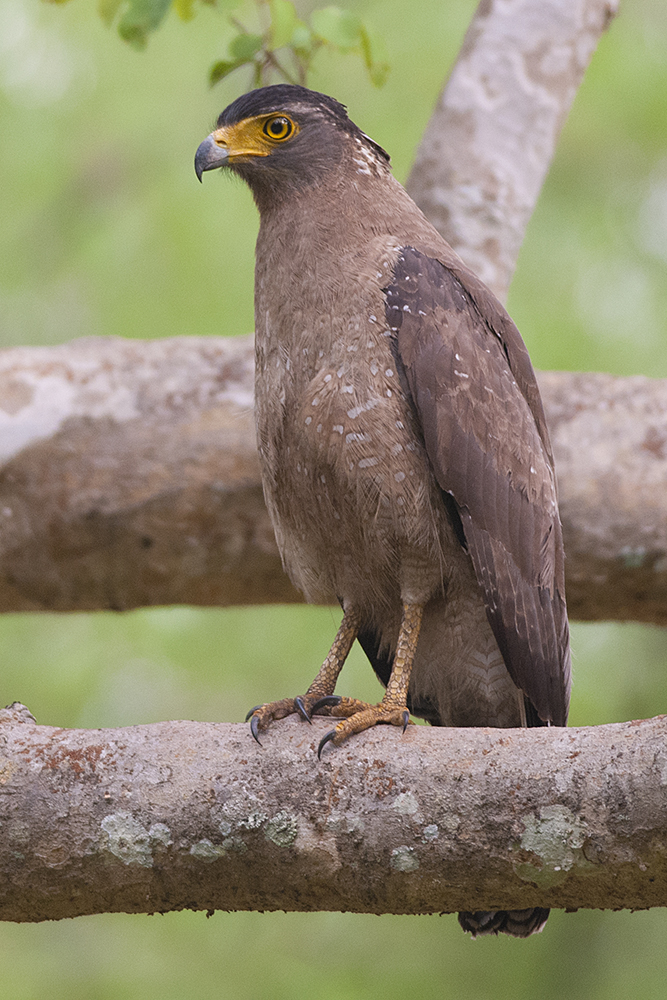
The Crested Serpent-Eagle is a medium-large raptor, measuring between 55 to 75 cm in length, with a wingspan of around 110 to 160 cm. It is characterized by its prominent crest, which is often raised when the bird is alert. The plumage of the adult is predominantly dark brown, with a lighter, spotted belly and bold white and black barring on the wings and tail. The head features a striking yellow cere and eye-ring, giving it a fierce appearance. Juvenile Crested Serpent-Eagles are generally paler, with more pronounced streaks on their bodies and a less developed crest.
Females are typically larger than males, a common trait among raptors, though visually they are quite similar. A key identification feature is the white band across the tail, which is especially visible in flight. When perching, the Crested Serpent-Eagle maintains an upright posture, often scanning its surroundings for potential prey. In flight, it has a broad-winged silhouette with wings held flat and slightly arched, allowing for efficient soaring.
Confusion with other species can occur, particularly with the Changeable Hawk-Eagle or other serpent-eagles, but the Crested Serpent-Eagle's combination of crest, yellow eye-ring, and wing pattern helps distinguish it. Its distinctive whistling call, often heard during early mornings or before rain, serves as another identifying characteristic.
Having trouble telling birds apart? Upload a photo to our bird identification tool for an instant species match.
Crested Serpent-Eagle Habitat and Range
Preferred Habitat
The Crested Serpent-Eagle occupies a wide range of habitats, from dense tropical and subtropical forests to open woodlands and grasslands. It is commonly found in lowland regions, though it can also be seen in hilly and mountainous areas up to 2,000 meters in elevation. This adaptability allows it to thrive in various settings, including mangroves and cultivated landscapes.
In more urbanized areas, the Crested Serpent-Eagle can sometimes be observed in parks and large gardens, as long as there are sufficient trees for perching and a food supply. However, its preference remains for regions with ample tree cover and water sources, which support its primary diet of snakes and small mammals.
Seasonal shifts in habitat use are not pronounced for the Crested Serpent-Eagle, as it generally remains within its home range year-round. However, in regions affected by monsoons or dry seasons, the eagle may adjust its foraging areas in response to prey availability and water levels.
Geographic Range
The Crested Serpent-Eagle has a broad range that extends from the Indian subcontinent through Southeast Asia, reaching as far east as the Philippines and Indonesia. Its breeding range includes countries like India, Sri Lanka, Nepal, Bhutan, Myanmar, Malaysia, Thailand, and parts of southern China.
Unlike some raptors that undertake long-distance migrations, the Crested Serpent-Eagle is primarily sedentary, with individuals typically residing within a defined territory year-round. In some areas, however, minor altitudinal movements occur in response to climatic variations or prey abundance.
Population density varies across its range, with higher concentrations in regions where suitable habitats are extensive and prey is abundant. In places like the Western Ghats or the rainforests of Borneo, the Crested Serpent-Eagle is a common sight, whereas in more arid or heavily urbanized areas, its presence may be sporadic.
Want to know which birds visit your area? Browse our backyard birds by location guides for region-specific species lists.
What Does the Crested Serpent-Eagle Eat?
The diet of the Crested Serpent-Eagle predominantly consists of snakes, which it skillfully hunts using its keen eyesight and swift flight. It is capable of taking down both venomous and non-venomous species, sometimes tackling prey larger than itself. In addition to snakes, this eagle consumes a variety of other vertebrates including lizards, small mammals such as rodents, and occasionally birds.
Seasonal diet changes are minimal, but the eagle may adjust its feeding habits based on prey availability. During the monsoon or in wetter regions, it might focus more on amphibians and water snakes, while in drier areas, it targets terrestrial reptiles and mammals. The Crested Serpent-Eagle employs a sit-and-wait hunting strategy, often perching quietly before swooping down to seize its prey with powerful talons.
Its feeding schedule is primarily diurnal, with peak hunting activity occurring during the early morning and late afternoon when prey is most active.
Crested Serpent-Eagle Behavior and Social Structure
The Crested Serpent-Eagle exhibits a largely solitary lifestyle, with individuals maintaining and defending distinct territories. During the breeding season, pairs become more visible and vocal, often engaging in soaring displays above the forest canopy. These displays serve both to reinforce pair bonds and to deter rivals.
Territorial behavior is pronounced, with eagles using calls and physical displays to demarcate their domain. In areas with abundant resources, territories may overlap slightly, but conflict is generally avoided through vocal communication. Courtship involves elaborate aerial displays, where both male and female perform dives and spirals, showcasing their agility and strength.
The Crested Serpent-Eagle is largely diurnal, with activity peaks in the morning and late afternoon. It spends much of the day perched quietly, either alone or in pairs, scanning for prey or resting. When faced with potential threats, such as larger raptors or human disturbance, the eagle may issue a series of sharp alarm calls and take flight to a higher perch or more secluded area.
Crested Serpent-Eagle Nesting and Reproduction
Crested Serpent-Eagles build large stick nests high in the canopy, usually in the fork of a tree. The nest is often reused and added to each year, forming a substantial structure. The interior is lined with green leaves and other soft materials to cushion the eggs.
The typical clutch size is one to two eggs, with both parents sharing incubation duties over a period of 35 to 40 days. Once the eggs hatch, the female primarily tends to the young while the male provides food. Fledging occurs approximately 60 to 70 days after hatching, although young eagles may stay near the nest for several weeks as they develop their flying and hunting skills.
Usually, the Crested Serpent-Eagle raises one brood per year, though in regions with extended favorable conditions, a second brood may occasionally be attempted. Parental investment is significant, with both adults being highly attentive to the needs of their offspring.
Crested Serpent-Eagle Sounds and Vocalizations
The primary call of the Crested Serpent-Eagle is a distinctive, high-pitched whistling that carries over long distances. This call is often described as a clear, rising 'wheee-oo', repeated several times in succession, and is most frequently heard during the early morning or pre-storm periods.
In addition to its territorial and mating calls, the eagle produces various alarm calls when disturbed or threatened. These calls are sharper and more urgent in tone, intended to ward off intruders or alert nearby eagles to potential danger.
Compared to more melodious songbirds, the Crested Serpent-Eagle's vocalizations are straightforward but effective in their ecological context, communicating essential information regarding territory and social interactions.
Interesting Facts About the Crested Serpent-Eagle
- 1The Crested Serpent-Eagle is known for its remarkable eyesight, capable of spotting prey from a considerable distance.
- 2Despite its name, the Crested Serpent-Eagle's diet includes more than just snakes, showcasing its dietary adaptability.
- 3In some cultures, the Crested Serpent-Eagle is considered a symbol of protection and strength due to its fierce hunting skills.
- 4The eagle's call is often used by local communities as an indicator of impending rain or approaching storms.
- 5Juvenile Crested Serpent-Eagles are sometimes mistaken for different species due to their lighter plumage and distinctive markings.
- 6These eagles have been observed using their wings to shade water, creating a clearer view for hunting aquatic prey.
- 7Crested Serpent-Eagles are known to inhabit a wide range of altitudes, from sea level to highland forests.
Crested Serpent-Eagle Conservation Status
According to the IUCN Red List, the Crested Serpent-Eagle is currently classified as Least Concern, with a stable population trend across much of its range. While not immediately threatened, this species faces challenges from habitat destruction, particularly in regions undergoing rapid deforestation and urbanization. Conservation efforts have focused on protecting critical habitats and encouraging sustainable land-use practices. In some areas, wildlife corridors have been established to connect fragmented habitats, aiding in the movement and genetic exchange of eagle populations. Historically, the Crested Serpent-Eagle has shown resilience, maintaining healthy populations even as other raptors declined. However, continuous conservation vigilance is necessary to ensure that this adaptable raptor continues to thrive amidst changing environmental conditions.


