
Crimson-bellied Parakeet
Pyrrhura perlata
Order: Psittaciformes / Family: Psittacidae
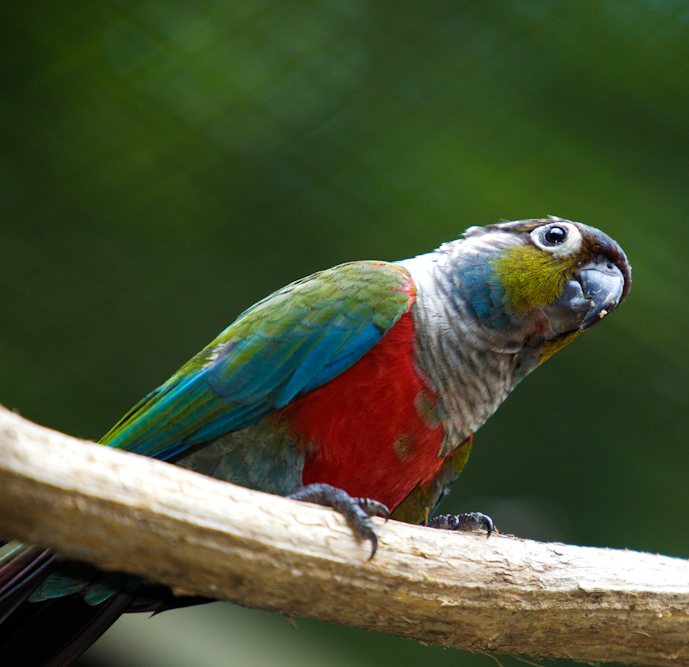
Wikimedia Commons
About the Crimson-bellied Parakeet
The Crimson-bellied Parakeet (Pyrrhura perlata) is a strikingly colorful member of the family Psittacidae, recognized for its vivid crimson underparts that contrast beautifully with the green plumage covering its back. Found primarily in the Amazon Basin, this parakeet plays a vital ecological role in its native rainforest habitats. Its presence in countries such as Brazil and Bolivia underscores the parakeet’s preference for dense, humid environments. These birds are integral to seed dispersal, aiding in the propagation of various plant species throughout the forest. As a highly social species, the Crimson-bellied Parakeet often forms small flocks, engaging in complex social interactions. During the breeding season, these parakeets exhibit increased territoriality, with pairs defending nesting sites vigorously against intruders. Seasonal behaviors include slight altitudinal movements within the rainforest, as they adjust to the availability of food resources. In non-breeding seasons, they may expand their range slightly, seeking out fruiting trees and other food sources. The Crimson-bellied Parakeet also contributes to the soundscape of the rainforest with its distinctive calls, adding to the rich tapestry of Amazonian wildlife. Conservation efforts are increasingly crucial due to habitat destruction and illegal pet trade pressures, which threaten their populations.
The Crimson-bellied Parakeet belongs to the family Psittacidae, within the order Psittaciformes. These birds typically live average 15-20 years with a max recorded of 25 years..
How to Identify a Crimson-bellied Parakeet
Adult Crimson-bellied Parakeets are easily identifiable by their brilliant red belly and green plumage. They have a bluish crown and nape, with a subtle grayish hue on their chest. Juveniles resemble adults but often have less pronounced red on their bellies and may exhibit slightly duller coloration overall. Both males and females share these plumage characteristics, making sex differentiation through visual cues challenging. The flight silhouette of the Crimson-bellied Parakeet is distinctive, with a short, square tail and relatively broad wings that create a noticeable fluttering pattern. When perched, they often display a slightly hunched posture, accentuating their rounded bodies. Confusion with similar species such as the Green-cheeked Parakeet can occur, but the unique combination of the Crimson-bellied Parakeet's red belly and blue crown typically provides clear differentiation. Observing them in their natural rainforest habitat, one can appreciate the subtle nuances of their plumage, which blends yet stands out against the lush foliage.
Having trouble telling birds apart? Upload a photo to our bird identification tool for an instant species match.
Crimson-bellied Parakeet Habitat and Range
Preferred Habitat
The Crimson-bellied Parakeet primarily inhabits the lowland rainforests of the Amazon Basin. These birds thrive in dense, humid environments characterized by tall trees and a rich understory. They often frequent areas near rivers and streams, which provide abundant food resources. Their habitat preference generally includes elevations up to 1000 meters, though they are more commonly found below 500 meters. During certain seasons, they may shift slightly in elevation as they follow food availability. Unlike many birds that adapt to urban environments, the Crimson-bellied Parakeet remains largely within forested areas, demonstrating a preference for natural habitats over human-altered landscapes. This reliance on intact rainforest makes them particularly vulnerable to deforestation and habitat fragmentation.
Geographic Range
The Crimson-bellied Parakeet is native to the Amazon Basin, with a range primarily encompassing parts of Brazil and Bolivia. Within Brazil, their presence extends through northern regions such as Amazonas and Pará, while in Bolivia, they are found in the northern departments like Pando. These parakeets do not migrate extensively but may exhibit local movements in response to food availability and breeding requirements. Areas of high population density often coincide with regions of extensive rainforest cover, highlighting the importance of these ecosystems for their survival. The lack of significant migratory behavior means these parakeets rely heavily on the preservation of their native habitats year-round.
Want to know which birds visit your area? Browse our backyard birds by location guides for region-specific species lists.
What Does the Crimson-bellied Parakeet Eat?
The diet of the Crimson-bellied Parakeet is predominantly frugivorous, comprising a variety of fruits, seeds, and berries found in the Amazon rainforest. They have a particular preference for figs and other soft fruits, which they consume using their strong beaks to break open tough outer skins. Seasonal changes in fruiting patterns influence their diet, with these parakeets often shifting their foraging efforts to match the availability of ripe fruits. Besides fruits, they sometimes consume flowers and buds, supplementing their diet with essential nutrients. Observations of their foraging behavior reveal a methodical approach, as they move through the canopy in small flocks, meticulously scrutinizing branches for hidden food sources. Typically, feeding occurs during the cooler parts of the day, primarily in the morning and late afternoon.
Crimson-bellied Parakeet Behavior and Social Structure
Crimson-bellied Parakeets exhibit highly social behavior, often found in small flocks that facilitate complex social interactions. These flocks, usually consisting of 6-10 individuals, display intricate communication patterns through vocalizations and physical gestures. Territorial behavior becomes more pronounced during the breeding season, with pairs defending their chosen nesting sites with vigor. Courtship displays involve mutual preening and food sharing, which strengthen pair bonds. In response to predators, these parakeets rely on alert calls to warn each other of potential threats, often retreating into dense foliage for protection. During daily activities, they maintain a balance between foraging, socializing, and resting, with peak activity occurring during cooler parts of the day. Their tendency to form communal roosts at night reflects their social nature and provides additional protection from nocturnal predators.
Crimson-bellied Parakeet Nesting and Reproduction
Crimson-bellied Parakeets prefer nesting in cavities, often utilizing natural hollows found in large trees, which offer protection and stability. These cavities, typically located at mid to upper levels of the tree canopy, provide a secure environment for raising young. The nesting season generally coincides with the onset of the rainy season, when food resources are plentiful. A typical clutch consists of 3-5 eggs, with incubation lasting approximately 22-24 days. Both parents participate in feeding and caring for the chicks, which fledge around 6-7 weeks after hatching. The parental roles are well-defined, with both sexes sharing responsibilities such as feeding and protection. These parakeets generally produce one brood per year, but favorable conditions sometimes allow for a second.
Crimson-bellied Parakeet Sounds and Vocalizations
The vocal repertoire of the Crimson-bellied Parakeet includes a variety of calls and sounds used for communication within flocks. Their primary song consists of a series of high-pitched, melodic notes delivered in rapid succession, which can be heard echoing through the rainforest canopy. In addition to their song, they produce distinctive call notes that serve as contact calls when individuals become separated from the group. Alarm calls are sharper and more urgent, facilitating immediate responses among flock members to potential threats. During the dawn chorus, these parakeets contribute to the vibrant avian acoustics of the rainforest, their voices merging with other species to create a lively symphony that heralds the new day.
Interesting Facts About the Crimson-bellied Parakeet
- 1Crimson-bellied Parakeets are known for their striking courtship rituals, which involve elaborate displays and mutual feeding.
- 2These parakeets have a preference for figs, making them important seed dispersers within their ecosystem.
- 3The vibrant red belly of the Crimson-bellied Parakeet is a key identifier, setting it apart from similar species.
- 4Despite their colorful appearance, these parakeets can be surprisingly difficult to spot in the dense rainforest foliage.
- 5Crimson-bellied Parakeets often form large communal roosts, providing safety in numbers against predators.
- 6Their vocalizations can be heard from a great distance, especially during the early morning and late afternoon.
- 7The species' reliance on rainforest habitats makes it particularly vulnerable to the impacts of deforestation.
Crimson-bellied Parakeet Conservation Status
The Crimson-bellied Parakeet currently holds a conservation status of Near Threatened according to the IUCN Red List. This status reflects ongoing threats such as habitat loss due to deforestation and the illegal pet trade, both of which contribute to population declines. Conservation efforts focus on habitat preservation and anti-poaching measures, aiming to secure the future of these vibrant birds. Historically, their populations have fluctuated in response to environmental pressures, underscoring the need for sustained conservation initiatives. Programs aiming to protect large swathes of the Amazon rainforest are crucial to ensuring the survival of the Crimson-bellied Parakeet along with countless other species.


