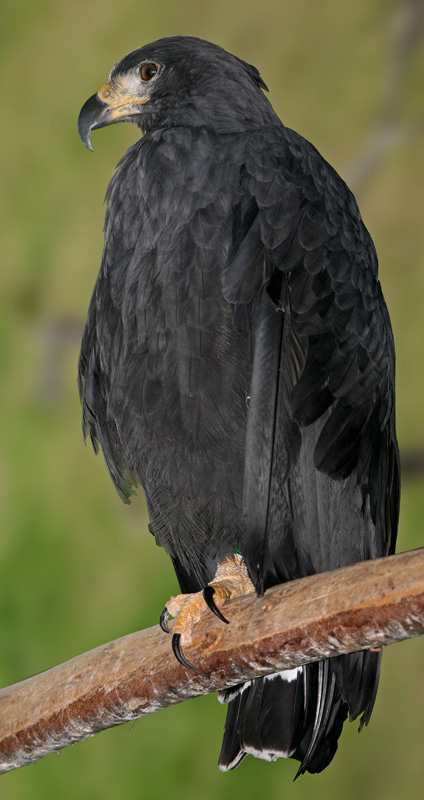
Crowned Solitary Eagle
Harpyhaliaetus coronatus
Order: Accipitriformes / Family: Accipitridae

Wikimedia Commons
About the Crowned Solitary Eagle
The Crowned Solitary Eagle (Harpyhaliaetus coronatus) is an impressive bird of prey within the family Accipitridae, renowned for its solitary habits and distinctive appearance. This eagle inhabits diverse regions ranging from southern Brazil and Bolivia to central Argentina, with sporadic occurrences in Paraguay and Uruguay. As a top predator, it plays a crucial role in maintaining the ecological balance within its habitats, predominantly open dry forests, savannas, and scrublands. With a wingspan reaching up to 183 cm, this eagle commands presence in the sky, patrolling its territory in search of prey. Its significance extends beyond its ecological role, as it is considered a symbol of wilderness in the regions it inhabits. The Crowned Solitary Eagle is particularly active during the dry season, often observed soaring at higher altitudes when prey is more visible due to reduced vegetation cover. It is during these times that the eagle demonstrates its remarkable hunting prowess, capturing a variety of prey including small mammals, birds, and reptiles. This solitary hunter is typically observed alone or in pairs, only forming closer associations during the breeding season. Its presence serves as an indicator of the health of its habitat, making it a key species for conservationists who aim to preserve the biodiversity of South America's temperate regions. The Crowned Solitary Eagle's distinctive call, a series of high-pitched whistles, often resonates through its territory, a sound that is as much a part of its environment as the wind through the trees. These eagles are not migratory, maintaining their territories year-round, which highlights the importance of protecting their habitats from deforestation and human encroachment. As their population continues to be threatened by habitat loss and fragmentation, understanding and preserving the habitats they depend on becomes ever more critical.
The Crowned Solitary Eagle belongs to the family Accipitridae, within the order Accipitriformes. These birds typically live average 15-20 years, with a maximum recorded of 25 years..
How to Identify a Crowned Solitary Eagle
Identifying the Crowned Solitary Eagle involves noting several distinguishing features. Adults boast a striking crown of elongated feathers, which gives the species its name. Their plumage is mainly dark gray, with lighter underparts and a distinctive white band at the base of their tail feathers. Juveniles present a more mottled appearance, with brown and white streaks that gradually transition to the adult plumage over several years. While the sexes are similar in appearance, females tend to be slightly larger than males, a common trait among raptors. In flight, this eagle exhibits broad, rounded wings and a relatively short tail, creating a silhouette that is unmistakable in the open skies of its native range. Perched, it maintains a regal posture, often on prominent branches or rocky outcrops, scanning its surroundings with keen eyesight. Confusion with other species is unlikely due to its size and distinctive crown, though it may occasionally be mistaken for the less common Harpy Eagle in overlapping areas. However, the Crowned Solitary Eagle's less robust build and unique plumage patterns set it apart.
Having trouble telling birds apart? Upload a photo to our bird identification tool for an instant species match.
Crowned Solitary Eagle Habitat and Range
Preferred Habitat
The Crowned Solitary Eagle primarily inhabits open and semi-open landscapes such as dry forests, grasslands, and savannas. It is commonly found in regions like the Gran Chaco and the Pampas, where the open terrain facilitates its hunting style. These eagles prefer areas with scattered trees or patches of woodland that provide perching sites necessary for their hunting strategy. They are known to occupy elevations ranging from sea level up to approximately 1,500 meters, favoring lower elevations where prey is more abundant. Unlike some raptors, this species is not typically found in urban areas, as it requires large territories with minimal human disturbance to thrive. Seasonal habitat shifts are minimal, as these eagles are non-migratory. However, they may adjust their range locally in response to prey availability and environmental changes, especially during breeding seasons.
Geographic Range
The breeding range of the Crowned Solitary Eagle extends from central and southern Brazil through eastern Bolivia and into northern Argentina, with its presence also known in Paraguay and Uruguay. This eagle does not undertake long migrations; instead, it remains within its established territory throughout the year. Population densities are highest in the Gran Chaco region, where suitable habitats are most widespread. Despite this, the overall population is sparse and declining, primarily due to habitat loss. The species occupies a patchy distribution across its range, with isolated populations potentially existing in suitable habitats outside the main areas of occurrence. Conservation efforts focus on preserving these areas to ensure the eagle's survival.
Want to know which birds visit your area? Browse our backyard birds by location guides for region-specific species lists.
What Does the Crowned Solitary Eagle Eat?
The diet of the Crowned Solitary Eagle is diverse, comprising mainly small to medium-sized mammals such as armadillos and small deer. Birds and reptiles, including snakes and lizards, also form a significant part of its diet. This eagle employs a sit-and-wait hunting strategy, utilizing its keen eyesight to spot prey from a distance before launching a swift aerial attack. During the dry season, when prey is more visible, the eagle may adjust its hunting schedule to take advantage of increased activity among prey species. While it primarily hunts during daylight hours, it has been observed occasionally hunting at dusk, demonstrating a degree of adaptability in its feeding habits. The eagle's powerful talons and beak are well-suited for subduing a variety of prey sizes, allowing it to maintain a varied diet year-round.
Crowned Solitary Eagle Behavior and Social Structure
The Crowned Solitary Eagle is a predominantly solitary bird, as its name suggests. It establishes large territories that it defends vigorously against intruders, often engaging in dramatic aerial displays to assert dominance. During the breeding season, pairs may engage in mutual soaring and calling, strengthening pair bonds. Courtship displays include synchronized flight patterns and mutual preening. Unlike many raptors, this eagle does not form flocks, preferring solitary or paired life. Its daily routine involves long periods of perching and scanning for prey, interspersed with short bursts of flight during hunting. When confronted by potential predators, such as larger eagles or humans, the Crowned Solitary Eagle may engage in aggressive defensive behavior. It remains largely diurnal, with peak activity occurring in the early morning and late afternoon when temperatures are cooler, and prey is more active.
Crowned Solitary Eagle Nesting and Reproduction
Nesting for the Crowned Solitary Eagle involves constructing large stick nests, typically situated high in trees or on cliffs, providing a commanding view of the surrounding terrain. The eagle selects locations that offer protection from predators and proximity to hunting grounds. Nest construction involves both members of the pair, who gather sticks, leaves, and other materials to create a sturdy structure. Clutch sizes usually range from one to two eggs, with the female primarily responsible for incubation, which lasts approximately 40 days. After hatching, the chicks remain in the nest for around 70 days, during which both parents contribute to feeding and protection. The fledging process is gradual, with young eagles taking their first flights before fully leaving the nest. Typically, the Crowned Solitary Eagle raises one brood per year, although this can vary with environmental conditions and prey availability.
Crowned Solitary Eagle Sounds and Vocalizations
The vocalizations of the Crowned Solitary Eagle are characterized by a series of high-pitched whistles, which serve as both communication and territorial markers. These calls are often heard during early morning hours when the eagle is most active. The primary call resembles a long, drawn-out whistle that rises in pitch, used to announce presence and deter rivals. Alarm calls are sharper and more abrupt, signaling potential threats to the nest or territory. Unlike many songbirds, the Crowned Solitary Eagle does not participate in a dawn chorus, its calls instead punctuating the silence of its habitat at intervals. These vocalizations serve as a vital means of maintaining social bonds with its mate and asserting dominance over its territory.
Interesting Facts About the Crowned Solitary Eagle
- 1The Crowned Solitary Eagle's wingspan can reach up to 183 cm, making it one of the larger raptors in the Americas.
- 2Despite its name, the Crowned Solitary Eagle sometimes forms mating pairs, although it prefers solitude outside of breeding seasons.
- 3Its preferred prey includes armadillos, which can weigh up to 10 kg, showcasing the eagle's impressive hunting capabilities.
- 4This eagle's distinctive crown of feathers is not just ornamental; it may help in communication and species recognition.
- 5The Crowned Solitary Eagle has been observed using thermal currents to soar effortlessly, conserving energy during long flights.
- 6In some local cultures, the Crowned Solitary Eagle is considered a symbol of strength and wilderness.
- 7The eagle's nest can measure up to 1.5 meters across and is reused year after year, with repairs made as needed.
Crowned Solitary Eagle Conservation Status
The Crowned Solitary Eagle is currently classified as Endangered by the IUCN, with populations in decline. The primary threats to this species are habitat destruction and fragmentation due to agriculture, logging, and urban expansion. Conservation efforts focus on habitat preservation and restoration, alongside legal protection measures to prevent further decline. Historically, the eagle's range has contracted significantly, emphasizing the need for ongoing conservation initiatives. Collaboration between local communities and conservation organizations aims to safeguard critical habitats and promote sustainable land-use practices. Increasing awareness and education about the eagle's ecological importance are also crucial components of conservation strategies.
Other Accipitridae Species


Birds Similar to the Crowned Solitary Eagle
These species are often confused with the Crowned Solitary Eagle due to similar appearance or overlapping range.