Cyrilavis colburnorum
Cyrilavis colburnorum
Order: Piciformes / Family: Picidae
About the Cyrilavis colburnorum
Cyrilavis colburnorum, more commonly known as the Colburn's Woodpecker, is a captivating member of the family Picidae. This species inhabits the dense deciduous and mixed forests of Central and South America, showcasing a particular affinity for regions like the Amazon Basin and the slopes of the Andes. Its presence is a testament to the rich biodiversity of these areas. Colburn's Woodpecker plays a vital ecological role as both a predator and a creator of nesting opportunities for other species by excavating cavities in trees. As a keystone species, its activities promote forest health by controlling insect populations and facilitating the growth of new vegetation through the aeration of tree bark. Seasonal behaviors are notable in Cyrilavis colburnorum, as it engages in more active foraging during the breeding season, which spans from late spring to early summer. During this period, the woodpecker becomes more vocal, using its distinct drumming to establish territories and attract mates. The bird's adaptability to varying altitudes, from lowland tropical forests to montane regions, emphasizes its ecological flexibility. Additionally, Colburn's Woodpecker exhibits a fascinating interaction with its environment, often seen foraging in the canopy layers of mature forests and occasionally venturing into secondary growth forests, indicating its resilience to habitat change. The Colburn's Woodpecker's contribution to forest ecosystems is invaluable, and its presence serves as an indicator of forest health and biodiversity.
The Cyrilavis colburnorum belongs to the family Picidae, within the order Piciformes. These birds typically live unknown, but likely similar to other woodpeckers, averaging 5-8 years..
How to Identify a Cyrilavis colburnorum
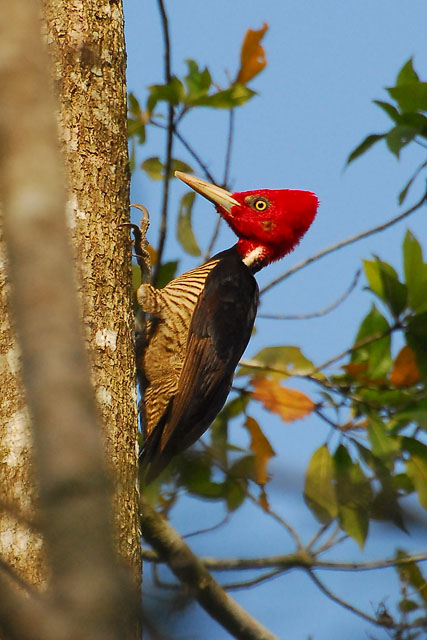
The Colburn's Woodpecker, Cyrilavis colburnorum, is immediately recognizable by its vibrant red crown, a trait that is particularly striking against its predominantly black-and-white plumage. Adult birds display a complex pattern of black and white striping on their back, with a distinctive white patch on the wings visible in flight. Juveniles, however, can be distinguished by their more muted crown color, which appears orange rather than red, and less defined striping. Males and females are similar in appearance, though males often have a slightly more pronounced red crown. When compared to similar species like the Hairy Woodpecker, the Colburn's Woodpecker is notably smaller and more vividly colored. In flight, this woodpecker exhibits a characteristic undulating pattern, a typical trait of the Picidae family, where the bird alternates between rapid wingbeats and short glides. When perched, the woodpecker often adopts an upright posture, clinging to tree trunks with its stiff tail feathers providing support. This posture aids in its foraging behavior as it taps and drills into tree bark in search of insects.
Having trouble telling birds apart? Upload a photo to our bird identification tool for an instant species match.
Cyrilavis colburnorum Habitat and Range
Preferred Habitat
Cyrilavis colburnorum primarily inhabits dense deciduous and mixed forests. It is frequently found in the lush Amazon Basin, where the vast expanse of tropical rainforest provides ample foraging and nesting opportunities. The species is also present in the Andean slopes, adapting to elevations ranging from 500 to 2,500 meters. During the breeding season, Colburn's Woodpecker may venture into secondary growth forests, exploiting new territories as needed. While primarily a forest dweller, it occasionally appears in more open woodland areas, especially where old-growth trees are available. Unlike some woodpeckers, this species shows limited presence in urban areas, preferring the solitude and resources of rural forested landscapes.
Geographic Range
The breeding range of Cyrilavis colburnorum spans the tropical and subtropical zones of Central and South America, with significant populations in countries such as Brazil, Peru, and Colombia. During the non-breeding season, some populations may exhibit altitudinal migration, moving to lower elevations in response to colder conditions at higher altitudes. Migration corridors are less defined for this species, as it largely remains within its range year-round. Population density hotspots include the Amazon rainforest, where the abundant resources support large numbers. In the Andean regions, the bird is less common, yet it still maintains a stable presence. Its range reflects its adaptability to diverse forest types, from lowland rainforests to montane cloud forests.
Want to know which birds visit your area? Browse our backyard birds by location guides for region-specific species lists.
What Does the Cyrilavis colburnorum Eat?
The diet of Cyrilavis colburnorum consists primarily of insects, particularly beetles and ants, which it extracts from tree bark using its strong, chisel-like beak. During the wet season, when insect activity is high, the woodpecker's diet is augmented with caterpillars and larvae, providing essential protein for its energy-intensive lifestyle. In the dry season, the Colburn's Woodpecker may turn to fruit and seeds when insects become scarce. Its foraging technique involves both pecking at the bark to access insect tunnels and gleaning insects from the surface of leaves. The size of prey varies, but typically includes small to medium-sized insects. Feeding occurs throughout the day, with peak activity in the early morning and late afternoon, times when insect activity is highest.
Cyrilavis colburnorum Behavior and Social Structure
Cyrilavis colburnorum exhibits a solitary lifestyle outside the breeding season, though it is not uncommon to spot pairs during the nesting period. Territorial behavior is pronounced, with individuals defending their chosen nesting sites through vocalizations and drumming displays. Courtship involves both visual displays and the exchange of food between potential mates, a behavior that strengthens pair bonds. This woodpecker tends to be monogamous, maintaining the same mate across breeding seasons. In response to predators, such as raptors or larger mammals, the Colburn's Woodpecker employs evasive flight tactics and relies on its cryptic plumage to blend into the forest backdrop. Daily activity patterns show peaks in the early morning and late afternoon, coinciding with increased foraging activity. While largely arboreal, this species occasionally descends to the ground to forage for insects among the leaf litter.
Cyrilavis colburnorum Nesting and Reproduction
The nesting habits of Cyrilavis colburnorum are typical of woodpeckers, with the bird excavating a cavity in a dead or decaying tree. The nest cavity is usually located between 3 to 10 meters above the ground, providing protection from ground predators. The nesting materials are minimal, as the bird relies on the wood chips created during excavation to line the nest. A typical clutch consists of 3 to 5 eggs, which the parents incubate for approximately two weeks. Both male and female participate in incubation and feeding the chicks. After hatching, the young remain in the nest for about 24 days before fledging. Colburn's Woodpecker typically raises one brood per year, though in optimal conditions, a second brood may occur. Parental roles are shared, with both parents contributing to feeding and protecting the young.
Cyrilavis colburnorum Sounds and Vocalizations
The vocalizations of Cyrilavis colburnorum are distinct, with its primary song consisting of a rapid series of sharp, high-pitched notes that resonate through the forest. Its call notes, often heard during flight, are softer and consist of a series of 'chek-chek' sounds. Alarm calls are harsh and loud, serving to alert other birds to potential dangers. During the dawn chorus, the Colburn's Woodpecker is one of the early contributors, its calls blending into the symphony of the waking forest. Its drumming, used primarily to establish territory and communicate with potential mates, is a series of rapid taps that can be heard from a considerable distance.
Interesting Facts About the Cyrilavis colburnorum
- 1Cyrilavis colburnorum is named after the ornithologist Cyril Colburn, known for his extensive work in South American avifauna.
- 2The Colburn's Woodpecker can peck up to 20 times per second, a rate that allows it to efficiently forage for insects under bark.
- 3Unlike many woodpeckers, the Colburn's Woodpecker has a unique adaptation in its hyoid bone structure which wraps around its skull, providing additional shock absorption.
- 4Studies have shown that the Colburn's Woodpecker can recognize individual drumming patterns of neighbors, allowing them to avoid unnecessary territorial conflicts.
- 5The species' preference for decaying trees highlights its role in forest regeneration, as these trees provide essential habitats for a variety of other organisms.
Cyrilavis colburnorum Conservation Status
Cyrilavis colburnorum is currently classified as Least Concern by the IUCN, with population trends considered stable. The primary threats to this species include habitat loss due to deforestation and agricultural expansion in its native range. Conservation efforts focus on protecting large tracts of forest and promoting sustainable land-use practices to mitigate these threats. Historical data suggests that the population has remained relatively stable over the past few decades, though localized declines have occurred in areas experiencing significant habitat alteration. Ongoing research and monitoring are essential to ensure the long-term survival of this species.
Other Picidae Species


Birds Similar to the Cyrilavis colburnorum
These species are often confused with the Cyrilavis colburnorum due to similar appearance or overlapping range.