
Delegorgue's Pigeon
Columba delegorguei
Order: Columbiformes / Family: Columbidae
Wikimedia Commons
About the Delegorgue's Pigeon
Delegorgue's Pigeon, or Columba delegorguei, represents an intriguing member of the Columbidae family. This species primarily inhabits the montane forests of eastern Africa, from Kenya to Mozambique. Its presence in these regions underscores its preference for lush, forested environments, especially those at higher elevations. These pigeons are vital to their ecosystems, acting as seed dispersers due to their fruit-based diet. By distributing seeds across large areas, they contribute to forest regeneration and biodiversity. The ecological role of Delegorgue's Pigeon extends beyond seed dispersal, as they also serve as prey for various predators, thus integrating into the food web as a key species. In their natural habitats, these pigeons exhibit unique seasonal behaviors. During the breeding season, which typically spans from September to March, they engage in courtship displays characterized by distinct vocalizations and flight patterns. Outside of the breeding season, Delegorgue's Pigeons are less vocal and often form small flocks to forage. Their foraging behavior changes with the seasons, as they adapt to the availability of different fruiting trees. This adaptability ensures their survival in dynamic forest environments. Despite their importance, Delegorgue's Pigeons face threats from habitat destruction due to logging and agricultural expansion. Conservation efforts focus on preserving their forest habitats and understanding their ecological needs. Researchers emphasize the importance of protected areas in maintaining healthy populations of these pigeons. Additionally, studying their movement patterns and dietary preferences helps develop effective conservation strategies. Overall, Delegorgue's Pigeon embodies a species intricately linked to the health of eastern Africa's montane forests. Their presence indicates a thriving ecosystem, and their decline could signal environmental distress.
The Delegorgue's Pigeon belongs to the family Columbidae, within the order Columbiformes. These birds typically live average 8-10 years with a maximum recorded of 12 years..
How to Identify a Delegorgue's Pigeon
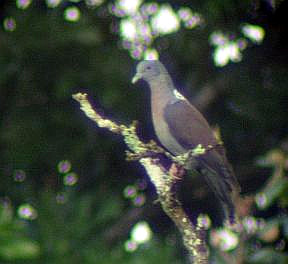
Delegorgue's Pigeon is easily identified by its striking plumage. Adults exhibit a combination of deep green on the back and wings, contrasted with a white belly and undertail. The neck features a metallic sheen, often appearing bluish in certain lights. Juveniles, however, display duller colors, lacking the bright iridescence seen in adults. Male and female Delegorgue's Pigeons appear similar, though males may have a slightly more pronounced sheen. In flight, their broad wings and long tail create a distinct silhouette. Perching postures often reveal their characteristic white belly, providing a useful field mark. Confusion with other species, such as the African Green Pigeon, can occur, but Delegorgue's Pigeon's white underparts and distinct vocalizations offer reliable identification points. Observing their behavior in conjunction with these physical traits can confirm the identification of this species.
Having trouble telling birds apart? Upload a photo to our bird identification tool for an instant species match.
Delegorgue's Pigeon Habitat and Range
Preferred Habitat
Delegorgue's Pigeon inhabits montane forests, favoring elevations between 1,000 and 3,000 meters. Within these forests, they are often found in areas with dense canopies and abundant fruiting trees. Seasonal shifts may occur, with pigeons descending to lower elevations during the non-breeding season in search of food. Unlike many urban-adapted pigeons, Delegorgue's Pigeon remains primarily in rural, forested environments. Their habitat preferences reflect their reliance on undisturbed, mature forests for both food and nesting sites. Conservation efforts prioritize these specific habitat types to ensure the species' continued survival.
Geographic Range
Delegorgue's Pigeon is endemic to the eastern regions of Africa, with a range that includes Kenya, Tanzania, Malawi, and Mozambique. During the breeding season, they are primarily found in the mountainous regions of these countries, where they utilize the dense forest canopies for nesting. In non-breeding periods, some populations may migrate short distances to lower elevations or different forest areas in search of food. Population density tends to be higher in protected forest reserves, where suitable habitat conditions are maintained. This species does not undertake long-distance migrations, but local movements are influenced by food availability and breeding needs.
Want to know which birds visit your area? Browse our backyard birds by location guides for region-specific species lists.
What Does the Delegorgue's Pigeon Eat?
The diet of Delegorgue's Pigeon consists mainly of fruits and seeds. They favor the fruits of native forest trees, such as figs, which provide essential nutrients. During the breeding season, they increase their intake of protein-rich seeds to support reproductive needs. Their foraging technique involves perching on branches and plucking fruits with precision. These pigeons also consume small invertebrates, particularly when fruits are scarce. Foraging occurs primarily during the early morning and late afternoon, aligning with peak fruit availability. Their role as seed dispersers is crucial, as they aid in the propagation of various tree species across their habitats.
Delegorgue's Pigeon Behavior and Social Structure
Delegorgue's Pigeon exhibits a social structure that varies with the season. During the breeding period, pairs form strong bonds, often returning to the same nesting sites annually. Courtship involves aerial displays and vocal duets, which strengthen pair bonds. Outside of the breeding season, these pigeons may form loose flocks for foraging, which provides safety in numbers. Territorial behavior is most pronounced during nesting, with pairs defending their chosen sites from intruders. Daily activity patterns involve early morning and late afternoon bouts of feeding, while resting occurs during the heat of midday. When faced with predators, these pigeons rely on their swift flight and forest cover for evasion.
Delegorgue's Pigeon Nesting and Reproduction
Delegorgue's Pigeon constructs simple nests, often in the forks of trees. Nests consist of twigs and leaves, providing minimal cushioning. They prefer nesting sites in dense forested areas, where canopy cover offers protection. A typical clutch consists of one to two eggs, with both parents sharing incubation duties over approximately 18 days. Post-hatching, both parents continue to care for the young, feeding them regurgitated fruit pulp. Fledging occurs around 30 days after hatching, though young may remain dependent on parents for several weeks. Generally, Delegorgue's Pigeons rear one to two broods per year, depending on environmental conditions.
Delegorgue's Pigeon Sounds and Vocalizations
The primary song of Delegorgue's Pigeon consists of a series of low, rhythmic coos. These vocalizations are most prominent during the breeding season, serving to attract mates and establish territories. Their call notes, softer and more subdued than their song, facilitate communication between mates and flock members. Alarm calls, harsher and more urgent, warn of potential threats. At dawn, their calls contribute to the forest's symphony, blending with other avian songs. The depth and quality of their calls distinguish them from similar species, offering an auditory clue for identification.
Interesting Facts About the Delegorgue's Pigeon
- 1Delegorgue's Pigeon's iridescent neck feathers can appear blue, green, or even purple depending on the light.
- 2These pigeons play a crucial role in their ecosystem by dispersing seeds of at least 20 different tree species.
- 3Delegorgue's Pigeon can consume fruits almost as large as its head, showcasing impressive gape size.
- 4Their nests are surprisingly simple, often appearing fragile, yet serve their purpose effectively.
- 5Despite their size, Delegorgue's Pigeons are agile flyers, capable of rapid escape maneuvers through dense forests.
- 6The species was named after the French explorer Adulphe Delegorgue, who documented African wildlife in the 19th century.
- 7Delegorgue's Pigeons exhibit site fidelity, often returning to the same nesting territories year after year.
Delegorgue's Pigeon Conservation Status
The International Union for Conservation of Nature (IUCN) currently lists Delegorgue's Pigeon as Least Concern, though populations face declining trends. Habitat loss due to deforestation and agricultural expansion poses significant threats. Conservation efforts focus on habitat protection and restoration, particularly in vital breeding areas. Historical population declines highlight the need for continued monitoring and research. Collaborations between conservation organizations and local communities aim to promote sustainable land use practices, ensuring the preservation of these pigeons and their habitats.


