
Double-toothed Kite
Harpagus bidentatus
Order: Accipitriformes / Family: Accipitridae
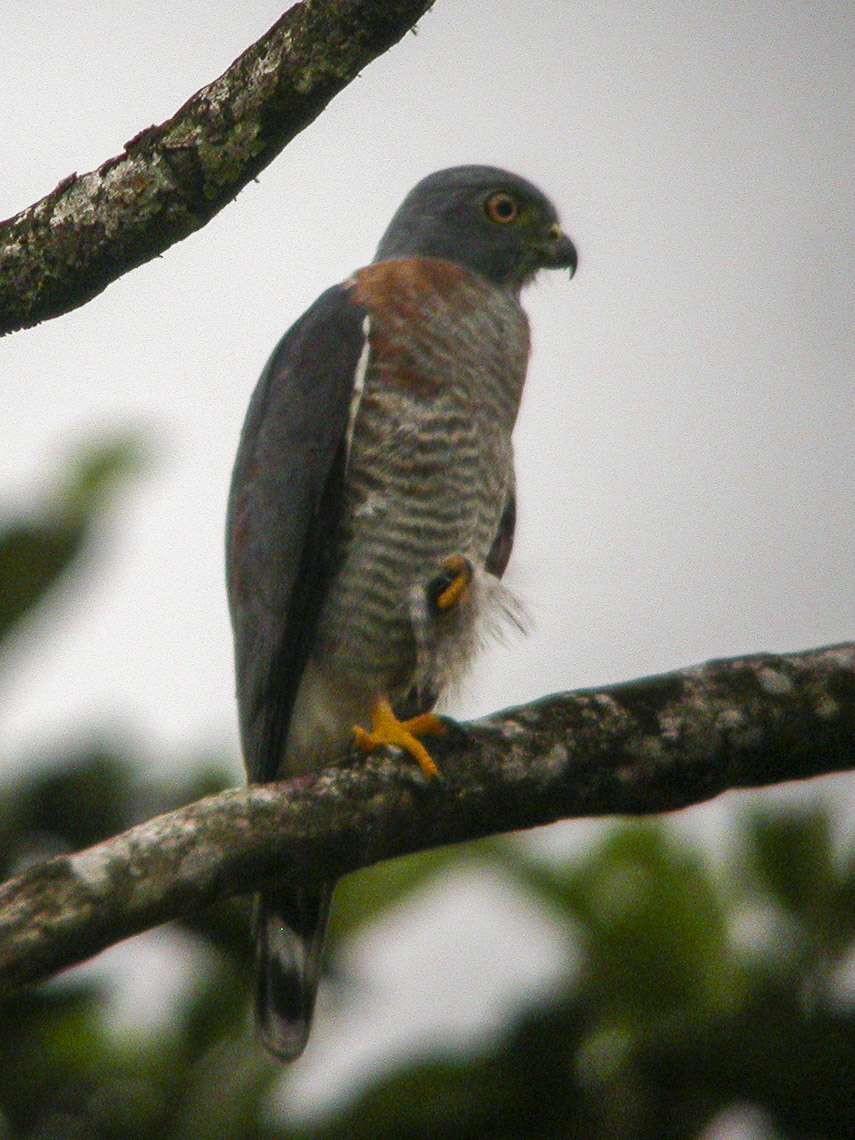
Wikimedia Commons
About the Double-toothed Kite
The Double-toothed Kite, scientifically known as Harpagus bidentatus, is a medium-sized raptor renowned for its agility and striking hunting strategies. This bird is predominantly found in the neotropical regions of Central and South America. It thrives in the lush, dense forests of countries such as Costa Rica, Panama, and Colombia, extending down to the Amazon basin. The Double-toothed Kite plays a crucial ecological role as a predator of insects and small vertebrates, maintaining the balance within its ecosystem. Its presence often indicates a healthy forest environment, as the bird relies on mature, undisturbed forest habitats. During the breeding season, which coincides with the wet months, the kite becomes particularly active, displaying notable hunting and nesting behaviors. Unlike many raptors, the Double-toothed Kite does not migrate extensively, remaining relatively sedentary throughout the year. However, some altitudinal movement may occur in response to food availability and climatic conditions. The kite's presence in various forest strata, from the canopy to the understory, provides insights into its adaptability and resourcefulness. This adaptability allows the Double-toothed Kite to exploit a variety of hunting opportunities, whether following troops of monkeys to catch disturbed prey or hunting independently. Despite its reliance on forested habitats, the kite exhibits resilience, occasionally venturing into secondary growth areas, suggesting a degree of adaptability to habitat modifications. Nevertheless, the ongoing deforestation in its range poses a potential threat, making its conservation status an important focus for ornithologists and environmentalists.
The Double-toothed Kite belongs to the family Accipitridae, within the order Accipitriformes. These birds typically live average 5-10 years in the wild..
How to Identify a Double-toothed Kite
The Double-toothed Kite is a medium-sized raptor, measuring approximately 30 to 38 centimeters in length, with a wingspan of about 60 to 70 centimeters. Adults are characterized by their slate-gray upperparts and white underparts with fine gray barring. The bird's name is derived from the two subtle notches or 'teeth' on its upper mandible, a unique feature among kites. The head is capped with a darker shade of gray, contrasting with a white throat and a pair of red eyes that add intensity to its gaze. Juveniles display a browner plumage with streaked underparts, which gradually transition to the adult plumage over time. There is little sexual dimorphism in this species, with males and females appearing similar, although females may be slightly larger. In flight, the Double-toothed Kite is agile, with rounded wings and a long, slightly notched tail, which aids in maneuvering through dense foliage. When perched, it often adopts a slightly hunched posture with its wings held close to the body, providing a compact silhouette. This kite can be confused with other small raptors, such as the Gray-headed Kite, but its unique bill and barring pattern are distinguishing features.
Having trouble telling birds apart? Upload a photo to our bird identification tool for an instant species match.
Double-toothed Kite Habitat and Range
Preferred Habitat
The Double-toothed Kite primarily inhabits tropical and subtropical forests, favoring pristine and mature rainforest environments. It is commonly found at elevations ranging from sea level up to 1,200 meters, although it occasionally ventures higher. The kite displays a preference for areas with dense canopy cover, where it can skillfully maneuver through the trees. While it is typically associated with primary forests, it can also be found in secondary growth areas and forest edges, demonstrating some adaptability to habitat changes. Unlike many raptors, it does not frequent open or urban areas, relying heavily on forested landscapes for its survival. Seasonal habitat shifts are minimal, as the kite remains largely sedentary, but slight altitudinal movements are possible in response to food availability.
Geographic Range
The Double-toothed Kite's range extends from southern Mexico through Central America to the northern and central parts of South America, including the Amazon basin. Countries where it is commonly found include Guatemala, Honduras, Nicaragua, Costa Rica, Panama, Venezuela, Ecuador, Peru, and Brazil. The species is generally non-migratory, residing in its range year-round. However, within its extensive range, population densities vary, with higher concentrations observed in well-preserved forest areas. Despite its wide distribution, habitat degradation and deforestation present ongoing challenges, potentially impacting local populations.
Want to know which birds visit your area? Browse our backyard birds by location guides for region-specific species lists.
What Does the Double-toothed Kite Eat?
The Double-toothed Kite primarily feeds on insects and small vertebrates, making it an adept predator in its forest habitat. Its diet includes large insects such as grasshoppers and beetles, as well as small reptiles like lizards and occasionally small birds. During certain times of the year, it may also consume small mammals. The kite employs a unique foraging strategy, often following troops of monkeys through the forest. As the monkeys move and disturb insects and other prey, the kite takes advantage of these opportunities to catch its food. This strategy, known as 'commensal foraging,' highlights the kite's adaptability and resourcefulness. While primarily a diurnal hunter, catching prey during daylight hours, the Double-toothed Kite has been observed hunting at dusk, adapting to the behavior of its prey.
Double-toothed Kite Behavior and Social Structure
The Double-toothed Kite exhibits intriguing behaviors, particularly its commensal foraging relationship with monkey troops. This bird is generally solitary or found in pairs, though it may form loose associations with other kites when food is abundant. Territoriality is not as pronounced in this species compared to other raptors, possibly due to its reliance on disturbed prey stirred up by primates. During the breeding season, pairs engage in aerial displays, showcasing their agility with acrobatic flights and vocalizations. These displays serve as courtship rituals and territory establishment. The kite responds to predators with a combination of evasive flight and alarm calls, alerting other forest inhabitants to potential threats. Its daily activity pattern peaks in the early morning and late afternoon when it is most active in foraging and patrolling its territory.
Double-toothed Kite Nesting and Reproduction
The Double-toothed Kite constructs its nest high in the canopy, often choosing the fork of a tree branch for stability. The nest is made of twigs, leaves, and other plant materials, providing a sturdy platform for its eggs. The typical clutch size is two to three eggs, with incubation lasting approximately 30 to 35 days. Both parents participate in incubation and feeding the chicks, although the female primarily incubates while the male provides food. Once hatched, the chicks fledge in about 35 to 40 days, but they remain dependent on the parents for several weeks thereafter. The kite typically raises one brood per year, although in optimal conditions, a second brood is possible. The choice of nest site and the high level of parental care contribute to the fledglings' survival in the competitive forest environment.
Double-toothed Kite Sounds and Vocalizations
The Double-toothed Kite's vocalizations are characterized by a series of sharp, high-pitched whistles, often repeated in quick succession. These calls serve as contact signals between mates and are most frequently heard during the breeding season. The alarm call is a rapid, higher-pitched series of notes, used to alert others of potential danger. While not as vocal as some other raptors, the kite's calls are distinct and can be heard echoing through the forest canopy, particularly during dawn and dusk. These vocalizations play a crucial role in communication and territory establishment within dense forest habitats.
Interesting Facts About the Double-toothed Kite
- 1The Double-toothed Kite is named for its distinctive bill, featuring two notches that aid in subduing prey.
- 2Unlike many raptors, the Double-toothed Kite often follows monkey troops to catch prey stirred up by their movement.
- 3This kite's diet mainly consists of insects and small reptiles, showcasing its adaptability in a forest environment.
- 4Despite its solitary nature, the Double-toothed Kite engages in cooperative hunting strategies, particularly with monkeys.
- 5The kite's agile flight allows it to navigate through dense forest canopies, a skill crucial for its hunting success.
- 6Juvenile Double-toothed Kites can be distinguished by their browner plumage and streaked underparts compared to adults.
- 7The species remains largely sedentary year-round, with minimal migration, contrasting with many other raptor species.
Double-toothed Kite Conservation Status
The Double-toothed Kite is currently classified as Least Concern by the IUCN, with stable populations across its range. However, ongoing deforestation and habitat fragmentation pose significant threats to its long-term survival. Conservation efforts focus on habitat preservation and the protection of mature forests, which are vital for the kite's survival. Historically, the population has remained relatively stable due to the kite's adaptability, but continued monitoring is necessary to ensure its resilience in the face of environmental changes. The protection of key habitats and the implementation of sustainable forest management practices are essential for the kite's conservation.
Other Accipitridae Species


Birds Similar to the Double-toothed Kite
These species are often confused with the Double-toothed Kite due to similar appearance or overlapping range.
